



 Chat with AI
Exam 6: Process Costing

Exam 1: Introduction to Managerial Accounting64 Questions
Exam 2: Basic Managerial Accounting Concepts247 Questions
Exam 3: Cost Behavior237 Questions
Exam 4: Cost-Volume-Profit Analysis: a Managerial Planning Tool179 Questions
Exam 5: Job-Order Costing196 Questions
Exam 6: Process Costing177 Questions
Exam 7: Activity-Based Costing and Management178 Questions
Exam 8: Absorption and Variable Costing, and Inventory Management124 Questions
Exam 9: Profit Planning186 Questions
Exam 10: Standard Costing: a Managerial Control Tool180 Questions
Exam 11: Flexible Budgets and Overhead Analysis172 Questions
Exam 12: Performance Evaluation and Decentralization166 Questions
Exam 13: Short-Run Decision Making: Relevant Costing170 Questions
Exam 14: Capital Investment Decisions172 Questions
Exam 15: Statement of Cash Flows185 Questions
Exam 16: Financial Statement Analysis191 Questions
Select questions type


Titan Manufacturing uses a process cost system. The following information pertains to operations for the month of December.
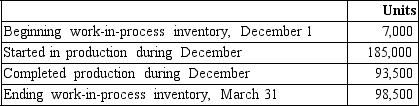 The beginning inventory was 80% complete for materials and 40% complete for conversion costs. The ending inventory was 85% complete for materials and 30% complete for conversion costs.
Costs pertaining to the month of December are as follows:
Beginning inventory costs are: materials, $38,200; conversion cost $41,400.
Costs incurred during December are: materials used, $462,300; conversion cost $602,700.
Required:
A. Using the weighted average method calculate the total equivalent units of production for direct materials and conversion cost.
B. Using the weighted average method, calculate the unit cost of materials and conversion for December.
C. Using the weighted average method, calculate the total cost of the units in the ending work-in-process inventory at December 31.
The beginning inventory was 80% complete for materials and 40% complete for conversion costs. The ending inventory was 85% complete for materials and 30% complete for conversion costs.
Costs pertaining to the month of December are as follows:
Beginning inventory costs are: materials, $38,200; conversion cost $41,400.
Costs incurred during December are: materials used, $462,300; conversion cost $602,700.
Required:
A. Using the weighted average method calculate the total equivalent units of production for direct materials and conversion cost.
B. Using the weighted average method, calculate the unit cost of materials and conversion for December.
C. Using the weighted average method, calculate the total cost of the units in the ending work-in-process inventory at December 31. (Essay)
4.8/5  (90)
(90) Parallel processing requires that units pass through one process before they can be worked on in the next process.
(True/False)
4.8/5 (82)
(82) Describe the differences in the ways that prior-period costs and output are treated under the weighted average method and the FIFO method?
(Essay)
4.8/5 (71)
(71) When computing equivalent units of production, the method that combines partially completed units in beginning inventory with current period production is the
(Multiple Choice)
4.9/5 (69)
(69) Which step is cost reconciliation in the general pattern of a process-costing production report?
(Multiple Choice)
5.0/5 (77)
(77) Figure 6-8.Department A had the following data for October:
 -Refer to Figure 6-8. What is the unit manufacturing cost for Department A for October?
 (Short Answer)
4.9/5 (76)
(76) Choose the most likely used costing system for the industries listed below.
-Costing system used by an architectural firm.
(Multiple Choice)
4.8/5 (73)
(73) Choose the most likely used costing system for the industries listed below.
-Costing system used by a chemical manufacturer.
(Multiple Choice)
4.8/5 (94)
(94) Explain how nonuniform inputs and multiple departments affect process costing.
(Essay)
4.9/5 (88)
(88) The costs transferred from a prior process to a subsequent process are referred to as transferred-in costs.
(True/False)
4.8/5 (72)
(72) Figure 6-1.The following information is available for Department Z for the month of July:
 Materials are added at the beginning of the process. (Round unit costs to two decimal places.)
-Refer to Figure 6-1. Department Z's cost of ending work in process using the FIFO method would be
Materials are added at the beginning of the process. (Round unit costs to two decimal places.)
-Refer to Figure 6-1. Department Z's cost of ending work in process using the FIFO method would be (Multiple Choice)
4.9/5 (82)
(82) To calculate the equivalent units of production, the number of physical units is multiplied by the percentage of completion.
(True/False)
4.8/5 (71)
(71) Which type of costing system works best with a large number of homogeneous products?
(Multiple Choice)
4.8/5 (87)
(87) Select the appropriate definition for each of the items listed below
-units pass through one process before they can be worked on in the next processes
(Multiple Choice)
4.7/5 (60)
(60) The number of physical units is multiplied by the _____________________ to calculate equivalent units.
(Short Answer)
4.9/5 (64)
(64) Different percentage completion figures for manufacturing inputs pose a problem for the calculation of equivalent units, unit cost, and valuation of ending work in process.
(True/False)
4.7/5 (90)
(90) Garcia Company uses the weighted average method in its costing system. For the month of May in the Assembly Department, the equivalent units for conversion costs amounted to 35,000. There were 5,000 units in beginning work-in-process that were 50% complete. During the month, 33,000 units were started and 31,400 were completed and transferred. The ending work in process consists of
(Multiple Choice)
5.0/5 (78)
(78) Figure 6-1.The following information is available for Department Z for the month of July:
Materials are added at the beginning of the process. (Round unit costs to two decimal places.)
-Refer to Figure 6-1. Department Z's cost per equivalent unit of production for conversion costs using the FIFO method would be
Materials are added at the beginning of the process. (Round unit costs to two decimal places.)
-Refer to Figure 6-1. Department Z's cost per equivalent unit of production for conversion costs using the FIFO method would be (Multiple Choice)
4.9/5 (89)
(89) Figure 6-6.The Martin Company uses the weighted average method. The beginning work in process consists of 6,000 units (100% completed as to materials and 50% complete as to conversion costs). The number of units completed was 120,000. The ending work in process consists of 10,000 units (100% complete as to materials and 20% complete as to conversion costs).
-Refer to Figure 6-6. What are the equivalent units of production for conversion costs?
(Multiple Choice)
5.0/5 (75)
(75) 
Filters
- Essay(0)
- Multiple Choice(0)
- Short Answer(0)
- True False(0)
- Matching(0)