



 Chat with AI
Exam 29: Mergers,acquisitions,and Divestitures

Exam 1: Introduction to Corporate Finance71 Questions
Exam 2: Financial Statements and Cash Flow106 Questions
Exam 3: Financial Statements and Cash Flow108 Questions
Exam 4: Discounted Cash Flow Valuation116 Questions
Exam 5: Net Present Value and Other Investment Rules98 Questions
Exam 6: Making Capital Investment Decisions98 Questions
Exam 7: Risk Analysis, real Options, and Capital Budgeting94 Questions
Exam 8: Interest Rates and Bond Valuation87 Questions
Exam 9: Stock Valuation87 Questions
Exam 10: Lessons From Market History77 Questions
Exam 11: Return, risk, and the Capital Asset Pricing Model Capm109 Questions
Exam 12: An Alternative View of Risk and Return: the Arbitrage Pricing Theory52 Questions
Exam 13: Risk, cost of Capital, and Valuation72 Questions
Exam 14: Efficient Capital Markets and Behavioral Challenges59 Questions
Exam 15: Long-Term Financing57 Questions
Exam 16: Capital Structure: Basic Concepts74 Questions
Exam 17: Capital Structure: Limits to the Use of Debt60 Questions
Exam 18: Valuation and Capital Budgeting for the Levered Firm54 Questions
Exam 19: Dividends and Other Payouts88 Questions
Exam 20: Raising Capital77 Questions
Exam 21: Leasing53 Questions
Exam 22: Options and Corporate Finance105 Questions
Exam 23: Options and Corporate Finance: Extensions and Applications43 Questions
Exam 24: Warrants and Convertibles63 Questions
Exam 25: Derivatives and Hedging Risk64 Questions
Exam 26: Short-Term Finance and Planning98 Questions
Exam 27: Cash Management63 Questions
Exam 28: Credit and Inventory Management66 Questions
Exam 29: Mergers,acquisitions,and Divestitures93 Questions
Exam 30: Financial Distress41 Questions
Exam 31: International Corporate Finance90 Questions
Select questions type


Western has a market value of $950 with 50 shares outstanding and a price per share of $19.Eastern has a market value of $3,000 with 120 shares outstanding and a price per share of $25.Eastern is acquiring Western by exchanging 40 of its shares for all 50 of Western's shares.What is the cost of the merger to Eastern's stockholders if the merger creates $200 of synergy?
(Multiple Choice)
4.8/5  (77)
(77) In a tax-free acquisition,the shareholders of the target firm:
(Multiple Choice)
4.9/5 (91)
(91) Assume a merger of two levered firms produced no synergy.In this case,the:
(Multiple Choice)
4.8/5 (85)
(85) Which one of the following is most likely a good candidate for an acquisition that could benefit from the use of complementary resources?
(Multiple Choice)
4.9/5 (78)
(78) Assume an acquiring firm obtained control of a target firm through a tender offer.This group is now proposing a merger that is generally referred to as a:
(Multiple Choice)
4.8/5 (94)
(94) Firm A is acquiring Firm B for $40,000 in cash.Firm A has a current market value of $66,000 while Firm B's current market value is $38,000.The synergy value from the acquisition is $2,500.What is the value of Firm A after the acquisition?
(Multiple Choice)
4.9/5 (74)
(74) ________ can provide a potential tax gain from an acquisition.
(Multiple Choice)
4.9/5 (76)
(76) Jay's has a market value of $3,600 and believes that if it acquires Benny's in a stock transaction the combination of the new firm will be worth $6,000 given the expected synergy of $200.If Jay's wants to keep 75 percent of the synergy for itself,what should be the value of the stock it issues to Benny's?
(Multiple Choice)
4.8/5 (78)
(78) Firm X has a market value of $8,400 with 120 shares outstanding and a price per share of $70.Firm Y has a market value of $2,000 with 100 shares outstanding and a price per share of $20.Firm X is acquiring Firm Y by exchanging 30 of its shares for all 100 of Firm Y's shares.Assume the merger creates $400 of synergy.What will be the value of Firm A's shareholders' stake in the merged firm?
(Multiple Choice)
4.7/5 (79)
(79) Firm V has a market value of $450 and Firm A has a market value of $375.If the two firms merged their estimated combined value is $900.What is the synergy of the merger?
(Multiple Choice)
4.9/5 (76)
(76) Firm A and Firm B join to create Firm AB.This is an example of:
(Multiple Choice)
4.8/5 (84)
(84) The distribution of shares in a subsidiary to existing parent company stockholders is called a(n):
(Multiple Choice)
4.8/5 (80)
(80) Herbal Gardens has a market value of $380 while Veggies has a market value of $530.Veggies is merging with Herbal Gardens and expects the combined firm to have a market value of $950.If the current Herbal Garden shareholders obtain $400 of equity in the new firm,how much synergy was allocated to the Veggies shareholders?
(Multiple Choice)
4.9/5 (83)
(83) Suppose that General Motors makes an offer to acquire General Mills.Ignoring potential antitrust problems,this merger would be classified as a:
(Multiple Choice)
4.8/5 (77)
(77) A change in the corporate charter making it more difficult for the firm to be acquired by increasing the percentage of shareholders that must approve a merger offer is called a:
(Multiple Choice)
4.8/5 (68)
(68) Tiger's is merging with Lion's.Tiger's has debt with a face value of $80 and Lion's has debt with a face value of $50.The pre-merger values of the firms given two economic states with equal probabilities of occurrence are as follows: 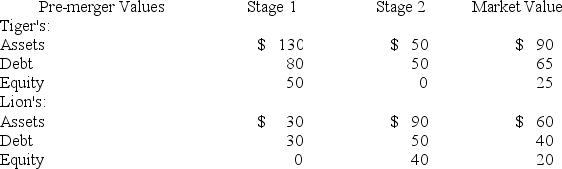 What will be the combined gain or loss to the bondholders of these two firms if the merger provides no synergy and Lion's stockholders receive stock in the combined firm in an amount equal to the stand-alone value of Lion's?
 (Multiple Choice)
5.0/5 (85)
(85) Suppose that Ford and General Motors were to merge.Ignoring potential antitrust problems,this merger would be classified as a(n):
(Multiple Choice)
5.0/5 (83)
(83) 
Filters
- Essay(0)
- Multiple Choice(0)
- Short Answer(0)
- True False(0)
- Matching(0)