



 Chat with AI
Exam 16: Working Capital Management

Exam 1: An Overview of Financial Management65 Questions
Exam 2: Financial Markets and Institutions33 Questions
Exam 3: Financial Statements, cash Flow, and Taxes130 Questions
Exam 4: Analysis of Financial Statements133 Questions
Exam 5: Time Value of Money163 Questions
Exam 6: Interest Rates82 Questions
Exam 7: Bonds and Their Valuation92 Questions
Exam 8: Risk and Rates of Return146 Questions
Exam 9: Stocks and Their Valuation89 Questions
Exam 10: The Cost of Capital94 Questions
Exam 11: The Basics of Capital Budgeting108 Questions
Exam 12: Cash Flow Estimation and Risk Analysis81 Questions
Exam 13: Real Options and Other Topics in Capital Budgeting41 Questions
Exam 14: Capital Structure and Leverage88 Questions
Exam 15: Distributions to Shareholders: Dividends and Share Repurchases75 Questions
Exam 16: Working Capital Management126 Questions
Exam 17: Financial Planning and Forecasting39 Questions
Exam 18: Derivatives and Risk Management35 Questions
Exam 19: Multinational Financial Management50 Questions
Exam 20: Hybrid Financing: Preferred Stock, leasing, warrants, and Convertibles60 Questions
Exam 21: Mergers and Acquisitions39 Questions
Exam 22: Continuous Compounding and Discounting8 Questions
Exam 23: Zero Coupon Bonds18 Questions
Exam 24: Bankruptcy and Reorganization4 Questions
Exam 25: Calculating Beta Coefficients8 Questions
Exam 26: Using the Capm to Estimate the Risk-Adjusted Cost of Capital5 Questions
Exam 27: Techniques for Measuring Beta Risk3 Questions
Exam 28: Degree of Leverage23 Questions
Select questions type


A line of credit can be either a formal or an informal agreement between a borrower and a bank regarding the maximum amount of credit the bank will extend to the borrower during some future period,assuming the borrower maintains its financial strength.
(True/False)
4.7/5  (84)
(84) Since depreciation is a non-cash charge,it neither appears on nor has any effect on the cash budget.Thus,if the depreciation charge for the coming year doubled or halved,this would have no effect on the cash budget.
(True/False)
4.7/5 (83)
(83) If a firm sells on terms of 2/10,net 30 days,and its DSO is 28 days,then the fact that the 28-day DSO is less than the 30-day credit period tell us that the credit department is functioning efficiently and there are no past due accounts.
(True/False)
5.0/5 (86)
(86) Not taking cash discounts is costly,and as a result,firms that do not take them are usually those that are performing poorly and have inadequate cash balances.
(True/False)
4.9/5 (81)
(81) Zervos Inc.had the following data for last year (in millions).The new CFO believes (1)that an improved inventory management system could lower the average inventory by $4,000,(2)that improvements in the credit department could reduce receivables by $2,000,and (3)that the purchasing department could negotiate better credit terms and thereby increase accounts payable by $2,000.Furthermore,she thinks that these changes would not affect either sales or the costs of goods sold.If these changes were made,by how many days would the cash conversion cycle be lowered? 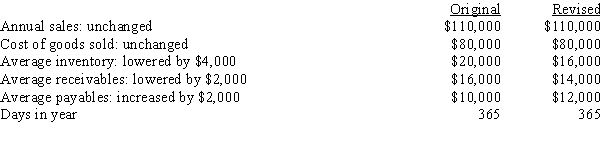
(Multiple Choice)
4.9/5 (77)
(77) Cass & Company has the following data.What is the firm's cash conversion cycle? Inventory conversion period =
50 days
Receivables collection period =
17 days
Payables deferral period =
25 days
(Multiple Choice)
4.9/5 (75)
(75) 
Filters
- Essay(0)
- Multiple Choice(0)
- Short Answer(0)
- True False(0)
- Matching(0)