



 Chat with AI
Exam 15: Distributions to Shareholders: Dividends and Share Repurchases

Exam 1: An Overview of Financial Management65 Questions
Exam 2: Financial Markets and Institutions33 Questions
Exam 3: Financial Statements, cash Flow, and Taxes130 Questions
Exam 4: Analysis of Financial Statements133 Questions
Exam 5: Time Value of Money163 Questions
Exam 6: Interest Rates82 Questions
Exam 7: Bonds and Their Valuation92 Questions
Exam 8: Risk and Rates of Return146 Questions
Exam 9: Stocks and Their Valuation89 Questions
Exam 10: The Cost of Capital94 Questions
Exam 11: The Basics of Capital Budgeting108 Questions
Exam 12: Cash Flow Estimation and Risk Analysis81 Questions
Exam 13: Real Options and Other Topics in Capital Budgeting41 Questions
Exam 14: Capital Structure and Leverage88 Questions
Exam 15: Distributions to Shareholders: Dividends and Share Repurchases75 Questions
Exam 16: Working Capital Management126 Questions
Exam 17: Financial Planning and Forecasting39 Questions
Exam 18: Derivatives and Risk Management35 Questions
Exam 19: Multinational Financial Management50 Questions
Exam 20: Hybrid Financing: Preferred Stock, leasing, warrants, and Convertibles60 Questions
Exam 21: Mergers and Acquisitions39 Questions
Exam 22: Continuous Compounding and Discounting8 Questions
Exam 23: Zero Coupon Bonds18 Questions
Exam 24: Bankruptcy and Reorganization4 Questions
Exam 25: Calculating Beta Coefficients8 Questions
Exam 26: Using the Capm to Estimate the Risk-Adjusted Cost of Capital5 Questions
Exam 27: Techniques for Measuring Beta Risk3 Questions
Exam 28: Degree of Leverage23 Questions
Select questions type


Grullon Co.is considering a 7-for-3 stock split.The current stock price is $75.00 per share,and the firm believes that its total market value would increase by 5% as a result of the improved liquidity that should follow the split.What is the stock's expected price following the split?
(Multiple Choice)
4.9/5  (76)
(76) D.Paul Inc.forecasts a capital budget of $725,000.The CFO wants to maintain a target capital structure of 45% debt and 55% equity,and she also wants to pay a dividend of $500,000.If the company follows the residual dividend model,how much income must it earn,and what will its dividend payout ratio be?
(Multiple Choice)
4.9/5 (78)
(78) Toombs Media Corp.recently completed a 3-for-1 stock split.Prior to the split,its stock sold for $90 per share.The firm's total market value was unchanged by the split.Other things held constant,what is the best estimate of the stock's post-split price?
(Multiple Choice)
4.7/5 (64)
(64) Dentaltech Inc.projects the following data for the coming year.If the firm follows the residual dividend model and also maintains its target capital structure,what will its dividend payout ratio be?

(Multiple Choice)
4.8/5 (76)
(76) Miller and Modigliani's dividend irrelevance theory says that the percentage of its earnings a firm pays out in dividends has no effect on either its cost of capital or its stock price.
(True/False)
5.0/5 (95)
(95) If on January 3,2015,a company declares a dividend of $1.50 per share,payable on January 31,2015,then the price of the stock should drop by approximately $1.50 on January 31.
(True/False)
4.9/5 (89)
(89) Whitman Antique Cars Inc.has the following data,and it follows the residual dividend model.Some Whitman family members would like more dividends,and they also think that the firm's capital budget includes too many projects whose NPVs are close to zero.If Whitman reduced its capital budget to the indicated level,by how much could dividends be increased,holding other things constant? 
(Multiple Choice)
4.9/5 (88)
(88) Whited Products recently completed a 4-for-1 stock split.Prior to the split,its stock sold for $120 per share.If the firm's total market value increased by 5% as a result of increased liquidity and favorable signaling effects,what was the stock price following the split?
(Multiple Choice)
4.8/5 (65)
(65) It has been argued that investors prefer high-payout companies because dividends are more certain (less risky)than the capital gains that are supposed to come from retained earnings.However,Miller and Modigliani say that this argument is incorrect,and they call it the "bird-in-the-hand fallacy." MM base their argument on the belief that most dividends are reinvested in stocks,hence are exposed to the same risks as reinvested earnings.
(True/False)
4.8/5 (81)
(81) Walter Industries is a family owned concern.It has been using the residual dividend model,but family members who hold a majority of the stock want more cash dividends,even if that means a slower future growth rate.Neither the net income nor the capital structure will change during the coming year as a result of a dividend policy change to the indicated target payout ratio.By how much would the capital budget have to be cut to enable the firm to achieve the new target dividend payout ratio? 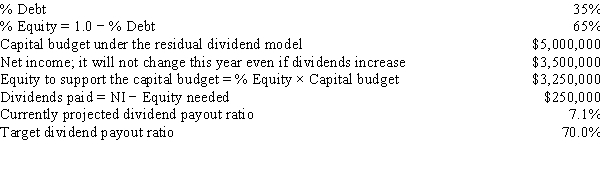
(Multiple Choice)
4.8/5 (78)
(78) Your firm uses the residual dividend model to set dividend policy.Market interest rates suddenly rise,and stock prices decline.Your firm's earnings,investment opportunities,and capital structure do not change.If the firm follows the residual dividend model,then its dividend payout ratio would increase.
(True/False)
4.9/5 (80)
(80) If a firm pays out all of its earnings as dividends and its stockholders then elect to have all of their dividends reinvested,the company should reconsider its dividend policy and possibly move to a lower dividend payout ratio.
(True/False)
4.8/5 (83)
(83) Portland Plastics Inc.has the following data.If it follows the residual dividend model,what is its forecasted dividend payout ratio? 
(Multiple Choice)
4.9/5 (94)
(94) NY Fashions has the following data.If it follows the residual dividend model,how much total dividends,if any,will it pay out? 
(Multiple Choice)
4.9/5 (71)
(71) If management wants to maximize its stock price,and if it believes that the dividend irrelevance theory is correct,then it must adhere to the residual dividend policy.
(True/False)
4.8/5 (80)
(80) Miller and Modigliani's dividend irrelevance theory says that the percentage of its earnings a firm pays out in dividends has no effect on its cost of capital,but it does affect its stock price.
(True/False)
4.9/5 (86)
(86) Sheehan Corp.is forecasting an EPS of $3.00 for the coming year on its 500,000 outstanding shares of stock.Its capital budget is forecasted at $800,000,and it is committed to maintaining a $2.00 dividend per share.It finances with debt and common equity,but it wants to avoid issuing any new common stock during the coming year.Given these constraints,what percentage of the capital budget must be financed with debt?
(Multiple Choice)
4.9/5 (69)
(69) 
Filters
- Essay(0)
- Multiple Choice(0)
- Short Answer(0)
- True False(0)
- Matching(0)