



 Chat with AI
Exam 10: The Cost of Capital

Exam 1: An Overview of Financial Management65 Questions
Exam 2: Financial Markets and Institutions33 Questions
Exam 3: Financial Statements, cash Flow, and Taxes130 Questions
Exam 4: Analysis of Financial Statements133 Questions
Exam 5: Time Value of Money163 Questions
Exam 6: Interest Rates82 Questions
Exam 7: Bonds and Their Valuation92 Questions
Exam 8: Risk and Rates of Return146 Questions
Exam 9: Stocks and Their Valuation89 Questions
Exam 10: The Cost of Capital94 Questions
Exam 11: The Basics of Capital Budgeting108 Questions
Exam 12: Cash Flow Estimation and Risk Analysis81 Questions
Exam 13: Real Options and Other Topics in Capital Budgeting41 Questions
Exam 14: Capital Structure and Leverage88 Questions
Exam 15: Distributions to Shareholders: Dividends and Share Repurchases75 Questions
Exam 16: Working Capital Management126 Questions
Exam 17: Financial Planning and Forecasting39 Questions
Exam 18: Derivatives and Risk Management35 Questions
Exam 19: Multinational Financial Management50 Questions
Exam 20: Hybrid Financing: Preferred Stock, leasing, warrants, and Convertibles60 Questions
Exam 21: Mergers and Acquisitions39 Questions
Exam 22: Continuous Compounding and Discounting8 Questions
Exam 23: Zero Coupon Bonds18 Questions
Exam 24: Bankruptcy and Reorganization4 Questions
Exam 25: Calculating Beta Coefficients8 Questions
Exam 26: Using the Capm to Estimate the Risk-Adjusted Cost of Capital5 Questions
Exam 27: Techniques for Measuring Beta Risk3 Questions
Exam 28: Degree of Leverage23 Questions
Select questions type


You were recently hired by Scheuer Media Inc.to estimate its cost of capital.You obtained the following data: D1 = $1.75; P0 = $42.50; g = 7.00% (constant); and F = 5.00%.What is the cost of equity raised by selling new common stock?
(Multiple Choice)
4.8/5  (69)
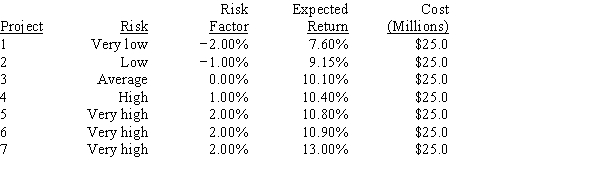
(69) Vang Enterprises,which is debt-free and finances only with equity from retained earnings,is considering 7 equal-sized capital budgeting projects.Its CFO hired you to assist in deciding whether none,some,or all of the projects should be accepted.You have the following information: rRF = 4.50%; RPM = 5.50%; and b = 0.92.The company adds or subtracts a specified percentage to the corporate WACC when it evaluates projects that have above- or below-average risk.Data on the 7 projects are shown below.If these are the only projects under consideration,how large should the capital budget be?
(Multiple Choice)
4.9/5 (90)
(90) Since 70% of the preferred dividends received by a corporation are excluded from taxable income,the component cost of equity for a company that pays half of its earnings out as common dividends and half as preferred dividends should,theoretically,be
Cost of equity = rs(0.30)(0.50)+ rps(1 − T)(0.70)(0.50).
(True/False)
4.7/5 (73)
(73) Exhibit 10.1
Assume that you have been hired as a consultant by CGT, a major producer of chemicals and plastics, including plastic grocery bags, styrofoam cups, and fertilizers, to estimate the firm's weighted average cost of capital. The balance sheet and some other information are provided below.
 The stock is currently selling for $15.25 per share, and its noncallable $1,000 par value, 20-year, 7.25% bonds with semiannual payments are selling for $875.00. The beta is 1.25, the yield on a 6-month Treasury bill is 3.50%, and the yield on a 20-year Treasury bond is 5.50%. The required return on the stock market is 11.50%, but the market has had an average annual return of 14.50% during the past 5 years. The firm's tax rate is 40%.
-Refer to Exhibit 10.1.What is the best estimate of the firm's WACC?
The stock is currently selling for $15.25 per share, and its noncallable $1,000 par value, 20-year, 7.25% bonds with semiannual payments are selling for $875.00. The beta is 1.25, the yield on a 6-month Treasury bill is 3.50%, and the yield on a 20-year Treasury bond is 5.50%. The required return on the stock market is 11.50%, but the market has had an average annual return of 14.50% during the past 5 years. The firm's tax rate is 40%.
-Refer to Exhibit 10.1.What is the best estimate of the firm's WACC? (Multiple Choice)
4.9/5 (90)
(90) A company's perpetual preferred stock currently sells for $92.50 per share,and it pays an $8.00 annual dividend.If the company were to sell a new preferred issue,it would incur a flotation cost of 5.00% of the issue price.What is the firm's cost of preferred stock?
(Multiple Choice)
4.7/5 (78)
(78) Exhibit 10.1
Assume that you have been hired as a consultant by CGT, a major producer of chemicals and plastics, including plastic grocery bags, styrofoam cups, and fertilizers, to estimate the firm's weighted average cost of capital. The balance sheet and some other information are provided below.
The stock is currently selling for $15.25 per share, and its noncallable $1,000 par value, 20-year, 7.25% bonds with semiannual payments are selling for $875.00. The beta is 1.25, the yield on a 6-month Treasury bill is 3.50%, and the yield on a 20-year Treasury bond is 5.50%. The required return on the stock market is 11.50%, but the market has had an average annual return of 14.50% during the past 5 years. The firm's tax rate is 40%.
-Refer to Exhibit 10.1.Based on the CAPM,what is the firm's cost of equity?
The stock is currently selling for $15.25 per share, and its noncallable $1,000 par value, 20-year, 7.25% bonds with semiannual payments are selling for $875.00. The beta is 1.25, the yield on a 6-month Treasury bill is 3.50%, and the yield on a 20-year Treasury bond is 5.50%. The required return on the stock market is 11.50%, but the market has had an average annual return of 14.50% during the past 5 years. The firm's tax rate is 40%.
-Refer to Exhibit 10.1.Based on the CAPM,what is the firm's cost of equity? (Multiple Choice)
4.8/5 (75)
(75) Duval Inc.uses only equity capital,and it has two equally-sized divisions.Division A's cost of capital is 10.0%,Division B's cost is 14.0%,and the corporate (composite)WACC is 12.0%.All of Division A's projects are equally risky,as are all of Division B's projects.However,the projects of Division A are less risky than those of Division B.Which of the following projects should the firm accept?
(Multiple Choice)
4.7/5 (66)
(66) If the expected dividend growth rate is zero,then the cost of external equity capital raised by issuing new common stock (re)is equal to the cost of equity capital from retaining earnings (rs)divided by one minus the percentage flotation cost required to sell the new stock,(1 − F).If the expected growth rate is not zero,then the cost of external equity must be found using a different formula.
(True/False)
4.8/5 (76)
(76) Suppose you are the president of a small,publicly-traded corporation.Since you believe that your firm's stock price is temporarily depressed,all additional capital funds required during the current year will be raised using debt.In this case,the appropriate marginal cost of capital for use in capital budgeting during the current year is the after-tax cost of debt.
(True/False)
4.9/5 (83)
(83) Which of the following is NOT a capital component when calculating the weighted average cost of capital (WACC)for use in capital budgeting?
(Multiple Choice)
4.9/5 (73)
(73) If a firm is privately owned,and its stock is not traded in public markets,then we cannot measure its beta for use in the CAPM model,we cannot observe its stock price for use in the DCF model,and we don't know what the risk premium is for use in the bond-yield-plus-risk-premium method.All this makes it especially difficult to estimate the cost of equity for a private company.
(True/False)
4.9/5 (90)
(90) 
Filters
- Essay(0)
- Multiple Choice(0)
- Short Answer(0)
- True False(0)
- Matching(0)