



 Chat with AI
Exam 28: Chemistry of the Living State

Exam 1: Matter: Its Properties and Measurement136 Questions
Exam 2: Atoms and the Atomic Theory119 Questions
Exam 3: Chemical Compounds152 Questions
Exam 4: Chemical Reactions170 Questions
Exam 5: Introduction to Reactions in Aqueous Solutions124 Questions
Exam 6: Gases113 Questions
Exam 7: Thermochemistry125 Questions
Exam 8: Electrons in Atoms123 Questions
Exam 9: The Periodic Table and Some Atomic Properties93 Questions
Exam 10: Chemical Bonding I: Basic Concepts107 Questions
Exam 11: Chemical Bonding Ii: Valence Bond and Molecular Orbital Theories104 Questions
Exam 12: Intermolecular Forces: Liquids and Solids121 Questions
Exam 13: Spontaneous Change: Entropy and Gibbs Energy123 Questions
Exam 14: Solutions and Their Physical Properties132 Questions
Exam 15: Principles of Chemical Equilibrium118 Questions
Exam 16: Acids and Bases137 Questions
Exam 17: Additional Aspects of Acidbase Equilibria130 Questions
Exam 18: Solubility and Complex-Ion Equilibria104 Questions
Exam 19: Electrochemistry127 Questions
Exam 20: Chemical Kinetics124 Questions
Exam 21: Chemistry of the Main-Group Elements I: Groups 1,2,13,and 14116 Questions
Exam 22: Chemistry of the Main-Group Elements Ii: Groups 18,17,16,15,and Hydrogen100 Questions
Exam 23: The Transition Elements108 Questions
Exam 24: Complex Ions and Coordination Compounds104 Questions
Exam 25: Nuclear Chemistry116 Questions
Exam 26: Structures of Organic Compounds99 Questions
Exam 27: Reactions of Organic Compounds94 Questions
Exam 28: Chemistry of the Living State104 Questions
Select questions type


Below is a double stranded DNA composed of one strand containing 15N atoms and the other strand containing 14N atoms.If the cell which contains this DNA is grown for one generation (replication)on 15N medium and then transferred to 14N media for a second generation,what would the resulting double stranded DNA molecules look like? 
(Multiple Choice)
5.0/5  (65)
(65) A typical E.coli bacterium is a cylindrical cell about 2 μm long and 1 μm in diameter,weighing about 1.8 × 10⁻¹² g and containing 80% water by volume.Calculate the number of lipid molecules present,assuming their average molecular weight is 688 g/mol and the lipid content is 1.9%.
(Multiple Choice)
4.8/5 (87)
(87) Which of the following is unimportant for tertiary structure of the proteins?
(Multiple Choice)
4.8/5 (75)
(75) Compounds which are optical isomers of one another but differ in physical and chemical properties are known as what?
(Multiple Choice)
4.7/5 (84)
(84) All of the known elements occur in measurable amounts in the human body.
(True/False)
5.0/5 (77)
(77) Lactose,the sugar found in milk,is a disaccharide of galactose and glucose in a 1,4 linkage.What is the configuration of the 1,4 linkage between the two glycoses in lactose? 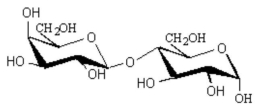
(Multiple Choice)
4.9/5 (68)
(68) Which of the following examples of protein structure would be classified as the tertiary structure of a protein?
(Multiple Choice)
4.8/5 (94)
(94) Which of the following contains less than six carbon atoms?
(Multiple Choice)
4.9/5 (81)
(81) ΔG° = -2880 kJ/mol for the oxidation of glucose (C6H12O6).What is ΔG° for the oxidation of 3.45 grams of glucose?
(Multiple Choice)
4.9/5 (85)
(85) Which of the following combinations make up the nucleic acid,RNA?
(Multiple Choice)
4.7/5 (76)
(76) Living cells are unable to convert glucose-6P into which of the following?
(Multiple Choice)
4.8/5 (86)
(86) What is the direction of migration of the amino acid phenylalanine in a gel that is 0.25 M in NaH2PO4 and 0.50 M in Na2HPO4? For phenylalanine,pI = 5.74.
(Short Answer)
4.9/5 (74)
(74) Which one of the following amino acids does not contain a basic side chain?
(Multiple Choice)
4.8/5 (66)
(66) Fats and oils differ in the nature of the acid components in the triglycerides.
(True/False)
4.9/5 (90)
(90) 
Filters
- Essay(0)
- Multiple Choice(0)
- Short Answer(0)
- True False(0)
- Matching(0)