



 Chat with AI
Exam 16: Electrical Energy and Capacitance

Exam 1: Introduction60 Questions
Exam 1: Introduction: Part A47 Questions
Exam 2: Motion in One Dimension64 Questions
Exam 2: Motion in One Dimension: Part A42 Questions
Exam 3: Vectors and Two-Dimensional Motion74 Questions
Exam 3: Vectors and Two-Dimensional Motion: Part A64 Questions
Exam 4: The Laws of Motion93 Questions
Exam 4: The Laws of Motion: Part A69 Questions
Exam 5: Energy84 Questions
Exam 5: Energy: Part A32 Questions
Exam 6: Momentum and Collisions83 Questions
Exam 6: Momentum and Collisions: Part A61 Questions
Exam 7: Rotational Motion and the Law of Gravity84 Questions
Exam 7: Rotational Motion and the Law of Gravity: Part A48 Questions
Exam 8: Rotational Equilibrium and Rotational Dynamics60 Questions
Exam 8: Rotational Equilibrium and Rotational Dynamics: Part A61 Questions
Exam 9: Solids and Fluids78 Questions
Exam 9: Solids and Fluids: Part A46 Questions
Exam 10: Thermal Physics82 Questions
Exam 10: Thermal Physics: Part A56 Questions
Exam 11: Energy in Thermal Processes Heat and Internal Energy82 Questions
Exam 11: Energy in Thermal Processes Heat and Internal Energy: Part A54 Questions
Exam 12: The Laws of Thermodynamics Work in Thermodynamic Processes70 Questions
Exam 12: The Laws of Thermodynamics Work in Thermodynamic Processes: Part A40 Questions
Exam 13: Vibrations and Waves83 Questions
Exam 13: Vibrations and Waves: Part A48 Questions
Exam 14: Sound81 Questions
Exam 14: Sound: Part A67 Questions
Exam 15: Electric Forces and Electric Fields81 Questions
Exam 15: Electric Forces and Electric Fields: Part A42 Questions
Exam 16: Electrical Energy and Capacitance81 Questions
Exam 16: Electrical Energy and Capacitance: Part A33 Questions
Exam 17: Current and Resistance Electric Current83 Questions
Exam 17: Current and Resistance Electric Current: Part A37 Questions
Exam 18: Direct-Current Circuits Sources of EMF77 Questions
Exam 18: Direct-Current Circuits Sources of EMF: Part A54 Questions
Exam 19: Magnetism Magnets82 Questions
Exam 19: Magnetism Magnets: Part A67 Questions
Exam 20: Induced Voltages and Inductance83 Questions
Exam 20: Induced Voltages and Inductance: Part A46 Questions
Exam 21: Alternating-Current Circuits and Electromagnetic Waves98 Questions
Exam 21: Alternating-Current Circuits and Electromagnetic Waves: Part A32 Questions
Exam 22: Reflection and Refraction of Light81 Questions
Exam 22: Reflection and Refraction of Light: Part A49 Questions
Exam 23: Mirrors and Lenses82 Questions
Exam 23: Mirrors and Lenses: Part A31 Questions
Exam 24: Wave Optics88 Questions
Exam 24: Wave Optics: Part A71 Questions
Exam 25: Optical Instruments79 Questions
Exam 25: Optical Instruments: Part A59 Questions
Exam 26: Relativity62 Questions
Exam 26: Relativity: Part A29 Questions
Exam 27: Quantum Physics Blackbody Radiation and Plancks Hypothesis79 Questions
Exam 27: Quantum Physics Blackbody Radiation and Plancks Hypothesis: Part A52 Questions
Exam 28: Atomic Physics71 Questions
Exam 28: Atomic Physics: Part A38 Questions
Exam 29: Nuclear Physics75 Questions
Exam 29: Nuclear Physics: Part A43 Questions
Exam 30: Nuclear Energy and Elementary Particles88 Questions
Exam 30: Nuclear Energy and Elementary Particles: Part A37 Questions
Exam 31: Particle Collisions, Mediating Photons, and Quark Structures: Exploring the Fundamentals of Physics16 Questions
Select questions type


A pair of parallel plates,forming a capacitor,are connected to a battery.While the capacitor is still connected to the battery maintaining a constant voltage,the plates are pulled apart to triple their original distance.What is the ratio of the final energy stored to the original energy stored?
(Multiple Choice)
4.9/5  (87)
(87) If two parallel,conducting plates have equal positive charge,the electric field lines will:
(Multiple Choice)
4.8/5 (86)
(86) If an electron is accelerated from rest through a potential difference of 1,000 V,find its approximate velocity at the end of this process.(e = 1.6 × 10⁻¹⁹ C;me = 9.1 × 10⁻³¹ kg)
(Multiple Choice)
4.8/5 (84)
(84) Two equal positive charges are separated by d.Then one of the charges is replaced by a negative charge of the same magnitude.Take the potential at infinity to be zero.In which situation is the potential higher midway between the charges;is this value of potential zero?
(Multiple Choice)
4.8/5 (77)
(77) Two parallel-plate capacitors have the same plate area,and the gap between the plates is filled with a dielectric with a dielectric constant equal to 8.The gap in capacitor A is one half that in Capacitor B.What is the ratio of the capacitance of A to B?
(Multiple Choice)
4.9/5 (71)
(71) What is the equivalent capacitance of the combination shown? 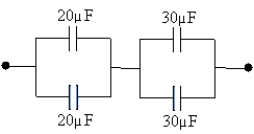
(Multiple Choice)
4.9/5 (76)
(76) There is a hollow,conducting,uncharged sphere with a negative charge inside the sphere.Consider the electrical potential at the inner and outer surfaces of the sphere.Which of the following is true? 
(Multiple Choice)
4.9/5 (74)
(74) Two capacitors with capacitances of 1.0 μF and 0.35 μF,respectively,are connected in parallel.The system is connected to a 40-V battery.What electrical potential energy is stored in the 1.0-μF capacitor?
(Multiple Choice)
4.8/5 (84)
(84) A free electron is in an electric field.With respect to the field,it experiences a force acting:
(Multiple Choice)
4.9/5 (81)
(81) If the distance between two negative point charges is increased by a factor of three,the resultant potential energy is what factor times the initial potential energy?
(Multiple Choice)
4.7/5 (89)
(89) If C1 = 30 µF,C2 = 25 µF,C3 = 15 µF,and ΔV0 = 22 V,determine the energy stored by C2.
(Multiple Choice)
4.8/5 (79)
(79) A 4-μF capacitor is attached to a 10-V power supply.How much energy is stored in the capacitor?
(Multiple Choice)
5.0/5 (77)
(77) Two protons,each of charge 2.2 × 10⁻¹⁹ C,are 4.6 × 10⁻⁵ m apart.What is the change in potential energy if they are brought 2.3 × 10⁻⁵ m closer together? (ke = 8.99 × 10⁹ N·m2/C2)
(Multiple Choice)
4.9/5 (78)
(78) Two capacitors with capacitances of 1.25 and 3.75 μF,respectively,are connected in parallel.The system is connected to a 45-V battery.What charge accumulates on the 1.25-μF capacitor?
(Multiple Choice)
4.9/5 (87)
(87) A 20-μF capacitor is attached across a 1000-V power supply.What is the net charge on the capacitor?
(Multiple Choice)
4.7/5 (75)
(75) A parallel-plate capacitor with plate area A and plate separation d has a capacitance of 3  With the gap between the plates unfilled.The gap is then filled with two dielectric materials,one with dielectric constant 3 and the other one with dielectric constant 6.Each slab of dielectric has area A and thickness d/2,the layering of the dielectrics resulting in the gap being completely filled.Which of the following combinations of capacitors will have the same capacitance as the newly filled parallel-plate one?
 (Multiple Choice)
4.7/5 (82)
(82) A capacitor is made by taking two sheets of aluminum foil,each 0.022 mm thick and placing between them a sheet of paper which comes from a ream of 520 sheets,the ream being 5.3 cm thick with sheets measuring 216 mm by 279 mm (the usual 8 1/2 by 11).What is the capacitance of the capacitor made this way if the dielectric constant of the paper is 3.7? (ε0 = 8.85 × 10⁻¹² C2/N × m2)
(Multiple Choice)
4.9/5 (67)
(67) If the distance between two isolated parallel plates that are oppositely charged is doubled,the electric field between the plates is essentially unchanged.However,the:
(Multiple Choice)
4.8/5 (96)
(96) A solid conducting sphere of 9 cm radius has a net charge of 17 nC.If the potential at infinity is taken as zero,what is the potential at the center of the sphere?
(Multiple Choice)
4.8/5 (85)
(85) Three capacitors of 0.6,1.6,and 2.6 μF are connected in series.Find the combined capacitance.
(Multiple Choice)
4.9/5 (76)
(76) 
Filters
- Essay(0)
- Multiple Choice(0)
- Short Answer(0)
- True False(0)
- Matching(0)