



 Chat with AI
Exam 16: Electrical Energy and Capacitance

Exam 1: Introduction60 Questions
Exam 1: Introduction: Part A47 Questions
Exam 2: Motion in One Dimension64 Questions
Exam 2: Motion in One Dimension: Part A42 Questions
Exam 3: Vectors and Two-Dimensional Motion74 Questions
Exam 3: Vectors and Two-Dimensional Motion: Part A64 Questions
Exam 4: The Laws of Motion93 Questions
Exam 4: The Laws of Motion: Part A69 Questions
Exam 5: Energy84 Questions
Exam 5: Energy: Part A32 Questions
Exam 6: Momentum and Collisions83 Questions
Exam 6: Momentum and Collisions: Part A61 Questions
Exam 7: Rotational Motion and the Law of Gravity84 Questions
Exam 7: Rotational Motion and the Law of Gravity: Part A48 Questions
Exam 8: Rotational Equilibrium and Rotational Dynamics60 Questions
Exam 8: Rotational Equilibrium and Rotational Dynamics: Part A61 Questions
Exam 9: Solids and Fluids78 Questions
Exam 9: Solids and Fluids: Part A46 Questions
Exam 10: Thermal Physics82 Questions
Exam 10: Thermal Physics: Part A56 Questions
Exam 11: Energy in Thermal Processes Heat and Internal Energy82 Questions
Exam 11: Energy in Thermal Processes Heat and Internal Energy: Part A54 Questions
Exam 12: The Laws of Thermodynamics Work in Thermodynamic Processes70 Questions
Exam 12: The Laws of Thermodynamics Work in Thermodynamic Processes: Part A40 Questions
Exam 13: Vibrations and Waves83 Questions
Exam 13: Vibrations and Waves: Part A48 Questions
Exam 14: Sound81 Questions
Exam 14: Sound: Part A67 Questions
Exam 15: Electric Forces and Electric Fields81 Questions
Exam 15: Electric Forces and Electric Fields: Part A42 Questions
Exam 16: Electrical Energy and Capacitance81 Questions
Exam 16: Electrical Energy and Capacitance: Part A33 Questions
Exam 17: Current and Resistance Electric Current83 Questions
Exam 17: Current and Resistance Electric Current: Part A37 Questions
Exam 18: Direct-Current Circuits Sources of EMF77 Questions
Exam 18: Direct-Current Circuits Sources of EMF: Part A54 Questions
Exam 19: Magnetism Magnets82 Questions
Exam 19: Magnetism Magnets: Part A67 Questions
Exam 20: Induced Voltages and Inductance83 Questions
Exam 20: Induced Voltages and Inductance: Part A46 Questions
Exam 21: Alternating-Current Circuits and Electromagnetic Waves98 Questions
Exam 21: Alternating-Current Circuits and Electromagnetic Waves: Part A32 Questions
Exam 22: Reflection and Refraction of Light81 Questions
Exam 22: Reflection and Refraction of Light: Part A49 Questions
Exam 23: Mirrors and Lenses82 Questions
Exam 23: Mirrors and Lenses: Part A31 Questions
Exam 24: Wave Optics88 Questions
Exam 24: Wave Optics: Part A71 Questions
Exam 25: Optical Instruments79 Questions
Exam 25: Optical Instruments: Part A59 Questions
Exam 26: Relativity62 Questions
Exam 26: Relativity: Part A29 Questions
Exam 27: Quantum Physics Blackbody Radiation and Plancks Hypothesis79 Questions
Exam 27: Quantum Physics Blackbody Radiation and Plancks Hypothesis: Part A52 Questions
Exam 28: Atomic Physics71 Questions
Exam 28: Atomic Physics: Part A38 Questions
Exam 29: Nuclear Physics75 Questions
Exam 29: Nuclear Physics: Part A43 Questions
Exam 30: Nuclear Energy and Elementary Particles88 Questions
Exam 30: Nuclear Energy and Elementary Particles: Part A37 Questions
Exam 31: Particle Collisions, Mediating Photons, and Quark Structures: Exploring the Fundamentals of Physics16 Questions
Select questions type


Electrons in an x-ray machine are accelerated from rest through a potential difference of 20,000 V.What is the kinetic energy of each of these electrons in eV?
(Multiple Choice)
4.9/5  (78)
(78) Using a 0.5-mF capacitor,a 2.5-mF capacitor,and a 3.5-mF capacitor,which of the following capacitances cannot be made by a combination that uses all three? (Hint: At most only 2 combinations must be considered to determine the correct answer).
(Multiple Choice)
4.8/5 (81)
(81) A uniform electric field,with a magnitude of 550 N/C,is directed parallel to the positive x-axis.If the potential at x = 5 m is 1,900 V,what is the potential at x = 3 m?
(Multiple Choice)
4.8/5 (80)
(80) Increasing the voltage across the two plates of a capacitor will produce what effect on the capacitor?
(Multiple Choice)
4.9/5 (81)
(81) An electron in a cathode ray tube is accelerated through a potential difference of 7.0 kV.What kinetic energy does the electron gain in the process? (e = 1.6 × 10⁻¹⁹ C)
(Multiple Choice)
4.8/5 (78)
(78) Which of the following characteristics are held in common by both gravitational and electrostatic forces when dealing with either point masses or charges?
(Multiple Choice)
4.8/5 (78)
(78) Two point charges of values +3.4 and +7.0 μC are separated by 0.3 m.What is the electrical potential at the point midway between the two point charges? (ke = 8.99 × 10⁹ N⋅m2/C2)
(Multiple Choice)
4.9/5 (69)
(69) An electron in a TV picture tube is accelerated through a potential difference of 29 kV before it hits the screen.What is the kinetic energy of the electron in electron volts? (1 eV = 1.6 × 10⁻¹⁹ J)
(Multiple Choice)
4.9/5 (83)
(83) If three 1.9-µF capacitors are connected in parallel,what is the combined capacitance?
(Multiple Choice)
5.0/5 (91)
(91) The unit of capacitance,the farad,is dimensionally equivalent to which of the following?
(Multiple Choice)
4.8/5 (87)
(87) Two capacitors with CA greater than CB and are connected in series with a battery.Which of the following is true?
(Multiple Choice)
4.8/5 (80)
(80) Two capacitors with capacitances of 2 μF and 0.4 μF,respectively,are connected in series.The system is connected to a 100-V battery.What electrical potential energy is stored in the 2-μF capacitor?
(Multiple Choice)
4.7/5 (85)
(85) How much charge can be placed on a capacitor of plate area 15 cm2 with air between the plates before it reaches "atmospheric breakdown" where E = 3.0 × 10⁶ V/m? (ε0 = 8.85 × 10⁻¹² C2/N⋅m2)
(Multiple Choice)
4.7/5 (80)
(80) The quantity of electrical potential,the volt,is dimensionally equivalent to:
(Multiple Choice)
4.9/5 (83)
(83) What is the equivalent capacitance of the combination shown? 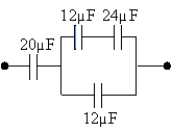
(Multiple Choice)
4.8/5 (68)
(68) Very large capacitors have been considered as a means for storing electrical energy.If we constructed a very large parallel-plate capacitor of plate area 1.4 m2 using paper (κ = 3.7)of thickness 1.7 mm as a dielectric,how much electrical energy would it store at a plate voltage of 5,020 V? (ε0 = 8.85 × 10⁻¹² C2/N⋅m2)
(Multiple Choice)
4.8/5 (88)
(88) Four point charges are on the rim of a circle of radius 10 cm.The charges are (in μC)+0.50,+1.5,−1.0,−0.50.If the electrical potential at the circle's center due to the +0.5 charge alone is 4.5 × 10⁴ V,what is the total potential at the center due to the four charges combined?
(Multiple Choice)
4.8/5 (82)
(82) A point charge of +2.1 μC is located at the origin of a coordinate system and a second point charge of −6.9 μC is at x = 1.2 m.What is the electric potential at the x = 0.6 m point? (ke = 8.99 × 10⁹ N⋅m2/C2)
(Multiple Choice)
4.8/5 (85)
(85) A parallel-plate capacitor has dimensions 3.8 cm × 4 cm.The plates are separated by a 1.12-mm thickness of paper (dielectric constant κ = 3.7).What is the charge that can be stored on this capacitor,when connected to a 1.2-V battery? (ε0 = 8.85 × 10⁻¹² C2/N⋅m2)
(Multiple Choice)
4.8/5 (77)
(77) What is the equivalent capacitance between points a and b? All capacitors are 2.5 μF. 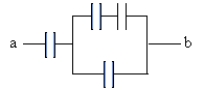
(Multiple Choice)
4.9/5 (69)
(69) 
Filters
- Essay(0)
- Multiple Choice(0)
- Short Answer(0)
- True False(0)
- Matching(0)