



 Chat with AI
Exam 16: Electrical Energy and Capacitance

Exam 1: Introduction60 Questions
Exam 1: Introduction: Part A47 Questions
Exam 2: Motion in One Dimension64 Questions
Exam 2: Motion in One Dimension: Part A42 Questions
Exam 3: Vectors and Two-Dimensional Motion74 Questions
Exam 3: Vectors and Two-Dimensional Motion: Part A64 Questions
Exam 4: The Laws of Motion93 Questions
Exam 4: The Laws of Motion: Part A69 Questions
Exam 5: Energy84 Questions
Exam 5: Energy: Part A32 Questions
Exam 6: Momentum and Collisions83 Questions
Exam 6: Momentum and Collisions: Part A61 Questions
Exam 7: Rotational Motion and the Law of Gravity84 Questions
Exam 7: Rotational Motion and the Law of Gravity: Part A48 Questions
Exam 8: Rotational Equilibrium and Rotational Dynamics60 Questions
Exam 8: Rotational Equilibrium and Rotational Dynamics: Part A61 Questions
Exam 9: Solids and Fluids78 Questions
Exam 9: Solids and Fluids: Part A46 Questions
Exam 10: Thermal Physics82 Questions
Exam 10: Thermal Physics: Part A56 Questions
Exam 11: Energy in Thermal Processes Heat and Internal Energy82 Questions
Exam 11: Energy in Thermal Processes Heat and Internal Energy: Part A54 Questions
Exam 12: The Laws of Thermodynamics Work in Thermodynamic Processes70 Questions
Exam 12: The Laws of Thermodynamics Work in Thermodynamic Processes: Part A40 Questions
Exam 13: Vibrations and Waves83 Questions
Exam 13: Vibrations and Waves: Part A48 Questions
Exam 14: Sound81 Questions
Exam 14: Sound: Part A67 Questions
Exam 15: Electric Forces and Electric Fields81 Questions
Exam 15: Electric Forces and Electric Fields: Part A42 Questions
Exam 16: Electrical Energy and Capacitance81 Questions
Exam 16: Electrical Energy and Capacitance: Part A33 Questions
Exam 17: Current and Resistance Electric Current83 Questions
Exam 17: Current and Resistance Electric Current: Part A37 Questions
Exam 18: Direct-Current Circuits Sources of EMF77 Questions
Exam 18: Direct-Current Circuits Sources of EMF: Part A54 Questions
Exam 19: Magnetism Magnets82 Questions
Exam 19: Magnetism Magnets: Part A67 Questions
Exam 20: Induced Voltages and Inductance83 Questions
Exam 20: Induced Voltages and Inductance: Part A46 Questions
Exam 21: Alternating-Current Circuits and Electromagnetic Waves98 Questions
Exam 21: Alternating-Current Circuits and Electromagnetic Waves: Part A32 Questions
Exam 22: Reflection and Refraction of Light81 Questions
Exam 22: Reflection and Refraction of Light: Part A49 Questions
Exam 23: Mirrors and Lenses82 Questions
Exam 23: Mirrors and Lenses: Part A31 Questions
Exam 24: Wave Optics88 Questions
Exam 24: Wave Optics: Part A71 Questions
Exam 25: Optical Instruments79 Questions
Exam 25: Optical Instruments: Part A59 Questions
Exam 26: Relativity62 Questions
Exam 26: Relativity: Part A29 Questions
Exam 27: Quantum Physics Blackbody Radiation and Plancks Hypothesis79 Questions
Exam 27: Quantum Physics Blackbody Radiation and Plancks Hypothesis: Part A52 Questions
Exam 28: Atomic Physics71 Questions
Exam 28: Atomic Physics: Part A38 Questions
Exam 29: Nuclear Physics75 Questions
Exam 29: Nuclear Physics: Part A43 Questions
Exam 30: Nuclear Energy and Elementary Particles88 Questions
Exam 30: Nuclear Energy and Elementary Particles: Part A37 Questions
Exam 31: Particle Collisions, Mediating Photons, and Quark Structures: Exploring the Fundamentals of Physics16 Questions
Select questions type


Five identical 3.5 mF capacitors are connected together electrically.What is the least possible capacitance of the combination?
(Multiple Choice)
4.8/5  (76)
(76) When charge Q1 is placed at point P1,the resulting potential at point P is V1.When Q2 is placed at point P2 after Q1 is in position at P1,the resulting potential at P becomes V2.What is the potential at point P if charge Q1 is then removed?
(Multiple Choice)
4.8/5 (77)
(77) If C = 42 µF,determine the equivalent capacitance for the combination shown. 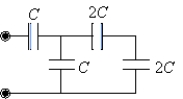
(Multiple Choice)
4.7/5 (86)
(86) A 0.25-μF capacitor is connected to a 300-V battery.What potential energy is stored in the capacitor?
(Multiple Choice)
5.0/5 (83)
(83) Doubling the voltage across a parallel plate capacitor does not double which of the following?
(Multiple Choice)
4.8/5 (75)
(75) A parallel-plate capacitor has a capacitance of 24 µF.What potential difference across the plates is required to store 6.8 × 10⁻⁴ C on this capacitor?
(Multiple Choice)
4.9/5 (76)
(76) An electron is released from rest at the negative plate of a parallel-plate capacitor.If the distance across the plate is 6.0 mm and the potential difference across the plate is 4.0 V,with what velocity does the electron hit the positive plate? (me = 9.1 × 10⁻³¹ kg,e = 1.6 × 10⁻¹⁹ C)
(Multiple Choice)
5.0/5 (78)
(78) In which case does an electric field do positive work on a charged particle?
(Multiple Choice)
4.7/5 (71)
(71) A 0.55-μF capacitor is connected to a 310-V battery.Find the charge on the capacitor.
(Multiple Choice)
4.7/5 (57)
(57) The unit of electrical potential,the volt,is dimensionally equivalent to:
(Multiple Choice)
4.9/5 (76)
(76) A parallel-plate capacitor with plate area A and plate separation d has a capacitance of 3.0  With the gap between the plates unfilled.The gap is then filled with two dielectric materials,one with dielectric constant 2.0 and the other one with dielectric constant 4.0.Each slab of dielectric has area A/2 and thickness d,the placing side-by-side of the dielectics resulting in the gap being completely filled.Which of the following combinations of capacitors will have the same capacitance as the newly filled parallel-plate one?
(Multiple Choice)
4.7/5 (70)
(70) Six identical 3.5 mF capacitors are connected together electrically.What is the greatest possible capacitance of the combination?
(Multiple Choice)
4.8/5 (73)
(73) Inserting a dielectric material between two charged parallel conducting plates,originally separated by air and disconnected from a battery,will produce what effect on the capacitor?
(Multiple Choice)
4.7/5 (78)
(78) At what distance from a point charge of 7.3 μC would the electrical potential be 4.9 × 10⁴ V? (ke = 8.99 × 10⁹ N⋅m2/C2)
(Multiple Choice)
4.8/5 (70)
(70) Two point charges of values +3.3 and +5.1 μC,respectively,are separated by 0.65 m.What is the potential energy of this 2-charge system? (ke = 8.99 × 10⁹ N⋅m2/C2)
(Multiple Choice)
4.8/5 (85)
(85) If C = 14 µF,what is the equivalent capacitance for the combination shown? 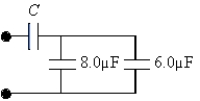
(Multiple Choice)
4.9/5 (82)
(82) If a doubly-ionized oxygen atom (O-2)is accelerated from rest by going through a potential difference of 21 V,what will be the change in its kinetic energy?
(Multiple Choice)
4.7/5 (73)
(73) A proton (+1.6 × 10⁻¹⁹ C)moves 15 cm on a path in the direction of a uniform electric field of strength 2.6 N/C.How much work is done on the proton by the electrical field?
(Multiple Choice)
4.9/5 (92)
(92) An ion is released from rest and moves due to the force from an electric field from a position in the field having a potential of 14 V to a position having a potential of 8 V.The ion:
(Multiple Choice)
4.9/5 (89)
(89) When charges qa,qb,and qc are placed respectively at the corners a,b,and c of a right triangle,the potential at the midpoint of the hypotenuse is 20 V.When the charge qa is removed,the potential at the midpoint becomes 15 V.When,instead,the charge qb is removed (qa and qc both in place),the potential at the midpoint becomes 12 V.What is the potential at the midpoint if only the charge qc is removed from the array of charges?
(Multiple Choice)
4.8/5 (79)
(79) 
Filters
- Essay(0)
- Multiple Choice(0)
- Short Answer(0)
- True False(0)
- Matching(0)