



 Chat with AI
Exam 18: Thermodynamics and Equilibrium

Exam 1: Chemistry and Measurement111 Questions
Exam 2: Atoms, molecules, and Ions149 Questions
Exam 3: Calculations With Chemical Formulas and Equations139 Questions
Exam 4: Chemical Reactions159 Questions
Exam 5: The Gaseous State104 Questions
Exam 6: Thermochemistry119 Questions
Exam 7: Quantum Theory of the Atom68 Questions
Exam 8: Electron Configurations and Periodicity100 Questions
Exam 9: Ionic and Covalent Bonding125 Questions
Exam 10: Molecular Geometry and Chemical Bonding Theory101 Questions
Exam 11: States of Matter; Liquids and Solids123 Questions
Exam 12: Solutions119 Questions
Exam 13: Rates of Reaction113 Questions
Exam 14: Chemical Equilibrium97 Questions
Exam 15: Acids and Bases83 Questions
Exam 16: Acid-Base Equilibria148 Questions
Exam 17: Solubility and Complex-Ion Equilibria115 Questions
Exam 18: Thermodynamics and Equilibrium94 Questions
Exam 19: Electrochemistry122 Questions
Exam 20: Nuclear Chemistry90 Questions
Exam 21: Chemistry of the Main-Group Metals121 Questions
Exam 22: The Transition Elements and Coordination Compounds75 Questions
Exam 23: Organic Chemistry79 Questions
Exam 24: Polymer Materials: Synthetic and Biological56 Questions
Select questions type


In which of the following scenarios is no change in the internal energy of the system possible?
(Multiple Choice)
4.8/5  (74)
(74) Based on the following data,what is the standard Gibbs free energy of formation of the sulfate ion at 298 K? (R = 8.31 J/(K ∙ mol))
PbSO4(s)  Pb2+(aq)+ SO42-(aq); Ksp = 1.7 × 10⁻⁸
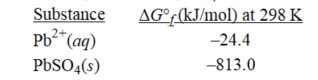
Pb2+(aq)+ SO42-(aq); Ksp = 1.7 × 10⁻⁸
(Multiple Choice)
4.8/5 (86)
(86) Which of the following reactions has the smallest value of ΔS° at 25°C?
(Multiple Choice)
4.7/5 (94)
(94) Under standard-state conditions,a reaction with ΔH° < 0 and ΔS° > 0 is
(Multiple Choice)
4.8/5 (86)
(86) For the reaction 2SO2(g)+ O2(g)→ 2SO3(g),ΔH° and ΔS° are both negative at 298 K,and the process is spontaneous at 298 K.Which of the following statements must also be true?
(Multiple Choice)
4.8/5 (82)
(82) What is the change in entropy when 0.517 g of water decomposes to form hydrogen gas and oxygen gas at 298 K?
2H2O(l)→ 2H2(g)+ O2(g); ΔS° = 326.3 J/K at 298 K
(Multiple Choice)
4.7/5 (71)
(71) Consider the following reaction,which is spontaneous at room temperature.
NH3(g)+ BF3(g)→ H3NBF3(s)
One would predict that
(Multiple Choice)
4.9/5 (77)
(77) The total entropy of a system and its surroundings always increases for a spontaneous process.This is a statement of
(Multiple Choice)
4.8/5 (82)
(82) For a particular process,q = 20 kJ and w = 15 kJ.Which of the following statements is true?
(Multiple Choice)
4.8/5 (96)
(96) The standard enthalpy of fusion of iodobenzene is 9.75 kJ/mol at its melting point,241.8 K.What is the standard change in entropy for the melting of iodobenzene at its melting point?
(Multiple Choice)
4.9/5 (86)
(86) The standard enthalpy of vaporization of methanol is 35.2 kJ/mol at its normal boiling point,64.6°C.What is the standard change in entropy for the vaporization of methanol at its normal boiling point?
(Multiple Choice)
4.8/5 (92)
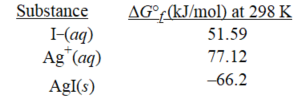
(92) -Given the following,determine ΔG° at 298 K for the precipitation reaction,
Ag+(aq)+I−(aq)→ AgI(s)
(Multiple Choice)
4.7/5 (85)
(85) The enthalpy of vaporization (ΔH°vap)of benzene is 30.7 kJ/mol at its normal boiling point of 353.3 K.What is ΔS°vap at this temperature?
(Multiple Choice)
4.9/5 (87)
(87) For a reaction system that is at equilibrium,which of the following must always be true?
(Multiple Choice)
4.8/5 (79)
(79) The standard free energy of formation of nitric oxide,NO,at 1000.K (roughly the temperature in an automobile engine during ignition)is 77.7 kJ/mol.Calculate the equilibrium constant for the reaction 
 2NO(g)
At 1000.K.(R = 8.31 J/(K ∙ mol))
2NO(g)
At 1000.K.(R = 8.31 J/(K ∙ mol)) (Multiple Choice)
4.9/5 (83)
(83) Which of the following is not a spontaneous process at 25°C and 1 atm pressure?
(Multiple Choice)
4.8/5 (79)
(79) 
Filters
- Essay(0)
- Multiple Choice(0)
- Short Answer(0)
- True False(0)
- Matching(0)