



 Chat with AI
Exam 18: Thermodynamics and Equilibrium

Exam 1: Chemistry and Measurement111 Questions
Exam 2: Atoms, molecules, and Ions149 Questions
Exam 3: Calculations With Chemical Formulas and Equations139 Questions
Exam 4: Chemical Reactions159 Questions
Exam 5: The Gaseous State104 Questions
Exam 6: Thermochemistry119 Questions
Exam 7: Quantum Theory of the Atom68 Questions
Exam 8: Electron Configurations and Periodicity100 Questions
Exam 9: Ionic and Covalent Bonding125 Questions
Exam 10: Molecular Geometry and Chemical Bonding Theory101 Questions
Exam 11: States of Matter; Liquids and Solids123 Questions
Exam 12: Solutions119 Questions
Exam 13: Rates of Reaction113 Questions
Exam 14: Chemical Equilibrium97 Questions
Exam 15: Acids and Bases83 Questions
Exam 16: Acid-Base Equilibria148 Questions
Exam 17: Solubility and Complex-Ion Equilibria115 Questions
Exam 18: Thermodynamics and Equilibrium94 Questions
Exam 19: Electrochemistry122 Questions
Exam 20: Nuclear Chemistry90 Questions
Exam 21: Chemistry of the Main-Group Metals121 Questions
Exam 22: The Transition Elements and Coordination Compounds75 Questions
Exam 23: Organic Chemistry79 Questions
Exam 24: Polymer Materials: Synthetic and Biological56 Questions
Select questions type


The following reaction is spontaneous at all temperatures:
CaC2(s)+ 2H2O(l)→ Ca(OH)2(s)+ C2H2(g)
Which of the following statements is true?
(Multiple Choice)
4.8/5  (85)
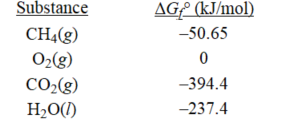
(85) Determine ΔG° for the following reaction:
CH4(g)+ 2O2(g)  CO2(g)+ 2H2O(l)
CO2(g)+ 2H2O(l)
(Multiple Choice)
4.7/5 (70)
(70) Consider the following reaction:
2C(s)+ 2H2(g)→ C2H4(g); ΔH° = 52.47 kJ; ΔS° = -53.5 J/K at 298 K
What is the equilibrium constant at 298 K for this reaction?
(Multiple Choice)
4.9/5 (65)
(65) What is the change in internal energy of the system (ΔU)if 82 kJ of heat energy is absorbed by the system and 40 kJ of work is done on the system for a certain process?
(Multiple Choice)
4.8/5 (90)
(90) An ideal fuel for the control jet of a space vehicle should decompose with
(Multiple Choice)
4.9/5 (74)
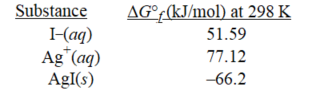
(74) Given the following,determine K at 298K for the reaction,
AgI(s)→ Ag+(aq)+I−(aq)
(Multiple Choice)
4.8/5 (81)
(81) A 0.0333 M solution of a particular weak base,B,has a pH of 8.30 at 298 K.What is ΔG° for the following equilibrium?
B(aq)+ H2O(l)  BH+(aq)+ OH-(aq)
 (Multiple Choice)
4.9/5 (78)
(78) What is the change in entropy when 0.802 g of silicon is burned in excess oxygen to yield silicon dioxide at 298 K?
Si(s)+ O2(g)→ SiO2(s); ΔS° = -182.4 J/K at 298 K
(Multiple Choice)
4.8/5 (67)
(67) For which of the following reactions is ΔS° at 25°C closest to zero?
(Multiple Choice)
4.9/5 (72)
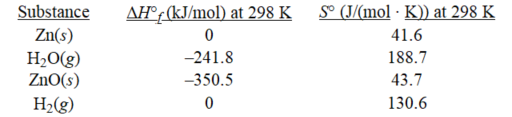
(72) What is ΔG° at 500.0 K for the following reaction?
Zn(s)+ H2O(g)→ ZnO(s)+ H2(g)
(Multiple Choice)
4.8/5 (75)
(75) Consider the following hypothetical reaction at 310 K.Standard free energies of formation are given in parentheses.
B  C ΔG° = -25.0kJ/mol
(?) (176.4 kJ/mol)
Calculate the standard free energy of formation of compound B.
C ΔG° = -25.0kJ/mol
(?) (176.4 kJ/mol)
Calculate the standard free energy of formation of compound B. (Multiple Choice)
4.7/5 (66)
(66) For a certain process,at 300.K,ΔG = -37.2 kJ and ΔH = -7.0 kJ.If the process is carried out reversibly,what is the amount of useful work that can be performed?
(Multiple Choice)
4.9/5 (64)
(64) Consider the following reaction,which is spontaneous at room temperature.
C3H8(g)+ 5O2(g)→ 3CO2(g)+ 4H2O(g)
One would predict that
(Multiple Choice)
4.8/5 (91)
(91) For the reaction MgSO3(s)→ MgO(s)+ SO2(g),which is spontaneous only at high temperatures,one would predict that
(Multiple Choice)
4.9/5 (76)
(76) 
Filters
- Essay(0)
- Multiple Choice(0)
- Short Answer(0)
- True False(0)
- Matching(0)