



 Chat with AI
Exam 12: Chemical Kinetics: Rates of Reactions

Exam 1: The Nature of Chemistry68 Questions
Exam 2: Atoms and Elements66 Questions
Exam 3: Chemical Compounds65 Questions
Exam 4: Quantities of Reactants and Products65 Questions
Exam 5: Chemical Reactions66 Questions
Exam 6: Energy and Chemical Reactions55 Questions
Exam 7: Electron Configurations and the Periodic Table64 Questions
Exam 8: Covalent Bonding67 Questions
Exam 9: Molecular Structure53 Questions
Exam 10: Gases and the Atmosphere57 Questions
Exam 11: Liquids, Solids, and Materials46 Questions
Exam 12: Chemical Kinetics: Rates of Reactions66 Questions
Exam 13: Chemical Equilibrium57 Questions
Exam 14: The Chemistry of Solutes and Solutions57 Questions
Exam 15: Acids and Bases62 Questions
Exam 16: Additional Aqueous Equilibria52 Questions
Exam 17: Thermodynamics: Directionality of Chemical Reactions56 Questions
Exam 18: Electrochemistry and Its Applications54 Questions
Exam 19: Nuclear Chemistry53 Questions
Select questions type


The rate constant for the first order decomposition of SO2Cl2 is 1.37 × 10⁻³ min-1 at a certain temperature. If the concentration is initially 0.500 M, predict it after 300 min.
(Multiple Choice)
4.9/5  (82)
(82) The solid catalysts used in many industrial processes where the reactants are liquids or gases are referred to as
(Multiple Choice)
5.0/5 (60)
(60) Consider the reaction with the mechanism shown:  The first step is ____; the second step is ____; and the third step is ____.
 (Multiple Choice)
4.8/5 (81)
(81) Which of the following factors increases the rate of a chemical reaction by decreasing the activation energy barrier?
(Multiple Choice)
4.7/5 (74)
(74) In a heterogeneous chemical reaction requiring the use of a solid catalyst, the rate of the reaction could not be increased by increasing the concentration of reactants, but was doubled by doubling the amount of solid catalyst added. This probably indicated that
(Multiple Choice)
4.9/5 (71)
(71) For many homogeneous reactions, the rate law has the general form
(Multiple Choice)
4.8/5 (64)
(64) For the reaction  the integrated rate law for a particular order of reaction
 (Multiple Choice)
4.9/5 (84)
(84) The table below gives the concentration of a substance A as a function of time at 473 K.
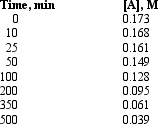 a. Establish whether the reaction is zeroth, first or second-order in A.
b. Calculate the rate constant at 473 K for this reaction.
a. Establish whether the reaction is zeroth, first or second-order in A.
b. Calculate the rate constant at 473 K for this reaction.
(Essay)
4.9/5 (75)
(75) The ____of a multistep reaction can be predicted unambiguously from the ____, but not vice versa.
(Multiple Choice)
4.9/5 (73)
(73) At a given temperature, the kinetics parameters for a new chemical reaction are determined in the following sequence from first to last
(Multiple Choice)
4.9/5 (65)
(65) Exhibit 12-2 For the following question(s), consider the following reaction mechanism:
 Refer to Exhibit 12-2. The catalysts in this reaction are
 (Multiple Choice)
4.8/5 (78)
(78) The best description of the induced fit model of enzyme function is
(Multiple Choice)
4.8/5 (98)
(98) Which of the following units may be used for describing reaction rates?
(Multiple Choice)
4.9/5 (62)
(62) The substrate in an enzyme-controlled biological reaction is a
(Multiple Choice)
4.8/5 (84)
(84) Which of the following factors increases the rate of a chemical reaction by increasing the fraction of molecules with energy in excess of a given value?
(Multiple Choice)
4.8/5 (81)
(81) Which of the following best describes a typical mechanism for an enzyme-catalyzed reaction?
(Multiple Choice)
5.0/5 (82)
(82) Exhibit 12-2 For the following question(s), consider the following reaction mechanism:
 Refer to Exhibit 12-2. The rate-limiting step in this reaction is Step ____, because ____.
 (Multiple Choice)
4.8/5 (84)
(84) The reaction  is ____ order with respect to NO, ____order with respect to Cl2, and ____ order overall.
 (Multiple Choice)
4.8/5 (79)
(79) The function of an automobile catalytic converter is to convert
(Multiple Choice)
5.0/5 (74)
(74) 
Filters
- Essay(0)
- Multiple Choice(0)
- Short Answer(0)
- True False(0)
- Matching(0)