



 Chat with AI
Exam 12: Chemical Kinetics: Rates of Reactions

Exam 1: The Nature of Chemistry68 Questions
Exam 2: Atoms and Elements66 Questions
Exam 3: Chemical Compounds65 Questions
Exam 4: Quantities of Reactants and Products65 Questions
Exam 5: Chemical Reactions66 Questions
Exam 6: Energy and Chemical Reactions55 Questions
Exam 7: Electron Configurations and the Periodic Table64 Questions
Exam 8: Covalent Bonding67 Questions
Exam 9: Molecular Structure53 Questions
Exam 10: Gases and the Atmosphere57 Questions
Exam 11: Liquids, Solids, and Materials46 Questions
Exam 12: Chemical Kinetics: Rates of Reactions66 Questions
Exam 13: Chemical Equilibrium57 Questions
Exam 14: The Chemistry of Solutes and Solutions57 Questions
Exam 15: Acids and Bases62 Questions
Exam 16: Additional Aqueous Equilibria52 Questions
Exam 17: Thermodynamics: Directionality of Chemical Reactions56 Questions
Exam 18: Electrochemistry and Its Applications54 Questions
Exam 19: Nuclear Chemistry53 Questions
Select questions type


Exhibit 12-2 For the following question(s), consider the following reaction mechanism:
 Refer to Exhibit 12-2. The intermediates in this reaction are
 (Multiple Choice)
4.8/5  (77)
(77) Exhibit 12-1 The following question(s) relate to the reaction between water and a complex ion of Co2+; the rate varies with concentration as follows. (The rate has no dependence on [H2O].)
 Refer to Exhibit 12-1. The rate law for the reaction is rate =
 (Multiple Choice)
4.9/5 (74)
(74) For a first-order reaction, which expression describes the relationship between the rate constant, k, and the half-life, t1/2?
(Multiple Choice)
4.9/5 (83)
(83) A reaction displays zero-order kinetics for its single reactant. It therefore follows that a plot of ____ versus time is linear, and that the slope of this plot = ____.
(Multiple Choice)
4.8/5 (83)
(83) The rate constant for the reaction  1 doubles on raising the temperature from 410 C to 425 C. The activation energy, in J/mol, is
 (Multiple Choice)
4.8/5 (91)
(91) Consider the hypothetical reaction  The rate of reaction is ____ times D[B]/Dt and ____ times D[C]/Dt.
 (Multiple Choice)
4.8/5 (105)
(105) For a new chemical reaction involving several reactants, the order of reaction with respect to each reactant
(Multiple Choice)
4.9/5 (63)
(63)  the rate law
In a bimolecular reaction, which term can be equated to the probability that a collision between molecules will have the correct relative orientation for chemical reaction to occur?
(Multiple Choice)
4.8/5 (69)
(69) Which of the following could not be the units of a rate constant?
(Multiple Choice)
4.9/5 (81)
(81) The species representing the combination of atoms or molecules at the top of the activation energy barrier is called the
(Multiple Choice)
4.8/5 (64)
(64) When two atoms, molecules or ions are involved in an elementary reaction, it is said to be a(n):
(Multiple Choice)
4.9/5 (60)
(60) If an elementary reaction involves the collision of two identical molecules, then the elementary reaction is ____, and the kinetics will be ____.
(Multiple Choice)
4.7/5 (69)
(69) In a reaction that is first-order with respect to reactant A and second-order with respect to reactant B, the rate of the reaction
(Multiple Choice)
4.8/5 (88)
(88) The rate of the chemical reaction involving two substances, A and B, is measured. It is found that if the initial concentration of A used is doubled, keeping the B concentration the same, the rate doubles. If the concentrations of both A and B are doubled, the rate is eight times that measured in the first experiment. The rate law for this reaction is rate =
(Multiple Choice)
4.8/5 (91)
(91) Consider the reaction 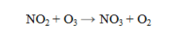 Use the data shown to determine the rate law for the reaction.

Use the data shown to determine the rate law for the reaction.
(Multiple Choice)
4.9/5 (88)
(88) The rate constant for the first-order conversion of A to B is 3.33 hr-1. How much time will be required for the concentration of A to reach 75% of its original value?
(Multiple Choice)
4.7/5 (80)
(80) The table below gives the rate constant for a certain reaction at
a. the activation energy for this reaction.
b. the frequency factor.
c. the value of k at 1100K.

(Essay)
4.8/5 (91)
(91) 
Filters
- Essay(0)
- Multiple Choice(0)
- Short Answer(0)
- True False(0)
- Matching(0)