



 Chat with AI
Exam 16: Additional Aqueous Equilibria

Exam 1: The Nature of Chemistry68 Questions
Exam 2: Atoms and Elements66 Questions
Exam 3: Chemical Compounds65 Questions
Exam 4: Quantities of Reactants and Products65 Questions
Exam 5: Chemical Reactions66 Questions
Exam 6: Energy and Chemical Reactions55 Questions
Exam 7: Electron Configurations and the Periodic Table64 Questions
Exam 8: Covalent Bonding67 Questions
Exam 9: Molecular Structure53 Questions
Exam 10: Gases and the Atmosphere57 Questions
Exam 11: Liquids, Solids, and Materials46 Questions
Exam 12: Chemical Kinetics: Rates of Reactions66 Questions
Exam 13: Chemical Equilibrium57 Questions
Exam 14: The Chemistry of Solutes and Solutions57 Questions
Exam 15: Acids and Bases62 Questions
Exam 16: Additional Aqueous Equilibria52 Questions
Exam 17: Thermodynamics: Directionality of Chemical Reactions56 Questions
Exam 18: Electrochemistry and Its Applications54 Questions
Exam 19: Nuclear Chemistry53 Questions
Select questions type


A mixture of two metal ions in solution is to be separated by selective precipitation. As the concentration of the precipitating ion is increased, which metal ion precipitates first?

Free
(Multiple Choice)
4.9/5  (77)
(77) Correct Answer: Verified
E
In order to make up a buffer solution with a neutral pH, it would be best to make use of
Free
(Multiple Choice)
4.9/5 (66)
(66) Correct Answer:Verified
VerifiedB
Which formula represents the Henderson-Hasselbalch equation for the generic acid HA?
(Multiple Choice)
4.8/5 (71)
(71) When 1.00 L of 0.45 M acetic acid (pKa = 4.74) is mixed with the exact volume of 0.55 M NaOH required to convert the acid to its conjugate base, at the endpoint the solution will have a
(Multiple Choice)
4.8/5 (70)
(70) What is the minimum volume of 0.55 M NaOH required to completely convert 1.00 L of 0.45 M acetic acid (pKa = 4.74) to its conjugate base?
(Multiple Choice)
4.9/5 (82)
(82) If solid sodium chloride is added to a saturated aqueous solution of sodium chloride
(Multiple Choice)
5.0/5 (77)
(77) A buffer solution is 0.500 M in acetic acid and 0.500 M in sodium acetate. Its pH is 4.74. What is its pH after dilution by a factor of 2?
(Multiple Choice)
4.8/5 (80)
(80) Isotonic saline solution is 0.154 M NaCl(aq). What is the solubility of AgCl (Ksp = 1.8 × 10⁻¹⁰) in such a solution?
(Multiple Choice)
4.8/5 (86)
(86) Will a precipitate form when 10.0 mL of 0.500 M NaCl is added to 10.0 mL of 0.0500 M AgNO3? The Ksp for AgCl is 1.8 × 10⁻¹⁰.
(Multiple Choice)
4.8/5 (82)
(82) Answer the following questions:
a. Explain why the solubility of carbonates and phosphates is increased by lowering the pH, but the solubility of chlorides is unaffected by lowering the pH.
b. The solubility of copper(II) carbonate is dramatically increased by the addition of NH3, but the solubility of copper(II) phosphate is not. Referring to the data below, explain why.
Ksp for copper(II) carbonate = 2.5 ´ 10-10
Ksp for copper(II) phosphate = 1.4 ´ 10-37
Cu2+(aq) + 4 NH3(aq)
(Kf = 1.1 ´ 1013)
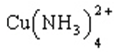 (aq)
(aq) (Essay)
4.8/5 (88)
(88) A 50.00 mL sample of 0.0950 M acetic acid (Ka = 1.8 × 10⁻⁵) is being titrated with 0.0848 M NaOH. What is the pH after 28.00 mL of NaOH has been added?
(Multiple Choice)
4.9/5 (76)
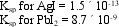
(76) A solution contains 0.100 M Pb(NO3)2 and 1.00 × 10⁻⁵ M AgNO3. It is intended to separate out the silver by selective precipitation of AgI. What is the maximum percentage of the total silver that can be recovered free of contamination by PbI2?
(Essay)
4.8/5 (74)
(74) What is the largest mass of solid NaCl that can be dissolved in 1.000 L of 5.00 × 10⁻³ M AgNO3 without a precipitate of AgCl forming? Ksp for AgCl is 1.8 × 10⁻¹⁰.
(Multiple Choice)
4.9/5 (87)
(87) In how many different pairs can these substances be mixed to produce buffer solutions? 
(Multiple Choice)
4.8/5 (79)
(79) The solubility of silver chloride in water is increased by the addition of NH3. Why?
(Multiple Choice)
5.0/5 (74)
(74) In which aqueous solution would the smallest amount of barium sulfate dissolve?
(Multiple Choice)
4.9/5 (70)
(70) What volume of 0.1060 M NaOH is needed to neutralize a 50.00 mL sample of 0.09500 M HNO3?
(Multiple Choice)
4.8/5 (86)
(86) Exhibit 16-1 The following question(s) refer to the same titration: a 50.00 mL sample of 0.0950 M acetic acid (Ka = 1.8 × 10⁻⁵) is being titrated with 0.106 M NaOH.
Refer to Exhibit 16-1. What is the pH at the midpoint of the titration?
(Multiple Choice)
5.0/5 (91)
(91) 
Filters
- Essay(0)
- Multiple Choice(0)
- Short Answer(0)
- True False(0)
- Matching(0)