



 Chat with AI
Exam 16: Additional Aqueous Equilibria

Exam 1: The Nature of Chemistry68 Questions
Exam 2: Atoms and Elements66 Questions
Exam 3: Chemical Compounds65 Questions
Exam 4: Quantities of Reactants and Products65 Questions
Exam 5: Chemical Reactions66 Questions
Exam 6: Energy and Chemical Reactions55 Questions
Exam 7: Electron Configurations and the Periodic Table64 Questions
Exam 8: Covalent Bonding67 Questions
Exam 9: Molecular Structure53 Questions
Exam 10: Gases and the Atmosphere57 Questions
Exam 11: Liquids, Solids, and Materials46 Questions
Exam 12: Chemical Kinetics: Rates of Reactions66 Questions
Exam 13: Chemical Equilibrium57 Questions
Exam 14: The Chemistry of Solutes and Solutions57 Questions
Exam 15: Acids and Bases62 Questions
Exam 16: Additional Aqueous Equilibria52 Questions
Exam 17: Thermodynamics: Directionality of Chemical Reactions56 Questions
Exam 18: Electrochemistry and Its Applications54 Questions
Exam 19: Nuclear Chemistry53 Questions
Select questions type


A weak acid-strong base titration is being performed using a visual indicator. By titrating a standard acid sample, it is found that the end point is occurring before the equivalence point.
a. Define endpoint and equivalence point.
b. Explain the probable origin of the error, and how you would modify the titration procedure to eliminate it.
(Essay)
4.9/5  (57)
(57) Exhibit 16-1 The following question(s) refer to the same titration: a 50.00 mL sample of 0.0950 M acetic acid (Ka = 1.8 × 10⁻⁵) is being titrated with 0.106 M NaOH.
Refer to Exhibit 16-1. What is the pH at the endpoint of the titration?
(Multiple Choice)
4.9/5 (77)
(77) Silver chloride has Ksp = 1.8 × 10⁻¹⁰. What is its molar solubility in water?
(Multiple Choice)
4.7/5 (81)
(81) Which of the following indicator(s) would be most suitable for the titration of acetic acid (pKa = 4.74) with NaOH? Your choices are:
I. bromothymol blue (transition range pH 6 to 8)
II. methyl red (transition range pH 4 to 6.3)
III. phenolphthalein (transition range pH 8.3 to 11)
(Multiple Choice)
4.9/5 (74)
(74) In which liquid or solution would CuI(s) have the greatest solubility?
(Multiple Choice)
4.9/5 (75)
(75) A buffer solution will result when ____ is added to a solution of K3PO4.
(Multiple Choice)
4.9/5 (89)
(89) Silver phosphate is less soluble in Na3PO4 than in water because
(Multiple Choice)
4.9/5 (90)
(90) Which acid, in combination with its conjugate base, would be the best choice to make a buffer of pH = 4.20?
(Multiple Choice)
4.9/5 (83)
(83) If a buffer is made up using 1.00 mole of a weak acid (pKa = 5.00) and 0.90 mole of its conjugate base, which of the following must be true?
(Multiple Choice)
4.7/5 (91)
(91) In which liquid or solution would calcium phosphate have the greatest solubility?
(Multiple Choice)
4.9/5 (82)
(82) Which acid-base titration would yield a titration curve of the general form shown? 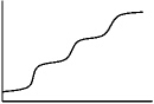
(Multiple Choice)
4.8/5 (81)
(81) When conducting a titration of an acid by adding base to the equivalence point, it is appropriate to use an indicator which has
(Multiple Choice)
4.8/5 (69)
(69) Which statement about the titration of 0.10 M HNO3 with 0.10 M KOH is not correct?
(Multiple Choice)
4.8/5 (83)
(83) A buffer solution is 0.080 M in lactic acid (Ka = 1.8 × 10⁻⁴) and 0.070 M in sodium lactate. The pH of the solution is
(Multiple Choice)
4.8/5 (78)
(78) Consider a buffer solution made up of H2PO4- and HPO42- For H2PO4-, Ka = 6.2 × 10⁻⁸. What mole ratio of HPO42- to H2PO4- will give a pH of 7.35?
(Multiple Choice)
4.9/5 (77)
(77) 
Filters
- Essay(0)
- Multiple Choice(0)
- Short Answer(0)
- True False(0)
- Matching(0)