



 Chat with AI
Exam 13: Chemical Equilibrium

Exam 1: The Nature of Chemistry68 Questions
Exam 2: Atoms and Elements66 Questions
Exam 3: Chemical Compounds65 Questions
Exam 4: Quantities of Reactants and Products65 Questions
Exam 5: Chemical Reactions66 Questions
Exam 6: Energy and Chemical Reactions55 Questions
Exam 7: Electron Configurations and the Periodic Table64 Questions
Exam 8: Covalent Bonding67 Questions
Exam 9: Molecular Structure53 Questions
Exam 10: Gases and the Atmosphere57 Questions
Exam 11: Liquids, Solids, and Materials46 Questions
Exam 12: Chemical Kinetics: Rates of Reactions66 Questions
Exam 13: Chemical Equilibrium57 Questions
Exam 14: The Chemistry of Solutes and Solutions57 Questions
Exam 15: Acids and Bases62 Questions
Exam 16: Additional Aqueous Equilibria52 Questions
Exam 17: Thermodynamics: Directionality of Chemical Reactions56 Questions
Exam 18: Electrochemistry and Its Applications54 Questions
Exam 19: Nuclear Chemistry53 Questions
Select questions type


Consider the equilibrium system 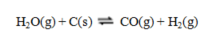 If C is removed, the equilibrium will ____, and if CO is added, the equilibrium will ____.
 (Multiple Choice)
4.9/5  (81)
(81) In a balanced chemical equation, if there is no net change in the total number of moles of gas from the reactant side to the product side, then
(Multiple Choice)
4.9/5 (73)
(73) If the reaction quotient, Q, is greater than the equilibrium constant, K, then
(Multiple Choice)
4.9/5 (73)
(73) Which of the following is not true for equilibrium constants?
(Multiple Choice)
4.9/5 (74)
(74) For the reaction 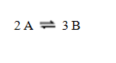 Kc = 1.37. If the concentrations of A and B are equal, what is the value of that concentration?
 (Multiple Choice)
4.8/5 (79)
(79) If the value of Kc for a given reaction at a given temperature is a large number, the energy of the products is likely to be ____ the energy of the reactants because ____.
(Multiple Choice)
4.8/5 (72)
(72) The equilibrium for a particular chemical reaction is dependent on the
(Multiple Choice)
4.7/5 (90)
(90) Consider the reaction
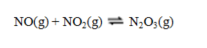 for which Kp = 2.00 at 20 C. A mixture of NO(g) at a partial pressure of 1.50 atm and NO2(g) at a partial pressure of 0.50 atm is allowed to come to equilibrium in a sealed container maintained at 20 C. What is the total pressure now?
The expression for
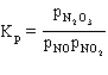 .
for which Kp = 2.00 at 20 C. A mixture of NO(g) at a partial pressure of 1.50 atm and NO2(g) at a partial pressure of 0.50 atm is allowed to come to equilibrium in a sealed container maintained at 20 C. What is the total pressure now?
The expression for
. (Essay)
4.8/5 (85)
(85) Consider the equilibrium reaction 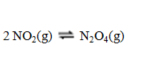 A sample of pure NO2(g) of concentration 0.140 M is allowed to come to equilibrium. It is then found that 57.0 % of the NO2(g) has reacted to form N2O4(g). What is the value of Kc?
 (Multiple Choice)
4.7/5 (87)
(87) Consider the gas-phase equilibrium A  B. In a series of experiments, different initial amounts of A and B are mixed together, and the mixture in each case allowed to come to equilibrium. Which one of these experiments would yield values for the amounts of A and B present at equilibrium different from all the other experiments?
 (Multiple Choice)
4.8/5 (95)
(95) A particular reaction mixture (Kp = 10) consisting of both gaseous reactants and products is analyzed and is determined to have a value of Q = 15. The pressure of the reaction mixture is then doubled by the addition of argon gas and the reaction is allowed to proceed to equilibrium. At equilibrium
(Multiple Choice)
4.9/5 (72)
(72) Consider the gas-phase equilibrium A  B. Certain amounts of A and B are mixed in a vessel. As they come to equilibrium
 (Multiple Choice)
4.9/5 (71)
(71) If a catalyst is added to a chemical reaction, the equilibrium yield of a product will be ____, and the time taken to come to equilibrium will be ____ than before.
(Multiple Choice)
4.9/5 (69)
(69) The equilibrium constant expression for the reverse of the reaction given below is 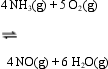
(Multiple Choice)
4.8/5 (67)
(67) 
Filters
- Essay(0)
- Multiple Choice(0)
- Short Answer(0)
- True False(0)
- Matching(0)