



 Chat with AI
Exam 13: Chemical Equilibrium

Exam 1: The Nature of Chemistry68 Questions
Exam 2: Atoms and Elements66 Questions
Exam 3: Chemical Compounds65 Questions
Exam 4: Quantities of Reactants and Products65 Questions
Exam 5: Chemical Reactions66 Questions
Exam 6: Energy and Chemical Reactions55 Questions
Exam 7: Electron Configurations and the Periodic Table64 Questions
Exam 8: Covalent Bonding67 Questions
Exam 9: Molecular Structure53 Questions
Exam 10: Gases and the Atmosphere57 Questions
Exam 11: Liquids, Solids, and Materials46 Questions
Exam 12: Chemical Kinetics: Rates of Reactions66 Questions
Exam 13: Chemical Equilibrium57 Questions
Exam 14: The Chemistry of Solutes and Solutions57 Questions
Exam 15: Acids and Bases62 Questions
Exam 16: Additional Aqueous Equilibria52 Questions
Exam 17: Thermodynamics: Directionality of Chemical Reactions56 Questions
Exam 18: Electrochemistry and Its Applications54 Questions
Exam 19: Nuclear Chemistry53 Questions
Select questions type


Once the reaction quotient, Q, has been determined for a reaction mixture, comparison with the value of the equilibrium constant, K, will determine
(Multiple Choice)
4.8/5  (78)
(78) For the reaction  Kc = 1.4 × 10¹⁵. In an equilibrium mixture, [A] = 0.45 M. What is the concentration of B?
 (Multiple Choice)
4.8/5 (79)
(79) If the equilibrium constants for the two reactions 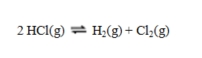 and
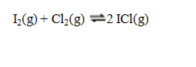 are denoted K1 and K2 respectively, then the equilibrium constant for the reaction
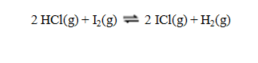 equals
and
are denoted K1 and K2 respectively, then the equilibrium constant for the reaction
equals (Multiple Choice)
4.8/5 (74)
(74) Concerning the Haber-Bosch for the synthesis of ammonia,  which of the following is true?
 (Multiple Choice)
4.8/5 (71)
(71) The reaction
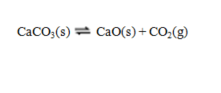 is the basis of a very ancient chemical industry. Seashells or chalk (limestone) are roasted in kilns to produce CaO (quicklime). When moistened and used in a mortar, this forms Ca(OH)2 (slaked lime). Atmospheric CO2 slowly converts this back to CaCO3. A strong bond thus results between the stones used in the wall.
a. Is the above reaction exothermic or endothermic? Explain.
b. Lime kilns, since ancient times, have been designed with efficient chimneys to draw exhaust gases away. In terms of Le Chatelier's Principle, give two reasons why this enhances the conversion of limestone to quicklime.
c. When a sample of CaCO3(s) is placed in a sealed, evacuated container, the equilibrium CO2 pressure at a given temperature is always the same, and is not influenced by the amount of CaCO3, provided that there is still some present at equilibrium. Explain why.
d. How would the result in Part c be affected by adding an equal number of moles of CaO to the flask? Explain.
is the basis of a very ancient chemical industry. Seashells or chalk (limestone) are roasted in kilns to produce CaO (quicklime). When moistened and used in a mortar, this forms Ca(OH)2 (slaked lime). Atmospheric CO2 slowly converts this back to CaCO3. A strong bond thus results between the stones used in the wall.
a. Is the above reaction exothermic or endothermic? Explain.
b. Lime kilns, since ancient times, have been designed with efficient chimneys to draw exhaust gases away. In terms of Le Chatelier's Principle, give two reasons why this enhances the conversion of limestone to quicklime.
c. When a sample of CaCO3(s) is placed in a sealed, evacuated container, the equilibrium CO2 pressure at a given temperature is always the same, and is not influenced by the amount of CaCO3, provided that there is still some present at equilibrium. Explain why.
d. How would the result in Part c be affected by adding an equal number of moles of CaO to the flask? Explain.
(Essay)
4.7/5 (75)
(75) For the reaction  Kc = 168. A mixture contains some C(s), [CO] = 0.50 M and [CO2] = 0.75 M. Therefore the system ____ at equilibrium, because ____.
 (Multiple Choice)
4.7/5 (74)
(74) This reaction is the basis for the Haber-Bosch process for the manufacture of ammonia: 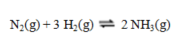 To maximize the yield of ammonia, the pressure ____ and the temperature____.
 (Multiple Choice)
4.9/5 (82)
(82) For a particular chemical reaction, which of the following will result in a change of the equilibrium constant?
(Multiple Choice)
4.8/5 (81)
(81) For the reaction  Kc = 0.0600 at a certain temperature. In an equilibrium mixture of the three gases, [NH3] = 0.242 M and [H2] = 1.03 M. What is the concentration of N2 in this system?
 (Multiple Choice)
4.8/5 (85)
(85) Consider the reaction 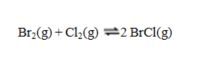 If the partial pressures in an equilibrium mixture of Br2, Cl2, and BrCl are 1.12 atm, 1.26 atm, and 3.14 atm, respectively, the value of Kp for this reaction at this temperature is
 (Multiple Choice)
4.7/5 (88)
(88) Consider the reaction 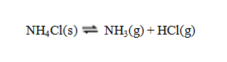 If the pressure is decreased on an equilibrium mixture of these three substances, equilibrium will ____, because ____.
 (Multiple Choice)
4.8/5 (72)
(72) Which statement concerning product-favored reactions is not correct?
(Multiple Choice)
4.9/5 (80)
(80) If a reaction is product-favored on the basis of enthalpy and reactant-favored on the basis of entropy, then it most likely is ____ and ____ net moles of gas.
(Multiple Choice)
5.0/5 (68)
(68) A weak acid is 5% ionized at equilibrium. Therefore we can say that the ionization reaction is ____-favored, because ____.
(Multiple Choice)
4.8/5 (78)
(78) The equilibrium constant for a particular chemical reaction is
(Multiple Choice)
4.8/5 (74)
(74) Consider the reaction
 for which
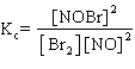 .
A sample of pure NOBr is isolated at low temperature. It is placed in a flask at a concentration of 0.200 M and warmed up to 50 C. When the reaction has come to equilibrium, the concentration of NOBr is 0.176 M. What is the value of Kc at 50 C for this reaction?
for which
.
A sample of pure NOBr is isolated at low temperature. It is placed in a flask at a concentration of 0.200 M and warmed up to 50 C. When the reaction has come to equilibrium, the concentration of NOBr is 0.176 M. What is the value of Kc at 50 C for this reaction? (Essay)
4.9/5 (82)
(82) For the reaction 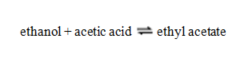 Kc = 0.95. A mixture of the three substances contains 0.45 M ethanol, 0.45 M acetic acid and 1.1 M ethyl acetate. Which statement is true?
 (Multiple Choice)
4.7/5 (83)
(83) 
Filters
- Essay(0)
- Multiple Choice(0)
- Short Answer(0)
- True False(0)
- Matching(0)