



 Chat with AI
Exam 9: Nontaxable Exchanges

Exam 1: Taxes and Taxing Jurisdictions85 Questions
Exam 2: Policy Standards for a Good Tax85 Questions
Exam 3: Taxes As Transaction Costs82 Questions
Exam 4: Maxims of Income Tax Planning92 Questions
Exam 5: Tax Research75 Questions
Exam 6: Taxable Income From Business Operations116 Questions
Exam 7: Property Acquisitions and Cost Recovery Deductions106 Questions
Exam 8: Property Dispositions110 Questions
Exam 9: Nontaxable Exchanges97 Questions
Exam 10: Sole Proprietorships, Partnerships, Llcs, and S Corporations72 Questions
Exam 11: The Corporate Taxpayer97 Questions
Exam 12: The Choice of Business Entity97 Questions
Exam 13: Jurisdictional Issues in Business Taxation102 Questions
Exam 14: The Individual Tax Formula113 Questions
Exam 15: Compensation and Retirement Planning107 Questions
Exam 16: Investment and Personal Financial Planning109 Questions
Exam 17: Tax Consequences of Personal Activities93 Questions
Exam 18: The Tax Compliance Process a Present Value of $1 B Present Value of Annuity of $1 C 2013 Income Tax Rates86 Questions
Select questions type


Perry Inc. and Dally Company entered into an exchange of real property. Here is the information for the properties to be exchanged. 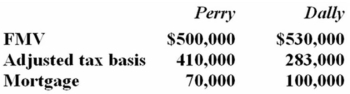 Pursuant to the exchange, Perry assumed the mortgage on the Dally property, and Dally assumed the mortgage on the Perry property. Compute Perry's gain recognized on the exchange and its tax basis in the property received from Dally.
 (Multiple Choice)
4.8/5  (84)
(84) Eliot Inc. transferred an old asset with a $53,100 adjusted tax basis plus $5,000 cash in exchange for a new asset worth $75,000. Which of the following statements is false?
(Multiple Choice)
4.9/5 (82)
(82) Qualifying property received in a nontaxable exchange has a cost basis for tax purposes.
(True/False)
4.9/5 (74)
(74) When unrelated parties agree to an exchange of noncash properties, the economic presumption is that the properties have the same adjusted book basis.
(True/False)
4.8/5 (76)
(76) The wash sale rule can result in the nonrecognition of both gains and losses.
(True/False)
5.0/5 (80)
(80) Rydell Company exchanged business equipment (initial cost $55,250; accumulated depreciation $25,450) for like-kind equipment worth $44,000 and $2,000 cash. As a result, Rydell must recognize:
(Multiple Choice)
4.7/5 (78)
(78) Itak Company transferred an old asset with a $44,300 adjusted tax basis in exchange for a new asset worth $48,000 and $3,000 cash. Which of the following statements is false?
(Multiple Choice)
4.9/5 (83)
(83) Vandals destroyed a business asset owned by L&L Company. L&L's adjusted tax basis in the asset was $60,800, and the reimbursement from its property insurance company was $90,000. L&L must pay at least $60,800 for a replacement asset in order to defer gain recognition on the involuntary conversion.
(True/False)
4.9/5 (73)
(73) All types of business and investment real properties are like-kind.
(True/False)
4.8/5 (83)
(83) In June, a fire completely destroyed office furniture owned by W&S Inc. W&S's adjusted tax basis in the furniture was $17,040. W&S received a $15,000 reimbursement from its property insurance company, and on August 8, it paid $16,000 to replace the furniture. Compute W&S's recognized gain on loss on the involuntary conversion and its tax basis in the new furniture.
(Multiple Choice)
4.7/5 (80)
(80) Mr. Lexon owns investment property with a $719,000 basis. If the property is worth only $500,000, Mr. Lexon would prefer a taxable disposition of the property over a like-kind exchange.
(True/False)
4.8/5 (76)
(76) Oxono Company realized a $74,900 gain on the exchange of one asset for another asset (no cash was included in the exchange). The assets were like-kind properties. Oxono reported the gain as revenue on its financial statements. Which of the following is true?
(Multiple Choice)
4.8/5 (89)
(89) Doppia Company transferred an old asset with a $68,750 adjusted tax basis in exchange for a new asset worth $90,000 and $10,000 cash. Which of the following statements is false?
(Multiple Choice)
4.8/5 (73)
(73) V&P Company exchanged unencumbered investment land for farmland subject to a $200,000 mortgage. If V&P realized a $168,000 gain on the exchange, it must recognize the entire gain.
(True/False)
4.8/5 (71)
(71) A taxpayer who transfers property for corporate stock can defer gain recognition only if the taxpayer owns at least 50% of the corporation's outstanding stock immediately after the exchange.
(True/False)
4.8/5 (70)
(70) YCM Inc. exchanged business equipment (initial cost $114,800; accumulated depreciation $63,400) for like-kind equipment worth $110,000 and $10,000 cash. As a result, Rydell must recognize:
(Multiple Choice)
4.8/5 (68)
(68) When unrelated parties agree to an exchange of noncash properties, the economic presumption is that the properties are of equal value.
(True/False)
4.8/5 (78)
(78) Loonis Inc. and Rhea Company formed LooNR Inc. by transferring business assets in exchange for 1,000 shares of LooNR common stock. Loonis transferred assets with a $820,000 FMV and a $444,000 adjusted tax basis and received 820 shares. Rhea transferred assets with a $180,000 FMV and a $75,000 adjusted tax basis and received 180 shares. Compute Loonis and Rhea's realized and recognized gain on the exchange.
(Multiple Choice)
4.7/5 (74)
(74) Mr. Weller and the Olson Partnership entered into an exchange of investment real property. Mr. Weller's property was subject to a $428,000 mortgage, which Olson assumed. Olson's property was subject to a $235,000 mortgage, which Mr. Weller assumed. Which of the following statements is true?
(Multiple Choice)
4.8/5 (79)
(79) Which of the following statements about the transfer of debt in a like-kind exchange is false?
(Multiple Choice)
4.8/5 (69)
(69) 
Filters
- Essay(0)
- Multiple Choice(0)
- Short Answer(0)
- True False(0)
- Matching(0)