



 Chat with AI
Exam 13: Jurisdictional Issues in Business Taxation

Exam 1: Taxes and Taxing Jurisdictions85 Questions
Exam 2: Policy Standards for a Good Tax85 Questions
Exam 3: Taxes As Transaction Costs82 Questions
Exam 4: Maxims of Income Tax Planning92 Questions
Exam 5: Tax Research75 Questions
Exam 6: Taxable Income From Business Operations116 Questions
Exam 7: Property Acquisitions and Cost Recovery Deductions106 Questions
Exam 8: Property Dispositions110 Questions
Exam 9: Nontaxable Exchanges97 Questions
Exam 10: Sole Proprietorships, Partnerships, Llcs, and S Corporations87 Questions
Exam 11: The Corporate Taxpayer97 Questions
Exam 12: The Choice of Business Entity97 Questions
Exam 13: Jurisdictional Issues in Business Taxation102 Questions
Exam 14: The Individual Tax Formula111 Questions
Exam 15: Compensation and Retirement Planning107 Questions
Exam 16: Investment and Personal Financial Planning104 Questions
Exam 17: Tax Consequences of Personal Activities93 Questions
Exam 18: The Tax Compliance Process86 Questions
Select questions type


International tax treaties generally allow a government to tax a non-resident firm that maintains a permanent residence in the treaty country.
(True/False)
4.8/5  (88)
(88) Supplies, Inc. does business in Georgia (6% tax rate) and Alabama (5% tax rate). All other factors being equal, the company will minimize state taxes if it increases the compensation paid to its employees in Alabama.
(True/False)
4.9/5 (81)
(81) The deemed paid foreign tax credit is available only to U.S. corporations that own 30% or more of the voting stock of a foreign corporation that paid dividends during the taxable year.
(True/False)
4.8/5 (74)
(74) Korn, Co. was incorporated in Delaware. It has production, distribution, and sales facilities in Kansas and Nebraska. All of Korn's customers reside in Kansas or Nebraska. Assume that both states use the UDITPA formula for apportionment of income. The corporation is investing in new equipment that cost $900,000. The equipment could be used in either the Kansas or Nebraska production facilities. Assume that Kansas' corporate income tax rate is 7% and Nebraska's is 8.5%. Should the equipment be placed in Kansas or Nebraska to minimize Korn's state income tax?
(Multiple Choice)
4.7/5 (78)
(78) The foreign tax credit is available for income taxes paid to a foreign country.
(True/False)
4.9/5 (78)
(78) Cross-crediting allows multinational corporations to use excess credits generated in low- tax jurisdictions to offset excess limitations generated in high-tax jurisdictions.
(True/False)
4.8/5 (85)
(85) In the United States, corporations are subject only to taxes imposed by the federal government.
(True/False)
4.8/5 (97)
(97) Pogo, Inc., which has a 34 percent marginal tax rate, owns 50 percent of the stock of a CFC. At the beginning of the year, Pogo's basis in the CFC stock was $2 million. The CFC's current year earnings were $750,000 of which $600,000 was subpart F income. The CFC paid no foreign income tax and distributed no dividends.
a. Explain Pogo's U.S. tax consequences with respect to its investment in the CFC.
b. Compute Pogo's basis in its CFC stock at the end of the year.
(Essay)
4.8/5 (81)
(81) Sunny, a California corporation, earned the following income this year.
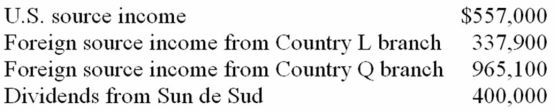 Sunny owns 100% of Sun de Sud, a foreign corporation operating a business in Country M and paying foreign income tax at a 50% rate. Sunny paid $124,000 foreign income tax to Country L, $203,000 income tax to Country Q, and no foreign withholding tax on its Sun de Sud dividends. Assuming a 34% tax rate, compute Sunny's U.S. tax.
 (Essay)
4.8/5 (82)
(82) A U.S. parent corporation that receives a dividend from a wholly-owned foreign subsidiary that pays a 45% income tax to its home country does not owe any U.S. tax on the dividend.
(True/False)
5.0/5 (64)
(64) The term "tax haven" refers to a foreign country that imposes an income tax at a rate higher than the U.S. rate.
(True/False)
5.0/5 (70)
(70) Albany, Inc. does business in states C and D. State C apportions income using an equally-weighted three-factor formula; state D uses an apportionment formula that double-weights the sales factor. Albany's before tax income is $3,000,000, and its sales, payroll, and property factors are as follows.
(Multiple Choice)
4.9/5 (91)
(91) Harris Corporation's before-tax income was $400,000. It does business entirely in Pennsylvania, which has a 6% corporate income tax. Compute Harris' federal income tax.
(Multiple Choice)
4.8/5 (73)
(73) Tri-State's, Inc. operates in Arkansas, Oklahoma, and Kansas. Assume that each state has adopted the UDITPA formula. During the corporation's tax year ended December 31, the apportionment data indicated:  Tri-State's income for the current year is $250,000. Approximately how much income will be taxed by Oklahoma?
 (Multiple Choice)
4.9/5 (81)
(81) The UDITPA formula for state income tax apportionment consists of three factors: sales, payroll, and profit.
(True/False)
4.8/5 (75)
(75) Galaxy Corporation conducts business in the U.S. and in Country X. In which of the following situations will Galaxy not be allowed a foreign tax credit for income taxes paid to Country X?
(Multiple Choice)
4.8/5 (86)
(86) The United States has jurisdiction to tax income earned by any foreign corporation that is a controlled subsidiary of a U.S. parent corporation.
(True/False)
4.8/5 (72)
(72) The income earned by a foreign branch operation of a U.S. corporation is taxable by the United States only when repatriated.
(True/False)
4.8/5 (79)
(79) Lilly Inc., a U.S. multinational with a 34% marginal tax rate, conducts a branch operation in a foreign country with a 25% income tax. This year, the branch generated $500,000 taxable income. What is the total tax burden (domestic and foreign) on the earnings of the branch operation?
(Multiple Choice)
4.9/5 (76)
(76) Non-resident firms selling tangible goods to in-state residents can use P.L. 86-272 to avoid having income tax nexus in a state.
(True/False)
4.8/5 (88)
(88) 
Filters
- Essay(0)
- Multiple Choice(0)
- Short Answer(0)
- True False(0)
- Matching(0)