



 Chat with AI
Exam 13: Monopolistic Competition and Oligopoly

Exam 1: An Introduction to Microeconomics95 Questions
Exam 2: Supply and Demand94 Questions
Exam 3: The Theory of Consumer Choice75 Questions
Exam 4: Individual and Market Demand100 Questions
Exam 5: Using Consumer Choice Theory85 Questions
Exam 6: Exchange, Efficiency, and Prices79 Questions
Exam 7: Production112 Questions
Exam 8: The Cost of Production121 Questions
Exam 9: Profit Maximization in Perfectly Competitive Markets97 Questions
Exam 10: Using the Competitive Model96 Questions
Exam 11: Monopoly112 Questions
Exam 12: Product Pricing With Monopoly Power89 Questions
Exam 13: Monopolistic Competition and Oligopoly98 Questions
Exam 14: Game Theory and the Economics of Information88 Questions
Exam 15: Using Noncompetitive Market Models78 Questions
Exam 16: Employment and Pricing of Inputs99 Questions
Exam 17: Wages, Rent, Interest, and Profit92 Questions
Exam 18: Using Input Market Analysis83 Questions
Exam 19: General Equilibrium Analysis and Economic Efficiency95 Questions
Exam 20: Public Goods and Externalities102 Questions
Select questions type


Which of the following is a defining characteristic of an oligopoly?
(Multiple Choice)
4.9/5  (88)
(88) Amazon.com,Starbucks,and eBay are all examples of firms that were the first to establish their presence in their respective markets.Would you consider any of these firms to be dominant in that they set the market price and other firms act as perfectly competitive firms using this market price?
(Essay)
4.9/5 (90)
(90) Which of the following is true of the Cournot duopoly model?
(Multiple Choice)
4.8/5 (92)
(92) How does the Stackelberg model of oligopoly differ from the dominant firm model?
(Multiple Choice)
4.8/5 (83)
(83) Figure 13-1 shows the Stackelberg model of a duopoly.Both firms face constant marginal costs equal to OJ and the market demand curve is AD.The Stackelberg firm produces an output of OF and OF is equal to FL.  -Refer to Figure 13-1.The difference between the total industry output produced under a perfect competition model and a Stackelberg model is represented by the distance _____.
 (Multiple Choice)
4.9/5 (64)
(64) Using a graph,show the equilibrium price and output for a perfectly competitive firm.If all the firms in the industry colluded to increase their profits,how would the equilibrium change for each firm? Assume that each firm produces an equal share of the industry output.
(Essay)
4.9/5 (68)
(68) If,in the Cournot model of a duopoly,the firms colluded instead of behaving independently:
(Multiple Choice)
5.0/5 (69)
(69) Which of the following would weaken the argument that monopolistically competitive firms should be regulated by the government?
(Multiple Choice)
5.0/5 (81)
(81) Suppose that most consumers who buy portable camping stoves buy the ones produced by Marshall and Blatt (M&B).Besides M&B,the portable stove market has a large number of smaller suppliers.The market demand curve for portable stoves is given by QD = 100 - 0.5P.The supply curve for all the other firms taken together is QS = 0.5P.M&B's total cost function has been estimated to be C = 5QM.Given that M&B sets output first,calculate how the total quantity supplied in the market is divided between M&B and the other firms.What is the price in the market?
(Essay)
5.0/5 (71)
(71) Which of the following is a key element of the Cournot model?
(Multiple Choice)
4.7/5 (72)
(72) A monopolistically competitive firm is considered to have excess capacity because it:
(Multiple Choice)
4.8/5 (57)
(57) A monopolistically competitive industry is characterized by:
(Multiple Choice)
4.9/5 (91)
(91) Unlike a monopolistically competitive market,firms in a perfectly competitive market:
(Multiple Choice)
4.8/5 (84)
(84) (
A)Assume two firms face a market demand curve of P = a - bQ,where a and b are positive constants,and marginal cost equals c for both firms.Fill in the following table,identify the respective points of equilibrium on the graph below,and explain the relevant characteristics of each model as you work through them. 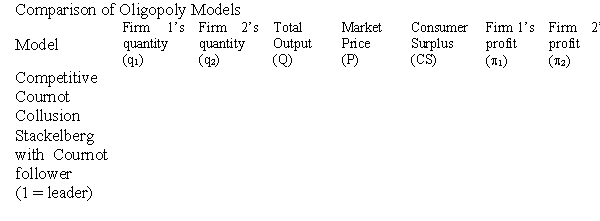
(Essay)
4.9/5 (87)
(87) 
Filters
- Essay(0)
- Multiple Choice(0)
- Short Answer(0)
- True False(0)
- Matching(0)