



 Chat with AI
Exam 7: The Analysis of Consumer Choice

Exam 1: Economics: The Study of Choice145 Questions
Exam 2: Confronting Scarcity: Choices in Production198 Questions
Exam 3: Demand and Supply251 Questions
Exam 4: Applications of Supply and Demand113 Questions
Exam 5: Elasticity: a Measure of Response255 Questions
Exam 6: Markets, Maximizers, and Efficiency239 Questions
Exam 7: The Analysis of Consumer Choice244 Questions
Exam 8: Production and Cost227 Questions
Exam 9: Competitive Markets for Goods and Services265 Questions
Exam 10: Monopoly234 Questions
Exam 11: The World of Imperfect Competition237 Questions
Exam 12: Wages and Employment in Perfect Competition189 Questions
Exam 13: Interest Rates and the Markets for Capital and Natural Resources170 Questions
Exam 14: Imperfectly Competitive Markets for Factors of Production183 Questions
Exam 15: Public Finance and Public Choice188 Questions
Exam 16: Antitrust Policy and Business Regulation137 Questions
Exam 17: International Trade186 Questions
Exam 18: The Economics of the Environment148 Questions
Exam 19: Inequality, Poverty, and Discrimination140 Questions
Select questions type


Jill Smith, a careful maximizer of utility, consumes only two goods, peanut butter and ice cream.She had just achieved the utility-maximizing solution in her consumption of the two goods when the price of peanut butter rose.As she adjusts to this event, she will consume:
(Multiple Choice)
4.8/5  (76)
(76) The Case in Point on P.O.W.camps stated that in situations where trade among the prisoners was allowed, in equilibrium the marginal rate of substitution between coffee and tea:
(Multiple Choice)
4.8/5 (75)
(75) Use the following for questions 61-69.

 -(Exhibit: Consumer Equilibrium 1) Assume that the price of both goods X and Y is $1 per unit, and you have $4 of income to spend on both goods.To maximize utility, you would consume ______ units of X and _______ units of Y.
 (Multiple Choice)
4.8/5 (90)
(90) Whatever the time period involved, a consumer's spending will be _______ by his or her _______ .
(Multiple Choice)
4.8/5 (74)
(74) Use the following for questions 23-27.
Exhibit: Total Utility and Marginal Utility from Consumption of Good A
 -(Exhibit: Total Utility and Marginal Utility from Consumption of Good A. If 2 units of A are consumed, the total utility received is _______ , and the marginal utility of the second unit is _______ .
 (Multiple Choice)
5.0/5 (75)
(75) The slope of a(n) _______ curve shows the rate at which two goods can be exchanged _______ the consumer's ________ .
(Multiple Choice)
4.9/5 (84)
(84) A decreasing marginal rate of substitution indicates that an indifference curve is:
(Multiple Choice)
4.8/5 (63)
(63) Use the following to answer question(s): Consumer Equilibrium 2
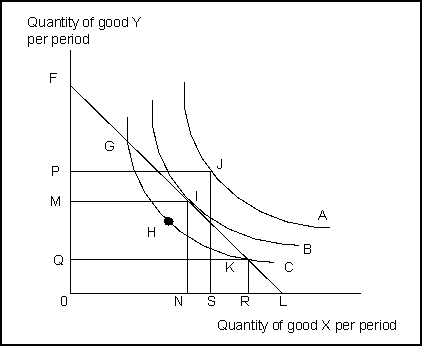 -(Exhibit: Consumer Equilibrium 2) The lowest level of total utility shown in the exhibit is associated with point _______ on curve _______ .
 (Multiple Choice)
4.9/5 (92)
(92) Suppose that the price of Cracker Jacks is 50 cents a box and the price of M&Ms is 25 cents a bag.If you have $10 to spend on both goods, the maximum quantity of M&Ms that you can purchase is ________ bags.
(Multiple Choice)
4.9/5 (81)
(81) Suppose that the price of Cracker Jacks is 50 cents a box and the price of M&Ms is 25 cents a bag.If you have $5 to spend and decide to purchase 8 boxes of Cracker Jacks, the maximum quantity of M&Ms that you can purchase is ________ bags.
(Multiple Choice)
4.8/5 (71)
(71) For a consumer to be in equilibrium, the marginal utilities of all goods must be equal.
(True/False)
4.8/5 (76)
(76) Use the following for questions 61-69.
-(Exhibit: Consumer Equilibrium 1) Assume that the price of both goods is $1 per unit, and you consume 3 units of good X and 3 units of good Y.To maximize utility, assuming that the goods are divisible, you would consume:
-(Exhibit: Consumer Equilibrium 1) Assume that the price of both goods is $1 per unit, and you consume 3 units of good X and 3 units of good Y.To maximize utility, assuming that the goods are divisible, you would consume: (Multiple Choice)
4.8/5 (84)
(84) Use the following for questions 61-69.
-(Exhibit: Consumer Equilibrium 1) Assume that the price of good X is $5 per unit, the price of good Y is $1 per unit, and you have $10 of income to spend on both goods.To maximize utility, you would consume _______ units of X and _______ units of Y.
-(Exhibit: Consumer Equilibrium 1) Assume that the price of good X is $5 per unit, the price of good Y is $1 per unit, and you have $10 of income to spend on both goods.To maximize utility, you would consume _______ units of X and _______ units of Y. (Multiple Choice)
4.8/5 (75)
(75) If a consumer derives more utility by spending an additional $1 on good X rather than on good Y, then:
(Multiple Choice)
4.9/5 (80)
(80) Suppose that the price of Cracker Jacks is 50 cents a box and the price of M&Ms is 25 cents a bag.If you have $10 to spend and decide to purchase 8 bags of M&Ms, the maximum quantity of Cracker Jacks that you can purchase is ________ boxes.
(Multiple Choice)
4.9/5 (77)
(77) If, for a particular consumer, the marginal utility of ties is greater than the marginal utility of shirts, this consumer should:
(Multiple Choice)
4.8/5 (80)
(80) If a consumer purchases a combination of commodities x and y such that MUₓ/Pₓ = 20 and MUᵧ/Pᵧ = 5, to maximize utility, the consumers should buy.
(Multiple Choice)
4.8/5 (82)
(82) 
Filters
- Essay(0)
- Multiple Choice(0)
- Short Answer(0)
- True False(0)
- Matching(0)