



 Chat with AI
Exam 23: Natural Resources, the Environment, and Climate Change

Exam 1: Economics: the Study of Opportunity Cost124 Questions
Exam 2: Supply and Demand204 Questions
Exam 3: The Concept of Elasticity and Consumer and Producer Surplus173 Questions
Exam 4: Firm Production, Cost, and Revenue158 Questions
Exam 5: Perfect Competition, Monopoly, and Economic Versus Normal Profit119 Questions
Exam 6: Every Macroeconomic Word You Ever Heard: Gross Domestic Product, Inflation, Unemployment, Recession, Depression201 Questions
Exam 7: Interest Rates and Present Value118 Questions
Exam 8: Aggregate Demand and Aggregate Supply110 Questions
Exam 9: Fiscal Policy66 Questions
Exam 10: Monetary Policy104 Questions
Exam 11: Federal Spending76 Questions
Exam 12: Federal Deficits, Surpluses, and the National Debt76 Questions
Exam 13: The Housing Bubble71 Questions
Exam 14: The Recession of 2007-2009: Causes and Policy Responses57 Questions
Exam 15: Is Economic Stagnation the New Normal42 Questions
Exam 16: Is the Fiscalsky Falling: An Examination of Unfunded Social Security, Medicare, and State and Local Pension Liabilities51 Questions
Exam 17: International Trade: Does It Jeopardize American Jobs86 Questions
Exam 18: International Finance and Exchange Rates77 Questions
Exam 19: The European Debt Crisis60 Questions
Exam 20: Economic Growth and Development60 Questions
Exam 21: Nafta, Gatt, Wto: Are Trade Agreements Good for Us42 Questions
Exam 22: The Line Between Legal and Illegal Goods71 Questions
Exam 23: Natural Resources, the Environment, and Climate Change73 Questions
Exam 24: Health Care87 Questions
Exam 25: Government-Provided Health Insurance: Medicaid, Medicare, and the Child Health Insurance Program79 Questions
Exam 26: The Economics of Prescription Drugs62 Questions
Exam 27: So You Want to Be a Lawyer: Economics and the Law62 Questions
Exam 28: The Economics of Crime62 Questions
Exam 29: Antitrust39 Questions
Exam 30: The Economics of Race and Discrimination60 Questions
Exam 31: Income and Wealth Inequality70 Questions
Exam 32: Farm Policy63 Questions
Exam 33: Minimum Wage60 Questions
Exam 34: Ticket Brokers and Ticket Scalping60 Questions
Exam 35: Rent Control31 Questions
Exam 36: Economics of K-12 Education55 Questions
Exam 37: Economics of College and University Education82 Questions
Exam 38: Poverty and Welfare69 Questions
Exam 39: Head Start44 Questions
Exam 40: Social Security60 Questions
Exam 41: Personal Income Taxes55 Questions
Exam 42: Energy Prices67 Questions
Exam 43: If We Build It, Will They Come and Other Sports Questions61 Questions
Exam 44: The Stock Market Crashes57 Questions
Exam 45: Unions66 Questions
Exam 46: Walmart: Always Low Prices and Low Wages- Always41 Questions
Exam 47: The Economic Impact of Casino Gambling39 Questions
Exam 48: The Economics of Terrorism43 Questions
Select questions type


The Obama Administration's proposed environmental policy of "Cap and Trade" would have
(Multiple Choice)
4.7/5  (83)
(83) Which of the following would economists label as an example of the "tragedy of the commons?"
(Multiple Choice)
4.8/5 (77)
(77) Suppose an ardent environmentalist sought to preserve limited natural resources for future generations, she would, more than likely be arguing that oil and gas companies use an inappropriately
(Multiple Choice)
5.0/5 (79)
(79) 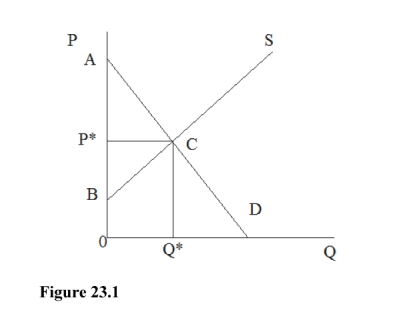 -In Figure 23.1 for a good with no externality, which area represents the total revenue to the producer?
 (Multiple Choice)
5.0/5 (91)
(91) Which of the following environmental problems is among the least easily solved?
(Multiple Choice)
4.9/5 (72)
(72) 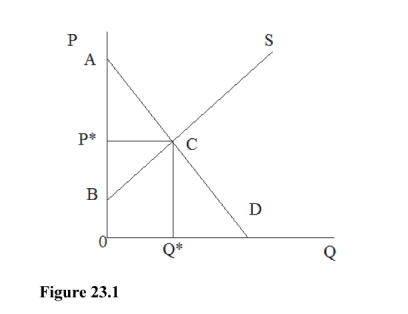 -In Figure 23.1 for a good with no externality, which area represents the total value to the consumer?
 (Multiple Choice)
4.8/5 (83)
(83) The Clean Air Act and the Clean Water Act were originally passed in
(Multiple Choice)
4.9/5 (83)
(83) If logging companies are allowed to harvest on public lands, economists use present value analysis to suggest that logging companies will
(Multiple Choice)
4.9/5 (85)
(85) If it costs Con Ed approximately $20 per additional ton of air pollution abated, but it costs PG&E only $10 per additional ton of air pollution abated and a marketable pollution permit trades for $14 per ton,
(Multiple Choice)
4.8/5 (89)
(89) Applying the concept of "clean enough" to climate change, an economist means the
(Multiple Choice)
4.9/5 (88)
(88) 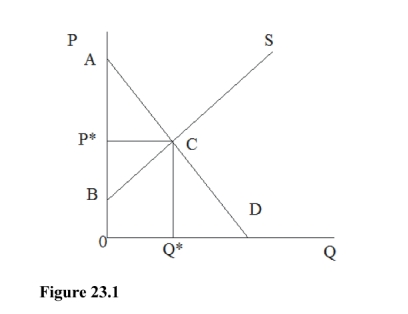 -In Figure 23.1 for a good with no externality, which area represents the total variable cost to the producer?
 (Multiple Choice)
4.9/5 (79)
(79) 
Filters
- Essay(0)
- Multiple Choice(0)
- Short Answer(0)
- True False(0)
- Matching(0)