



 Chat with AI
Exam 45: Unions

Exam 1: Economics: the Study of Opportunity Cost124 Questions
Exam 2: Supply and Demand204 Questions
Exam 3: The Concept of Elasticity and Consumer and Producer Surplus173 Questions
Exam 4: Firm Production, Cost, and Revenue158 Questions
Exam 5: Perfect Competition, Monopoly, and Economic Versus Normal Profit119 Questions
Exam 6: Every Macroeconomic Word You Ever Heard: Gross Domestic Product, Inflation, Unemployment, Recession, Depression201 Questions
Exam 7: Interest Rates and Present Value118 Questions
Exam 8: Aggregate Demand and Aggregate Supply110 Questions
Exam 9: Fiscal Policy66 Questions
Exam 10: Monetary Policy104 Questions
Exam 11: Federal Spending76 Questions
Exam 12: Federal Deficits, Surpluses, and the National Debt76 Questions
Exam 13: The Housing Bubble71 Questions
Exam 14: The Recession of 2007-2009: Causes and Policy Responses57 Questions
Exam 15: Is Economic Stagnation the New Normal42 Questions
Exam 16: Is the Fiscalsky Falling: An Examination of Unfunded Social Security, Medicare, and State and Local Pension Liabilities51 Questions
Exam 17: International Trade: Does It Jeopardize American Jobs86 Questions
Exam 18: International Finance and Exchange Rates77 Questions
Exam 19: The European Debt Crisis60 Questions
Exam 20: Economic Growth and Development60 Questions
Exam 21: Nafta, Gatt, Wto: Are Trade Agreements Good for Us42 Questions
Exam 22: The Line Between Legal and Illegal Goods71 Questions
Exam 23: Natural Resources, the Environment, and Climate Change73 Questions
Exam 24: Health Care87 Questions
Exam 25: Government-Provided Health Insurance: Medicaid, Medicare, and the Child Health Insurance Program79 Questions
Exam 26: The Economics of Prescription Drugs62 Questions
Exam 27: So You Want to Be a Lawyer: Economics and the Law62 Questions
Exam 28: The Economics of Crime62 Questions
Exam 29: Antitrust39 Questions
Exam 30: The Economics of Race and Discrimination60 Questions
Exam 31: Income and Wealth Inequality70 Questions
Exam 32: Farm Policy63 Questions
Exam 33: Minimum Wage60 Questions
Exam 34: Ticket Brokers and Ticket Scalping60 Questions
Exam 35: Rent Control31 Questions
Exam 36: Economics of K-12 Education55 Questions
Exam 37: Economics of College and University Education82 Questions
Exam 38: Poverty and Welfare69 Questions
Exam 39: Head Start44 Questions
Exam 40: Social Security60 Questions
Exam 41: Personal Income Taxes55 Questions
Exam 42: Energy Prices67 Questions
Exam 43: If We Build It, Will They Come and Other Sports Questions61 Questions
Exam 44: The Stock Market Crashes57 Questions
Exam 45: Unions66 Questions
Exam 46: Walmart: Always Low Prices and Low Wages- Always41 Questions
Exam 47: The Economic Impact of Casino Gambling39 Questions
Exam 48: The Economics of Terrorism43 Questions
Select questions type


A union model changes the market form from that of perfect competition to that of a
(Multiple Choice)
4.9/5  (81)
(81) 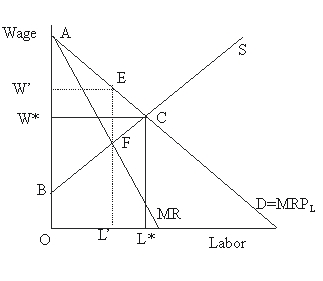 Figure 45.4
-In Figure 45.4, when compared to the perfectly competitive equilibrium, the wage paid to employees as a result of unionization
Figure 45.4
-In Figure 45.4, when compared to the perfectly competitive equilibrium, the wage paid to employees as a result of unionization (Multiple Choice)
4.9/5 (73)
(73) 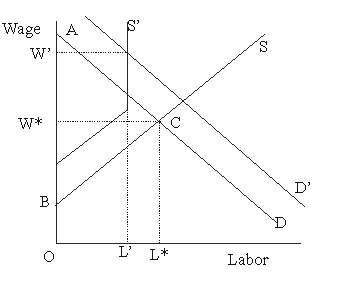 Figure 45.3
-In Figure 45.3, the fact that there is a limit on the number of workers that can be certified is shown by
Figure 45.3
-In Figure 45.3, the fact that there is a limit on the number of workers that can be certified is shown by (Multiple Choice)
4.8/5 (76)
(76) 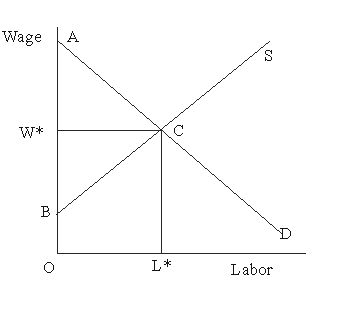 Figure 45.1
-In Figure 45.1, the added revenue that employers bring in from the work of their employees at the equilibrium wage-labor combination is
Figure 45.1
-In Figure 45.1, the added revenue that employers bring in from the work of their employees at the equilibrium wage-labor combination is (Multiple Choice)
4.8/5 (88)
(88) The percentage of workers represented by unions reached its peak in the
(Multiple Choice)
4.8/5 (79)
(79) Which of the following explains why private employers (more frequently than public employers)have tended to shift away from defined benefit programs?
(Multiple Choice)
4.8/5 (85)
(85) 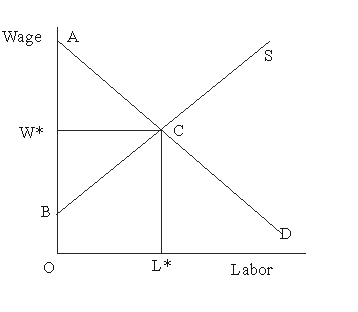 Figure 45.1
-In Figure 45.1, the (producer)surplus that employees get at the equilibrium wage-labor combination is
Figure 45.1
-In Figure 45.1, the (producer)surplus that employees get at the equilibrium wage-labor combination is (Multiple Choice)
4.9/5 (69)
(69) A company town model changes the market form from that of perfect competition to that of a
(Multiple Choice)
4.7/5 (64)
(64) 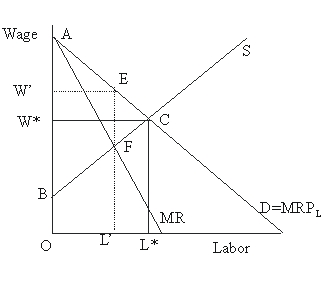 Figure 45.4
-In Figure 45.4, when compared to the perfectly competitive equilibrium, the number of workers hired as a result of unionization
Figure 45.4
-In Figure 45.4, when compared to the perfectly competitive equilibrium, the number of workers hired as a result of unionization (Multiple Choice)
4.7/5 (80)
(80) 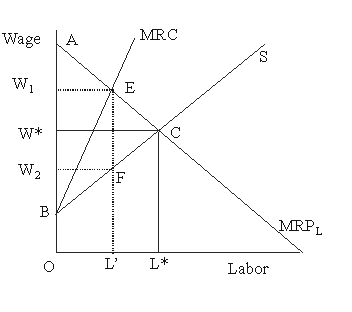 Figure 45.2
-In Figure 45.2, at the perfectly competitive equilibrium, the number of workers hired will be
Figure 45.2
-In Figure 45.2, at the perfectly competitive equilibrium, the number of workers hired will be (Multiple Choice)
4.9/5 (85)
(85) The percentage of government workers that are unionized ________ the percentage of private workers that are unionized.
(Multiple Choice)
4.8/5 (84)
(84) The current percentage of the total work force represented by unions is approximately
(Multiple Choice)
4.9/5 (74)
(74) Private employees (more frequently than public employees)tend to have their private retirements in
(Multiple Choice)
4.7/5 (94)
(94) 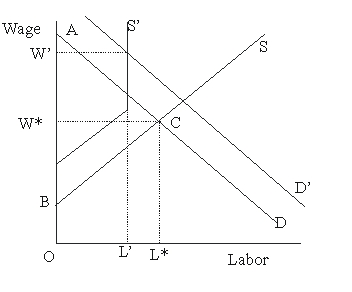 Figure 45.3
-In Figure 45.3, the fact that workers must pay for their apprenticeship in order to be certified is shown by
Figure 45.3
-In Figure 45.3, the fact that workers must pay for their apprenticeship in order to be certified is shown by (Multiple Choice)
4.9/5 (78)
(78) A labor system whereby a limited number of workers can be certified to work in a particular field but are of higher ability because of the training necessary for certification will cause
(Multiple Choice)
4.9/5 (70)
(70) The use of the supply and demand model to analyze labor markets implicitly assumes that there is ____ governing the labor market.
(Multiple Choice)
4.8/5 (85)
(85) In 2005, the membership of the AFL-CIO changed significantly when the
(Multiple Choice)
4.9/5 (80)
(80) The 2005 dispute between the Teamsters and the AFL-CIO centered around whether union
(Multiple Choice)
4.8/5 (79)
(79) 
Filters
- Essay(0)
- Multiple Choice(0)
- Short Answer(0)
- True False(0)
- Matching(0)