



 Chat with AI
Exam 2: The Market System and the Circular Flow

Exam 1: Limits, Alternatives, and Choices398 Questions
Exam 2: The Market System and the Circular Flow252 Questions
Exam 3: Demand, Supply, and Market Equilibrium339 Questions
Exam 4: Market Failures: Public Goods and Externalities235 Questions
Exam 5: Governments Role and Government Failure275 Questions
Exam 6: Elasticity255 Questions
Exam 7: Utility Maximization256 Questions
Exam 8: Behavioral Economics274 Questions
Exam 9: Businesses and the Costs of Production307 Questions
Exam 10: Pure Competition in the Short Run167 Questions
Exam 11: Pure Competition in the Long Run182 Questions
Exam 12: Pure Monopoly224 Questions
Exam 13: Monopolistic Competition194 Questions
Exam 14: Oligopoly and Strategic Behavior265 Questions
Exam 15: Technology, Rd, and Efficiency231 Questions
Exam 16: The Demand for Resources244 Questions
Exam 17: Wage Determination308 Questions
Exam 18: Rent, Interest, and Profit210 Questions
Exam 19: Natural Resource and Energy Economics290 Questions
Exam 20: Public Finance: Expenditures and Taxes232 Questions
Exam 21: Antitrust Policy and Regulation237 Questions
Exam 22: Agriculture: Economics and Policy217 Questions
Exam 23: Income Inequality, Poverty, and Discrimination272 Questions
Exam 24: Health Care240 Questions
Exam 25: Immigration197 Questions
Exam 26: International Trade241 Questions
Exam 27: The Balance of Payments, Exchange Rates, and Trade Deficits252 Questions
Exam 28: The Economics of Developing Countries249 Questions
Select questions type


In a market system, entrepreneurs start businesses in order to earn a high salary.
(True/False)
4.8/5  (74)
(74) The distribution of income in a market system is a primary factor that resolves which of the following fundamental economic questions?
(Multiple Choice)
4.8/5 (88)
(88) Even with the use of money, exchange and trade cannot occur if there is no coincidence of wants.
(True/False)
4.8/5 (78)
(78) The following table illustrates alternative production techniques for producing 18 widgets that can be sold for $1 each for a total revenue of $18.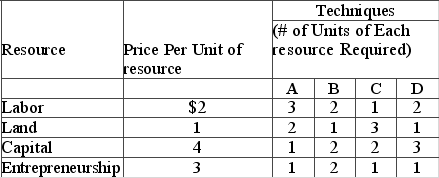 If the price of labor increases from $2 to $3, then the results of using Technique C will change from an economic
 (Multiple Choice)
4.8/5 (89)
(89) In terms of the circular flow diagram, businesses obtain revenue through the market and make expenditures in the market.
(Multiple Choice)
4.9/5 (80)
(80) The choice of the most efficient production technique is not affected by how much buyers want to buy the product.
(True/False)
4.9/5 (84)
(84) Which of the following is assumed to be most limited in scope under a market system?
(Multiple Choice)
4.7/5 (82)
(82) Government bailouts of failing businesses, like banks during the recent economic crisis, will tend to reduce the motivation among entrepreneurs to make prudent decisions is dealing with business risk.
(True/False)
4.9/5 (91)
(91) Suppose a firm can produce 70 units of a product, Zenia, by combining labor, land, capital, and entrepreneurial ability, as in the four alternative techniques shown in the table below. Assume further that the firm can hire labor at $3 per unit, land at $3 per unit, capital at $6 per unit, and entrepreneurship at $9 per unit. 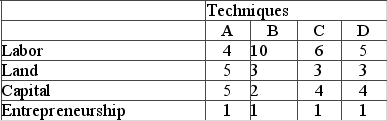 Refer to the provided table. If the price of labor declines from $3 to $2 per unit, then what is the least costly way of producing Zenias?
 (Multiple Choice)
4.9/5 (68)
(68) Payments that a firm makes to obtain needed resources comprise its
(Multiple Choice)
4.7/5 (79)
(79) The problems of central planning become less complex as an economy grows in size over time.
(True/False)
4.7/5 (64)
(64) Which of the following is not a typical characteristic of a market system?
(Multiple Choice)
4.8/5 (75)
(75) In the circular flow model of the market system, households' major role is to
(Multiple Choice)
4.7/5 (92)
(92) In the circular flow model, households earn their incomes in the
(Multiple Choice)
5.0/5 (92)
(92) Which of the following is the main problem with the barter system of exchange?
(Multiple Choice)
4.8/5 (83)
(83) 
Filters
- Essay(0)
- Multiple Choice(0)
- Short Answer(0)
- True False(0)
- Matching(0)