



 Chat with AI
Exam 5: Governments Role and Government Failure

Exam 1: Limits, Alternatives, and Choices398 Questions
Exam 2: The Market System and the Circular Flow252 Questions
Exam 3: Demand, Supply, and Market Equilibrium339 Questions
Exam 4: Market Failures: Public Goods and Externalities235 Questions
Exam 5: Governments Role and Government Failure275 Questions
Exam 6: Elasticity255 Questions
Exam 7: Utility Maximization256 Questions
Exam 8: Behavioral Economics274 Questions
Exam 9: Businesses and the Costs of Production307 Questions
Exam 10: Pure Competition in the Short Run167 Questions
Exam 11: Pure Competition in the Long Run182 Questions
Exam 12: Pure Monopoly224 Questions
Exam 13: Monopolistic Competition194 Questions
Exam 14: Oligopoly and Strategic Behavior265 Questions
Exam 15: Technology, Rd, and Efficiency231 Questions
Exam 16: The Demand for Resources244 Questions
Exam 17: Wage Determination308 Questions
Exam 18: Rent, Interest, and Profit210 Questions
Exam 19: Natural Resource and Energy Economics290 Questions
Exam 20: Public Finance: Expenditures and Taxes232 Questions
Exam 21: Antitrust Policy and Regulation237 Questions
Exam 22: Agriculture: Economics and Policy217 Questions
Exam 23: Income Inequality, Poverty, and Discrimination272 Questions
Exam 24: Health Care240 Questions
Exam 25: Immigration197 Questions
Exam 26: International Trade241 Questions
Exam 27: The Balance of Payments, Exchange Rates, and Trade Deficits252 Questions
Exam 28: The Economics of Developing Countries249 Questions
Select questions type


Answer the question on the basis of this table showing the marginal benefit that a particular public project will provide to each of the three members of a community. No vote trading is allowed. 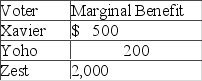 If the tax cost of this proposed project is $300 per person, a majority vote will
 (Multiple Choice)
4.9/5  (76)
(76) The concept of limited and bundled choice, as used in public choice theory, refers to the fact that
(Multiple Choice)
4.8/5 (75)
(75) Nobody gains from pork-barrel politics other than the politicians.
(True/False)
4.7/5 (79)
(79) Proponents of deregulation point to all of the following industries as examples of successful deregulation except for
(Multiple Choice)
4.9/5 (70)
(70) In presidential elections, voters often find that they do not agree with any single candidate on all the issues that matter to them (the voters). This is known as the
(Multiple Choice)
4.9/5 (84)
(84) The "pork" in pork-barrel politics refers to government projects that politicians try to secure in favor of the common good for the whole nation.
(True/False)
4.8/5 (88)
(88) Economists widely support deregulation of industries that tend toward monopoly or generate substantial negative externalities.
(True/False)
4.9/5 (78)
(78) If a public good provides social benefits that are greater than its costs, then the majority of voters would always vote in favor of producing the good.
(True/False)
4.8/5 (77)
(77) What is a likely explanation for why the budget of a government agency might increase beyond its optimal size?
(Multiple Choice)
4.9/5 (69)
(69) Special-interest groups result from people with strong preferences on a particular issue banding together to let policymakers know their preferences and could thereby lead to efficient outcomes.
(True/False)
5.0/5 (86)
(86) Government in a market system can increase economic efficiency by collecting taxes in order to subsidize the production of
(Multiple Choice)
4.7/5 (96)
(96) When politicians support policies such as imposing punitive tariffs on imports, which are popular among voters but which also reduce economic efficiency, we refer to this as
(Multiple Choice)
4.9/5 (73)
(73) Which of the following is a key difference between the economic activities of government and those of private firms?
(Multiple Choice)
4.9/5 (87)
(87) Deregulation of an industry will always lead to an improvement in economic efficiency.
(True/False)
4.9/5 (93)
(93) The idea of government failure includes all of the following except
(Multiple Choice)
4.7/5 (76)
(76) Majority voting produces efficient outcomes because it takes into account the strength of the preferences of individual voters.
(True/False)
4.8/5 (77)
(77) In what way, if any, does the invisible hand affect government resource allocation?
(Multiple Choice)
4.8/5 (85)
(85) The situation where "the few who yell the loudest get heard" is referred to as the
(Multiple Choice)
4.8/5 (69)
(69) 
Filters
- Essay(0)
- Multiple Choice(0)
- Short Answer(0)
- True False(0)
- Matching(0)