



 Chat with AI
Exam 9: Businesses and the Costs of Production

Exam 1: Limits, Alternatives, and Choices398 Questions
Exam 2: The Market System and the Circular Flow252 Questions
Exam 3: Demand, Supply, and Market Equilibrium339 Questions
Exam 4: Market Failures: Public Goods and Externalities235 Questions
Exam 5: Governments Role and Government Failure275 Questions
Exam 6: Elasticity255 Questions
Exam 7: Utility Maximization256 Questions
Exam 8: Behavioral Economics274 Questions
Exam 9: Businesses and the Costs of Production307 Questions
Exam 10: Pure Competition in the Short Run167 Questions
Exam 11: Pure Competition in the Long Run182 Questions
Exam 12: Pure Monopoly224 Questions
Exam 13: Monopolistic Competition194 Questions
Exam 14: Oligopoly and Strategic Behavior265 Questions
Exam 15: Technology, Rd, and Efficiency231 Questions
Exam 16: The Demand for Resources244 Questions
Exam 17: Wage Determination308 Questions
Exam 18: Rent, Interest, and Profit210 Questions
Exam 19: Natural Resource and Energy Economics290 Questions
Exam 20: Public Finance: Expenditures and Taxes232 Questions
Exam 21: Antitrust Policy and Regulation237 Questions
Exam 22: Agriculture: Economics and Policy217 Questions
Exam 23: Income Inequality, Poverty, and Discrimination272 Questions
Exam 24: Health Care240 Questions
Exam 25: Immigration197 Questions
Exam 26: International Trade241 Questions
Exam 27: The Balance of Payments, Exchange Rates, and Trade Deficits252 Questions
Exam 28: The Economics of Developing Countries249 Questions
Select questions type


If a firm produces 10 units of output, total costs are $1,030, and average fixed costs are $10, then total variable costs are
(Multiple Choice)
4.8/5  (77)
(77) Suppose a firm is in a range of production where it is experiencing economies of scale. Knowing this, we can predict that
(Multiple Choice)
4.9/5 (68)
(68) If a firm decides to produce no output in the short run, its costs will be
(Multiple Choice)
4.8/5 (83)
(83) If an industry's long-run average total cost curve has an extended range of constant returns to scale, this implies that
(Multiple Choice)
4.7/5 (87)
(87) If the minimum efficient scale in an industry were smaller than the size of the market of that industry, then we would have a natural-monopoly situation.
(True/False)
4.7/5 (89)
(89) In the short run, which of the following statements is correct?
(Multiple Choice)
4.9/5 (89)
(89) Plant sizes get larger as you move from ATC-1 to ATC-4. 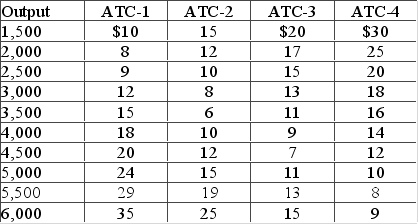 The firm's minimum efficient scale is at what output level?
 (Multiple Choice)
4.9/5 (79)
(79) The main difference between the short run and the long run is that
(Multiple Choice)
4.9/5 (84)
(84) Answer the question on the basis of the following cost data. Output Average Fixed Cost Average Variable Cost 1 \ 50.00 \ 100.00 2 25.00 80.00 3 16.67 66.67 4 12.50 65.00 5 10.00 68.00 6 8.37 73.33 7 7.14 80.00 8 6.25 87.50 The marginal cost of the fifth unit of output is
(Multiple Choice)
4.7/5 (83)
(83) 
Filters
- Essay(0)
- Multiple Choice(0)
- Short Answer(0)
- True False(0)
- Matching(0)