



 Chat with AI
Exam 5: Cost Behavior Cost-Volume-Profit Analysis

Exam 1: Managerial Accounting Concepts and Principles250 Questions
Exam 2: Job Order Costing and Analysis217 Questions
Exam 3: Process Costing and Analysis230 Questions
Exam 4: Activity Based Costing and Analysis220 Questions
Exam 5: Cost Behavior Cost-Volume-Profit Analysis247 Questions
Exam 6: Variable Costing and Analysis201 Questions
Exam 7: Master Budgets and Performance Planning213 Questions
Exam 8: Flexible Budgets and Standard Costs222 Questions
Exam 9: Performance Measurement and Responsibility Accounting208 Questions
Exam 10: Relevant Costing for Managerial Decisions117 Questions
Exam 11: Capital Budgeting and Investment Analysis159 Questions
Exam 12: Reporting Cash Flows239 Questions
Exam 13: Analysis of Financial Statements233 Questions
Exam 14: Time Value of Money84 Questions
Exam 15: Analyzing for Business Transactions250 Questions
Exam 16: Partnership Accounting179 Questions
Select questions type


Under variable costing, only costs that change in total with changes in production levels are included in product costs.
(True/False)
4.9/5  (82)
(82) The following information is available for Alba Company's maintenance cost over the last four months.
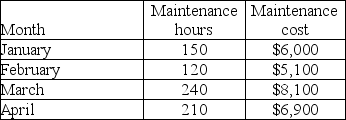 Use the high-low method to estimate both the fixed and variable component of its maintenance cost.
 (Essay)
4.9/5 (76)
(76) McCoy Brothers manufactures and sells two products, A and Z in the ratio of 5:2. Product A sells for $75; Z sells for $95. Variable costs for product A are $35; for Z $40. Fixed costs are $418,500. Compute the number of units of Product A McCoy must sell to break even.
(Multiple Choice)
4.9/5 (86)
(86) Kent Manufacturing produces a product that sells for $50.00 and has variable costs of $24.00 per unit. Fixed costs are $260,000. Kent can buy a new production machine that will increase fixed costs by $11,400 per year, but will decrease variable costs by $3.50 per unit. Compute the revised break-even point in units if the new machine is purchased.
(Multiple Choice)
4.8/5 (74)
(74) Cost-volume-profit analysis is based on necessary assumptions. Which of the following is not one of these assumptions?
(Multiple Choice)
4.9/5 (79)
(79) McCoy Brothers manufactures and sells two products, A and Z in the ratio of 5:2. Product A sells for $75; Z sells for $95. Variable costs for product A are $35; for Z $40. Fixed costs are $418,500. Compute the contribution margin per composite unit.
(Multiple Choice)
4.7/5 (74)
(74) Carver Packing Company reports total contribution margin of $72,000 and pretax net income of $24,000 for the current month. In the next month, the company expects sales volume to increase by 8%. The degree of operating leverage and the expected percent change in income, respectively, are:
(Multiple Choice)
4.8/5 (78)
(78) Barclay Enterprises manufactures and sells three distinct styles of bicycles: the Youth model sells for $300 and has a unit contribution margin of $105; the Adult model sells for $850 and has a unit contribution margin of $450; and the Recreational model sells for $1,000 and has a unit contribution margin of $500. The company's sales mix includes: 5 Youth models; 9 Adult models; and 6 Recreational models. If the firm's annual fixed costs total $6,500,000, calculate the firm's break-even point in composite units (rounded to the nearest whole unit).
(Multiple Choice)
4.9/5 (82)
(82) Solving problems to determine the relationship of cost, volume, and profit often commences with the measurement of the ________ point. Further analysis emphasizing profitability may be accomplished by measuring the ________ and ________.
(Essay)
4.9/5 (78)
(78) Elk Co. manufactures a product that sells for $12 per unit. Total fixed costs are $96,000 and variable costs are $7 per unit. Elk can buy a newer production machine that will increase total fixed costs by $22,800 but variable costs will be decreased by $0.40 per unit. What effect would the purchase of the new machine have on Elk's break-even point in units?
(Essay)
4.8/5 (73)
(73) Total fixed costs change in proportion to changes in volume of activity.
(True/False)
4.9/5 (73)
(73) A company has fixed costs of $270,000, a unit contribution margin of $14, and a contribution margin ratio of 55%. If the firm wants to earn a target $60,000 pretax income, what amount of sales must the company make (rounded to the nearest whole dollar)?
(Multiple Choice)
4.8/5 (74)
(74) Degree of operating leverage (DOL) is defined as total contribution margin in dollars divided by pretax income.
(True/False)
4.9/5 (89)
(89) The following data relate to a product sold by Hallstone Company:
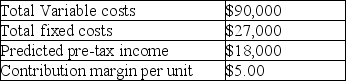 (a) Calculate the number of units expected to be sold.
(b) Calculate the expected total dollar sales.
(a) Calculate the number of units expected to be sold.
(b) Calculate the expected total dollar sales. (Essay)
4.8/5 (85)
(85) A cost-volume-profit (CVP) chart is a graph that plots number of units produced on the horizontal axis and dollars of costs and sales on the vertical axis.
(True/False)
4.8/5 (89)
(89) Cost-volume-profit analysis cannot be used when a firm produces and sells more than one product.
(True/False)
4.9/5 (86)
(86) Henderson Co. has fixed costs of $36,000 and a contribution margin ratio of 24%. If expected sales are $200,000, what is the margin of safety as a percent of sales?
(Multiple Choice)
4.9/5 (91)
(91) Flannigan Company manufactures and sells a single product that sells for $450 per unit; variable costs are $270. Annual fixed costs are $800,000. Current sales volume is $4,200,000. Flannigan Company management targets an annual pre-tax income of $1,125,000. Compute the unit sales to earn the target pre-tax net income.
(Multiple Choice)
4.9/5 (80)
(80) An important tool in predicting the volume of activity, the costs to be incurred, the sales to be made, and the profit to be earned is:
(Multiple Choice)
4.9/5 (86)
(86) 
Filters
- Essay(0)
- Multiple Choice(0)
- Short Answer(0)
- True False(0)
- Matching(0)