



 Chat with AI
Exam 5: Cost Behavior Cost-Volume-Profit Analysis

Exam 1: Managerial Accounting Concepts and Principles250 Questions
Exam 2: Job Order Costing and Analysis217 Questions
Exam 3: Process Costing and Analysis230 Questions
Exam 4: Activity Based Costing and Analysis220 Questions
Exam 5: Cost Behavior Cost-Volume-Profit Analysis247 Questions
Exam 6: Variable Costing and Analysis201 Questions
Exam 7: Master Budgets and Performance Planning213 Questions
Exam 8: Flexible Budgets and Standard Costs222 Questions
Exam 9: Performance Measurement and Responsibility Accounting208 Questions
Exam 10: Relevant Costing for Managerial Decisions117 Questions
Exam 11: Capital Budgeting and Investment Analysis159 Questions
Exam 12: Reporting Cash Flows239 Questions
Exam 13: Analysis of Financial Statements233 Questions
Exam 14: Time Value of Money84 Questions
Exam 15: Analyzing for Business Transactions250 Questions
Exam 16: Partnership Accounting179 Questions
Select questions type


The following information describes a product expected to be produced and sold by Quark Corporation:
Selling price $33 per unit
Variable costs $27 per unit
Total Fixed costs $855,000 per year
Required:
(a) Calculate the contribution margin per unit.
(b) Calculate the break-even point in units.
(Essay)
4.8/5  (63)
(63) Fuschia Company's contribution margin per unit is $12. Total fixed costs are $84,000. What is Fuschia's break-even point in units?
(Multiple Choice)
4.8/5 (92)
(92) Describe what happens to the net income of a company under each of the following assumptions: (a) Units sold are less than break-even units. (b) Units sold are greater than break-even units. (c) Units sold are equal to the break-even units.
(Essay)
4.9/5 (80)
(80) During March, a firm expects its total sales to be $160,000, its total variable costs to be $95,000, and its total fixed costs to be $25,000. The contribution margin for March is:
(Multiple Choice)
5.0/5 (77)
(77) Mott Company's sales mix is 3 units of A, 2 units of B, and 1 unit of C. Selling prices for each product are $20, $30, and $40, respectively. Variable costs per unit are $12, $18, and $24, respectively. Fixed costs are $320,000. What is the break-even point in composite units?
(Multiple Choice)
4.8/5 (83)
(83) The following information is available for a company's utility cost for operating its machines over the last four months. 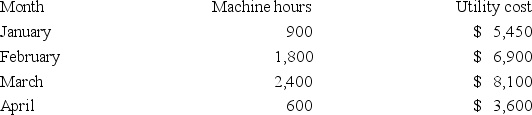 Using the high-low method, the estimated variable cost per unit for utilities is:
 (Multiple Choice)
4.7/5 (89)
(89) A graphic depiction of the break-even point is known as a cost-volume-profit (CVP) chart.
(True/False)
4.9/5 (88)
(88) A company sells a single product that has a contribution margin ratio of 28%. If the company's total fixed costs are $84,000, what is the break-even point in dollar sales?
(Essay)
4.8/5 (79)
(79) A firm expects to sell 25,000 units of its product at $11 per unit and to incur variable costs per unit of $6. Total fixed costs are $70,000. The total contribution margin is:
(Multiple Choice)
4.7/5 (76)
(76) Managers can use variable costing information for internal decision making, but they must use absorption costing for external reporting purposes.
(True/False)
4.8/5 (86)
(86) A firm sells two products, Regular and Ultra. For every unit of Regular the firm sells, two units of Ultra are sold. The firm's total fixed costs are $1,612,000. Selling prices and cost information for both products follow. The contribution margin per composite unit is: 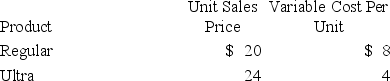
(Multiple Choice)
4.9/5 (77)
(77) Describe and compare the three cost estimation methods used to develop a cost equation.
(Essay)
4.8/5 (86)
(86) A company manufactures and sells searchlights. Each searchlight sells for $345. The variable cost per unit is $198, and the company's total fixed costs are $635,000. Predicted sales are 15,000 units. What is the contribution margin per unit?
(Short Answer)
4.9/5 (82)
(82) In Keegan Corporation's most recent fiscal year, the company reported pretax earnings of $215,000. Fixed costs totaled $325,800, the unit selling price of the firm's only product was $60, and the variable costs per unit were 40% of the selling price. Based on this information, the firm's break-even point in units was:
(Multiple Choice)
4.8/5 (78)
(78) The sales mix of Desert Springs Company is 5 units of A, 3 units of B, and 1 unit of C. Per unit sales prices for each product are $30, $40, and $50, respectively. Variable costs per unit are $14, $24, and $34, respectively. Fixed costs are $597,600. What is the break-even point in composite units and in units of A, B, and C?
(Essay)
4.8/5 (81)
(81) Use the following information to determine the break-even point in units (rounded to the nearest whole unit): 
(Multiple Choice)
4.8/5 (77)
(77) Cost-volume-profit analysis requires management to classify all costs as either fixed or variable with respect to production or sales volume within the relevant range of operations.
(True/False)
4.9/5 (86)
(86) A firm sells two different products, A and B. For each unit of B, the firm sells two units of A. Total fixed costs for this firm are $1,260,000. Additional selling prices and cost information for both products follow:
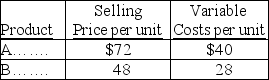 Required:
(a) Calculate the contribution margin per composite unit.
(b) Calculate the break-even point in units of each individual product.
(c) If pretax income before taxes of $294,000 is desired, how many units of A and B must be sold?
Required:
(a) Calculate the contribution margin per composite unit.
(b) Calculate the break-even point in units of each individual product.
(c) If pretax income before taxes of $294,000 is desired, how many units of A and B must be sold? (Essay)
4.8/5 (79)
(79) Johnston Co. anticipates total fixed costs of $120,000 and variable costs equal to 40% of sales. What is the pretax income if sales are $650,000?
(Essay)
4.8/5 (80)
(80) 
Filters
- Essay(0)
- Multiple Choice(0)
- Short Answer(0)
- True False(0)
- Matching(0)