



 Chat with AI
Exam 5: Cost Behavior Cost-Volume-Profit Analysis

Exam 1: Managerial Accounting Concepts and Principles250 Questions
Exam 2: Job Order Costing and Analysis217 Questions
Exam 3: Process Costing and Analysis230 Questions
Exam 4: Activity Based Costing and Analysis220 Questions
Exam 5: Cost Behavior Cost-Volume-Profit Analysis247 Questions
Exam 6: Variable Costing and Analysis201 Questions
Exam 7: Master Budgets and Performance Planning213 Questions
Exam 8: Flexible Budgets and Standard Costs222 Questions
Exam 9: Performance Measurement and Responsibility Accounting208 Questions
Exam 10: Relevant Costing for Managerial Decisions117 Questions
Exam 11: Capital Budgeting and Investment Analysis159 Questions
Exam 12: Reporting Cash Flows239 Questions
Exam 13: Analysis of Financial Statements233 Questions
Exam 14: Time Value of Money84 Questions
Exam 15: Analyzing for Business Transactions250 Questions
Exam 16: Partnership Accounting179 Questions
Select questions type


A manufacturer reports the following information below for its first three years in operation.  Income for year 2 using absorption costing is:
Free
(Multiple Choice)
4.8/5  (86)
(86) Correct Answer: Verified
C
Magnolia Company is considering the production and sale of a new product with the following sales and cost data: unit sales price, $350; unit variable costs, $180; total fixed costs, $399,500; and projected sales, $910,000. Round your answers to the nearest whole unit or dollar.
(a) Calculate break-even in units.
(b) Calculate break-even in dollars (use four decimal places when calculating the contribution margin ratio).
(c) Calculate number of units that would need to be sold to generate an after-tax profit of $420,000 assuming a 30% tax rate.
(d) Calculate dollar sales that would be needed to generate the same profit as above.
(e) Calculate the margin of safety stated as a percentage using the $910,000 projected sales level.
Be sure to label each calculation and show all calculations.
Free
(Essay)
4.9/5 (77)
(77) Correct Answer:Verified
Verified(a) $399,500/($350-180) = 2,350 units
(b) $399,500/(($350 - 180)/$350) = $822,524 or $822,500.
(c) $399,500 + ($420,000/(1-.3)) = ($399,500 + $600,000)/$170 = 5,880 units
(d) ($399,500 + $600,000)/.4857 = $2,057,855 or $2,058,000 or (5,880 BE units * $350=$2,058,000)
(e) $910,000 - $822,500 = $87,500/$822,500 = 10.6%
A company has fixed costs of $320,000 and a contribution margin per unit of $15. If the firm wants to earn a target $40,000 pretax income, how many units must be sold (rounded to the nearest whole unit)?
Free
(Multiple Choice)
4.8/5 (75)
(75) Correct Answer:Verified
VerifiedA
Contribution margin per unit is the amount by which a product's unit selling price exceeds its total variable cost per unit.
(True/False)
4.8/5 (77)
(77) A line on a scatter diagram that is intended to reflect the past relation between cost and unit volume is the:
(Multiple Choice)
5.0/5 (73)
(73) The basic form of cost-volume-profit analysis is often called break-even analysis.
(True/False)
4.9/5 (76)
(76) A firm expects to sell 25,000 units of its product at $11 per unit and to incur variable costs per unit of $6. Total fixed costs are $70,000. The pretax net income is:
(Multiple Choice)
4.9/5 (73)
(73) While the total amount of variable cost changes with the level of production, variable cost per unit remains constant as volume changes.
(True/False)
4.9/5 (88)
(88) A product sells for $200 per unit, and its variable costs are 65% of sales. The fixed costs are $420,000. What is the break-even point in sales dollars?
(Multiple Choice)
4.9/5 (71)
(71) A company manufactures a product and sells it for $120 per unit. The total fixed costs of manufacturing and selling the product are expected to be $155,250, and the variable costs are expected to be $75 per unit. What is the company's break-even point in (a) units and (b) dollar sales?
(Essay)
4.8/5 (85)
(85) A firm sells two products, Regular and Ultra. For every unit of Regular the firm sells, two units of Ultra are sold. The firm's total fixed costs are $1,612,000. Selling prices and cost information for both products follow. What is the firm's break-even point in units of Regular and Ultra? 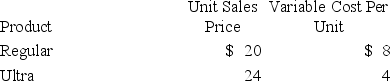
(Multiple Choice)
4.9/5 (66)
(66) McCoy Brothers manufactures and sells two products, A and Z in the ratio of 4:2. Product A sells for $75; Z sells for $95. Variable costs for product A are $35; for Z $40. Fixed costs are $418,500. Compute the number of units of Product Z McCoy must sell to break even.
(Multiple Choice)
4.8/5 (85)
(85) McCoy Brothers manufactures and sells two products, A and Z in the ratio of 5:2. Product A sells for $75; Z sells for $95. Variable costs for product A are $35; for Z $40. Fixed costs are $418,500. Compute the break-even point in composite units.
(Multiple Choice)
4.9/5 (68)
(68) The break-even point is the sales level at which a company neither earns a profit nor incurs a loss.
(True/False)
4.9/5 (80)
(80) Assume that sales are predicted to be $3,750, the expected contribution margin is $1,500, and a net loss of $250 is anticipated. The break-even point in sales dollars is:
(Multiple Choice)
4.9/5 (78)
(78) Watson Company has monthly fixed costs of $83,000 and a 40% contribution margin ratio. If the company has set a target monthly income of $15,000, what dollar amount of sales must be made to produce the target income?
(Multiple Choice)
4.8/5 (68)
(68) Describe how a cost-volume-profit analysis would be performed for a company that sells more than one product when the sales mix is known.
(Essay)
4.8/5 (92)
(92) During a recent fiscal year, Creek Company reported pretax income of $125,000, a contribution margin ratio of 25% and total contribution margin of $400,000. Total variable costs must have been:
(Multiple Choice)
4.7/5 (69)
(69) A product has a contribution margin per unit of $17 and sells at $25 per unit. If the break-even point is 82,000 units, calculate (a) the variable costs per unit and (b) the total fixed costs.
(Essay)
4.9/5 (72)
(72) In cost-volume-profit analysis, the unit contribution margin is:
(Multiple Choice)
4.9/5 (76)
(76) 
Filters
- Essay(0)
- Multiple Choice(0)
- Short Answer(0)
- True False(0)
- Matching(0)