



 Chat with AI
Exam 8: Flexible Budgets and Standard Costs

Exam 1: Managerial Accounting Concepts and Principles250 Questions
Exam 2: Job Order Costing and Analysis217 Questions
Exam 3: Process Costing and Analysis230 Questions
Exam 4: Activity Based Costing and Analysis220 Questions
Exam 5: Cost Behavior Cost-Volume-Profit Analysis247 Questions
Exam 6: Variable Costing and Analysis201 Questions
Exam 7: Master Budgets and Performance Planning213 Questions
Exam 8: Flexible Budgets and Standard Costs222 Questions
Exam 9: Performance Measurement and Responsibility Accounting208 Questions
Exam 10: Relevant Costing for Managerial Decisions117 Questions
Exam 11: Capital Budgeting and Investment Analysis159 Questions
Exam 12: Reporting Cash Flows239 Questions
Exam 13: Analysis of Financial Statements233 Questions
Exam 14: Time Value of Money84 Questions
Exam 15: Analyzing for Business Transactions250 Questions
Exam 16: Partnership Accounting179 Questions
Select questions type


A job was budgeted to require 3 hours of labor per unit at $8.00 per hour. The job consisted of 8,000 units and was completed in 22,000 hours at a total labor cost of $198,000. What is the direct labor efficiency variance?
(Multiple Choice)
4.8/5  (80)
(80) Which of the following is not part of the flow of events in variance analysis:
(Multiple Choice)
4.8/5 (86)
(86) Should both favorable and unfavorable variances be investigated, or only the unfavorable ones? Explain.
(Essay)
4.9/5 (76)
(76) Parallel Enterprises has collected the following data on one of its products. During the period the company produced 25,000 units. The direct materials price variance is: Direct materials standard (7@\ 2/) \ 014 per finished unit Actual cost of materials purchased \ 322,500 Actual direct materials purchared and used 150,000 lbs.
(Multiple Choice)
4.8/5 (81)
(81) Wren Company determined that in the production of their products last period; they had a favorable price variance and an unfavorable quantity variance for direct materials. What might be the cause(s) of this pattern of variances?
(Essay)
4.9/5 (79)
(79) Maxwell Co. collected the following information about its production activities for the current year.
a. Compute the direct materials price and quantity variances and indicate whether each is favorable or unfavorable.
b. Prepare the journal entry to record the issuance of direct materials into production.
Actual costs and quantities:
Direct materials used 95,000 lbs. @ $6.30 per lb.
Units completed during the year, 50,000 units
Standard costs and quantities:
Price per lb. of direct material, $6.05
Two lbs. of direct material per unit
(Essay)
5.0/5 (70)
(70) A favorable direct materials price variance might lead to an unfavorable direct materials quantity variance because the company purchased inferior materials.
(True/False)
4.8/5 (78)
(78) Milltown Company specializes in selling used cars. During the month, the dealership sold 22 cars at an average price of $15,000 each. The budget for the month was to sell 20 cars at an average price of $16,000. Compute the dealership's sales price variance for the month.
(Multiple Choice)
4.9/5 (63)
(63) Flexible budgets may be prepared before or after an actual period of activity. Why would management prepare such budgets at differing time frames?
(Essay)
4.8/5 (79)
(79) If Mercury Company's actual overhead incurred during a period was $32,700 and the company reported a favorable overhead controllable variance of $1,200 and an unfavorable overhead volume variance of $900, how much standard overhead cost was assigned to the products produced during the period?
(Essay)
4.8/5 (68)
(68) Summerlin Company budgeted 4,000 pounds of material costing $5.00 per pound to produce 2,000 units. The company actually used 4,500 pounds that cost $5.10 per pound to produce 2,000 units. What is the direct materials price variance?
(Multiple Choice)
4.7/5 (81)
(81) When there is a difference between the actual volume of production and the standard volume of production, which of the following, based solely on fixed overhead, occurs:
(Multiple Choice)
4.8/5 (86)
(86) Tiger, Inc. budgeted the following overhead costs for the current year assuming operations at 80% of capacity, or 40,000 units:
 The standard cost per unit when operating at this same 80% capacity level is:
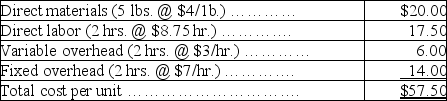 The actual production achieved in the current year was 60% of capacity, or 30,000 units. The actual costs were:
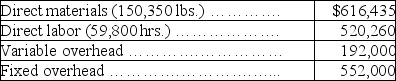 Calculate the following variances and indicate whether each is favorable or unfavorable.
Direct materials: Price variance Quantity variance Direct labor: Rate variance Efficiency variance Variable overhead: Spending variance Efficiency variance Fixed overhead: Spending variance Volume variance
The standard cost per unit when operating at this same 80% capacity level is:
The actual production achieved in the current year was 60% of capacity, or 30,000 units. The actual costs were:
Calculate the following variances and indicate whether each is favorable or unfavorable.
Direct materials: Price variance Quantity variance Direct labor: Rate variance Efficiency variance Variable overhead: Spending variance Efficiency variance Fixed overhead: Spending variance Volume variance (Essay)
4.9/5 (79)
(79) A volume variance is the difference between overhead at maximum volume of production and the standard volume of production.
(True/False)
4.9/5 (73)
(73) A job was budgeted to require 3 hours of labor per unit at $8.00 per hour. The job consisted of 8,000 units and was completed in 22,000 hours at a total labor cost of $198,000. What is the direct labor rate variance?
(Multiple Choice)
4.8/5 (94)
(94) Fletcher Company collected the following data regarding production of one of its products. Compute the total direct labor cost variance. Direct labor standard (2hrs. @, \ 12.75/.) \ 5.50 per finished unit Actual direct labor hours 81,500 hrs. Actual finished units produced 40,000 units Actual cost of direct labor \ 1,100,250
(Multiple Choice)
4.8/5 (75)
(75) When recording the journal entry for labor, the Work in Process Inventory account is
(Multiple Choice)
4.9/5 (85)
(85) Lavoie Company planned to use 18,500 pounds of material costing $2.50 per pound to make 4,000 units of its product. In actually making 4,000 units, the company used 18,800 pounds that cost $2.54 per pound. Calculate the direct materials quantity variance.
(Essay)
4.9/5 (76)
(76) An unfavorable variance is recorded with a debit because it reflects additional costs higher than the standard cost.
(True/False)
4.8/5 (78)
(78) 
Filters
- Essay(0)
- Multiple Choice(0)
- Short Answer(0)
- True False(0)
- Matching(0)