



 Chat with AI
Exam 8: Flexible Budgets and Standard Costs

Exam 1: Managerial Accounting Concepts and Principles250 Questions
Exam 2: Job Order Costing and Analysis217 Questions
Exam 3: Process Costing and Analysis230 Questions
Exam 4: Activity Based Costing and Analysis220 Questions
Exam 5: Cost Behavior Cost-Volume-Profit Analysis247 Questions
Exam 6: Variable Costing and Analysis201 Questions
Exam 7: Master Budgets and Performance Planning213 Questions
Exam 8: Flexible Budgets and Standard Costs222 Questions
Exam 9: Performance Measurement and Responsibility Accounting208 Questions
Exam 10: Relevant Costing for Managerial Decisions117 Questions
Exam 11: Capital Budgeting and Investment Analysis159 Questions
Exam 12: Reporting Cash Flows239 Questions
Exam 13: Analysis of Financial Statements233 Questions
Exam 14: Time Value of Money84 Questions
Exam 15: Analyzing for Business Transactions250 Questions
Exam 16: Partnership Accounting179 Questions
Select questions type


The following information describes a company's usage of direct labor in a recent period. The total direct labor cost variance is: Actual hours used 45,000 Actual rate per hour \1 5.00 Standard rate per hour \1 4.50 Standard hours for units produced 47,000
(Multiple Choice)
4.8/5  (79)
(79) Gleason Company has developed the following standard cost data based on 60,000 direct labor hours, which is 75% of capacity. Fixed overhead is $360,000 and variable overhead is $180,000 at this level of activity.
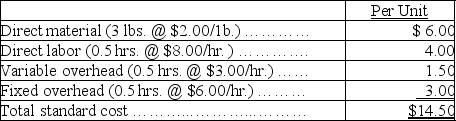 During the current period, the company operated at 80% of capacity and produced 128,000 units. Actual costs were:
 Calculate the variable overhead spending and efficiency variance and the fixed overhead spending and volume variances. Indicate whether each is favorable or unfavorable.
During the current period, the company operated at 80% of capacity and produced 128,000 units. Actual costs were:
Calculate the variable overhead spending and efficiency variance and the fixed overhead spending and volume variances. Indicate whether each is favorable or unfavorable. (Essay)
4.8/5 (95)
(95) A volume variance occurs when the company operates at a different capacity level than was expected.
(True/False)
4.8/5 (75)
(75) The difference between actual overhead costs incurred and the budgeted overhead costs based on a flexible budget is the:
(Multiple Choice)
4.8/5 (78)
(78) Companies promoting continuous improvement strive to achieve ________ standards by eliminating inefficiencies and waste.
(Short Answer)
4.9/5 (75)
(75) In this type of control system, the master budget is based on a single prediction for sales volume, and the budgeted amount for each cost essentially assumes that a specific amount of sales will occur:
(Multiple Choice)
4.8/5 (80)
(80) Milltown Company specializes in selling used cars. During the month, the dealership sold 22 cars at an average price of $15,000 each. The budget for the month was to sell 20 cars at an average price of $16,000. Compute the dealership's sales volume variance for the month.
(Multiple Choice)
4.9/5 (90)
(90) Oxford Co. produces and sells two lines of t-shirts, Classic and Mod. Oxford provides the following data. Compute the sales price and the sales volume variances for each product.
Budget Actual Unit sales price-Classic.... \ 15 \ 16 Unit sales price-Mod ...... \ 20 \ 19 Unit sales-Classic........ 2,400 2,500
(Essay)
4.8/5 (84)
(84) Milltown Company specializes in selling used cars. During the month, the dealership sold 22 cars at an average price of $15,000 each. The budget for the month was to sell 20 cars at an average price of $16,000. Compute the dealership's total sales variance for the month.
(Multiple Choice)
4.9/5 (88)
(88) Use the following data to find the direct labor efficiency variance if the company produced 3,500 units during the period. 
(Multiple Choice)
4.8/5 (82)
(82) A management approach that focuses attention on significant differences from plans and gives less attention to areas where performance is reasonably close to standards is known as ________.
(Short Answer)
4.8/5 (87)
(87) If ending variance account balances are material, they should always be closed directly to Cost of Goods Sold.
(True/False)
4.8/5 (80)
(80) Based on predicted production of 12,000 units, a company anticipates $150,000 of fixed costs and $123,000 of variable costs. The flexible budget amounts of fixed and variable costs for 10,000 units are:
(Multiple Choice)
4.9/5 (76)
(76) In the analysis of variances, management commonly focuses on four categories of production costs: ________ cost, ________ cost; ________ cost; and ________ cost.
(Essay)
4.9/5 (85)
(85) The difference between the total actual overhead cost incurred and the total standard overhead cost applied is the ________.
(Short Answer)
4.8/5 (82)
(82) The standard materials cost to produce 1 unit of Product R is 6 pounds of material at a standard price of $50 per pound. In manufacturing 8,000 units, 47,000 pounds of material were used at a cost of $51 per pound. What is the direct materials quantity variance?
(Multiple Choice)
4.9/5 (73)
(73) Fletcher Company collected the following data regarding production of one of its products. Compute the direct materials price variance. Direct materlals stardard (6lbs. @ \2 /16.) \ 12 per finished unit Actual direct materials used 243,000 lbs. Actual finished units produced 40,000 units Actual cost of direct materials used \4 83,570
(Multiple Choice)
4.7/5 (81)
(81) Ship Co. produces storage crates that require 1.2 meters of material at $.85 per meter and 0.1 direct labor hours at $15.00 per hour. Overhead is applied at the rate of $9 per direct labor hour. What is the total standard cost for one unit of product that would appear on a standard cost card?
(Multiple Choice)
4.9/5 (80)
(80) Based on a predicted level of production and sales of 12,000 units, a company anticipates reporting operating income of $26,000 after deducting variable costs of $72,000 and fixed costs of $10,000. Based on this information, the budgeted amounts of fixed and variable costs for 15,000 units would be:
(Multiple Choice)
4.8/5 (86)
(86) 
Filters
- Essay(0)
- Multiple Choice(0)
- Short Answer(0)
- True False(0)
- Matching(0)