



 Chat with AI
Exam 10: Management of Translation Exposure

Exam 1: Globalization and the Multinational Firm99 Questions
Exam 2: International Monetary System100 Questions
Exam 3: Balance of Payments100 Questions
Exam 4: Corporate Governance Around the World100 Questions
Exam 5: The Market for Foreign Exchange100 Questions
Exam 6: International Parity Relationships and Forecasting Foreign Exchange Rates100 Questions
Exam 7: Futures and Options on Foreign Exchange100 Questions
Exam 8: Management of Transaction Exposure100 Questions
Exam 9: Management of Economic Exposure100 Questions
Exam 10: Management of Translation Exposure81 Questions
Exam 11: International Banking and Money Market101 Questions
Exam 12: International Bond Market99 Questions
Exam 13: International Equity Markets99 Questions
Exam 14: Interest Rate and Currency Swaps95 Questions
Exam 15: International Portfolio Investment101 Questions
Exam 16: Foreign Direct Investment and Cross-Border Acquisitions100 Questions
Exam 17: International Capital Structure and the Cost of Capital99 Questions
Exam 18: International Capital Budgeting101 Questions
Exam 19: Multinational Cash Management98 Questions
Exam 20: International Trade Finance100 Questions
Exam 21: International Tax Environment and Transfer Pricing100 Questions
Select questions type


Find the foreign currency gain or loss for this U.S.MNC translating the balance sheet and income statement of a French subsidiary,which keeps its books in euro,but that is translated into U.S.dollars using the current/noncurrent method,the reporting currency of the U.S.MNC.
The subsidiary is at the end of its first year of operation.
The historical exchange rate is $1.60/€1.00 and the most recent exchange rate is $1.50/€ 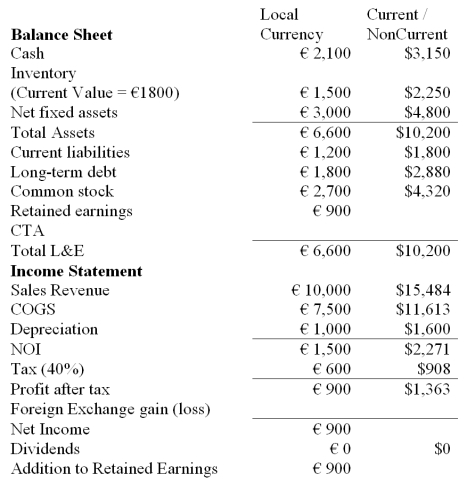
(Essay)
4.9/5  (77)
(77) When exchange rates change,the value of a foreign subsidiary's assets and liabilities denominated in a foreign currency change
(Multiple Choice)
4.8/5 (83)
(83) The underlying principle of the current/noncurrent method is
(Multiple Choice)
4.9/5 (79)
(79) Since fixed assets and inventory are usually carried at historical costs,
(Multiple Choice)
4.9/5 (82)
(82) What does it mean to have redenominated an asset in terms of the dollar?
(Multiple Choice)
4.9/5 (78)
(78) Under which method does the gain or loss due to translation adjustment not affect reported cash flows,as it does with the other three translation methods?
(Multiple Choice)
4.9/5 (87)
(87) The underlying philosophy of the monetary/nonmonetary method is that
(Multiple Choice)
4.8/5 (71)
(71) The sensitivity of "realized" domestic currency values of the firm's contractual cash flows denominated in foreign currency to unexpected changes in the exchange rate is
(Multiple Choice)
4.9/5 (79)
(79) The currency of the primary economic environment in which the entity operates is defined in FASB 52 as
(Multiple Choice)
4.8/5 (89)
(89) Consider a U.S.-based MNC with manufacturing activities in Japan.The result of a change in the ¥-$ exchange rate on the assets and liabilities of the consolidated balance sheet is: Exposed assets ¥700,000,000 Exposed liabilities ¥500,000,000 Ignoring transaction exposure in the yen,the translation exposure will indicate a possible need for a "derivatives hedge" of
(Multiple Choice)
4.9/5 (75)
(75) In comparison to the current/noncurrent method,the monetary/nonmonetary method
(Multiple Choice)
4.8/5 (93)
(93) 
Filters
- Essay(0)
- Multiple Choice(0)
- Short Answer(0)
- True False(0)
- Matching(0)