



 Chat with AI
Exam 2: International Monetary System

Exam 1: Globalization and the Multinational Firm99 Questions
Exam 2: International Monetary System100 Questions
Exam 3: Balance of Payments100 Questions
Exam 4: Corporate Governance Around the World100 Questions
Exam 5: The Market for Foreign Exchange100 Questions
Exam 6: International Parity Relationships and Forecasting Foreign Exchange Rates100 Questions
Exam 7: Futures and Options on Foreign Exchange100 Questions
Exam 8: Management of Transaction Exposure100 Questions
Exam 9: Management of Economic Exposure100 Questions
Exam 10: Management of Translation Exposure81 Questions
Exam 11: International Banking and Money Market101 Questions
Exam 12: International Bond Market99 Questions
Exam 13: International Equity Markets99 Questions
Exam 14: Interest Rate and Currency Swaps95 Questions
Exam 15: International Portfolio Investment101 Questions
Exam 16: Foreign Direct Investment and Cross-Border Acquisitions100 Questions
Exam 17: International Capital Structure and the Cost of Capital99 Questions
Exam 18: International Capital Budgeting101 Questions
Exam 19: Multinational Cash Management98 Questions
Exam 20: International Trade Finance100 Questions
Exam 21: International Tax Environment and Transfer Pricing100 Questions
Select questions type


The single European currency,the euro,was adopted by 11 member nations on January 1 of what year?
(Multiple Choice)
4.9/5  (59)
(59) Suppose that the pound is pegged to gold at £20 per ounce and the dollar is pegged to gold at $35 per ounce.This implies an exchange rate of $1.75 per pound.If the current market exchange rate is $1.80 per pound,how would you take advantage of this situation? Hint: assume that you have $350 available for investment.
(Multiple Choice)
4.9/5 (73)
(73) With regard to the current exchange rate arrangement between Italy and Germany,it is best characterized as
(Multiple Choice)
4.9/5 (79)
(79) Consider the supply-demand framework for the British pound relative to the U.S.dollar shown in the nearby chart.The exchange rate is currently $1.80 = £1.00.Which of the following is correct? 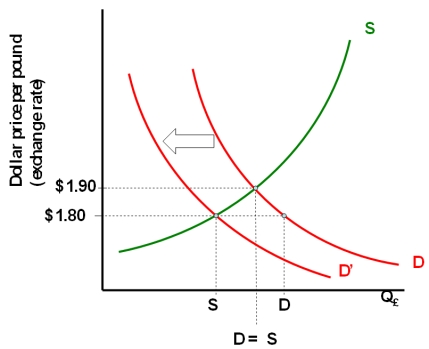
(Multiple Choice)
4.9/5 (76)
(76) During the period of the classical gold standard (1875-1914)there were
(Multiple Choice)
4.8/5 (88)
(88) The growth of the Eurodollar market,which is a transnational,unregulated fund market
(Multiple Choice)
4.9/5 (82)
(82) In the years leading to the collapse of the Bretton Woods system
(Multiple Choice)
4.8/5 (78)
(78) In the 1850s the French franc was valued by both gold and silver,under the official French ratio which equated a gold franc to a silver franc 15½ times as heavy.At the same time,the gold from newly discovered mines in California poured into the market,depressing the value of gold.As a result,
(Multiple Choice)
4.9/5 (70)
(70) Since the end of the fixed exchange rate system of the Smithsonian agreement
(Multiple Choice)
4.8/5 (74)
(74) A "good" (or ideal)international monetary system should provide
(Multiple Choice)
4.7/5 (88)
(88) To avoid currency crisis in the face of fully integrated capital markets,a country can have a
(Multiple Choice)
4.9/5 (78)
(78) Consider the supply-demand framework for the British pound relative to the U.S.dollar shown in the nearby chart.The exchange rate is currently $1.80 = £1.00.Which of the following is correct? 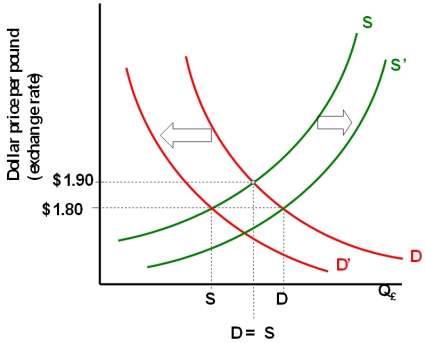
(Multiple Choice)
4.8/5 (78)
(78) Suppose that the British pound is pegged to gold at £6 per ounce,whereas one ounce of gold is worth €12.Under the gold standard,any misalignment of the exchange rate will be automatically corrected by cross border flows of gold.Calculate the possible gains for buying €1,000,if the British pound becomes undervalued and trades for €1.80.(Assume zero shipping costs). (Hint: Gold is first purchased using the devalued British pound from the Bank of England,then shipped to France and sold for €1,000 to the Bank of France).
(Multiple Choice)
4.8/5 (75)
(75) 
Filters
- Essay(0)
- Multiple Choice(0)
- Short Answer(0)
- True False(0)
- Matching(0)