



 Chat with AI
Exam 18: International Capital Budgeting

Exam 1: International Monetary System100 Questions
Exam 2: Globalization and the Multinational Firm100 Questions
Exam 3: Balance of Payments97 Questions
Exam 4: Corporate Governance Around the World100 Questions
Exam 5: The Market for Foreign Exchange100 Questions
Exam 6: International Parity Relationships and Forecasting Foreign Exchange Rates85 Questions
Exam 7: Futures and Options on Foreign Exchange94 Questions
Exam 8: Management of Transaction Exposure100 Questions
Exam 9: Management of Economic Exposure100 Questions
Exam 10: Management of Translation Exposure81 Questions
Exam 11: International Banking and Money Market100 Questions
Exam 12: International Bond Market100 Questions
Exam 13: International Equity Markets100 Questions
Exam 14: Interest Rate and Currency Swaps100 Questions
Exam 15: International Portfolio Investment100 Questions
Exam 16: Foreign Direct Investment and Cross-Border Acquisitions100 Questions
Exam 17: International Capital Structure and the Cost of Capital100 Questions
Exam 18: International Capital Budgeting99 Questions
Exam 19: Multinational Cash Management82 Questions
Exam 20: International Trade Finance100 Questions
Exam 21: International Tax Environment and Transfer Pricing98 Questions
Select questions type


Consider a project of the Cornell Haul Moving Company,the timing and size of the incremental after-tax cash flows (for an all-equity firm)are shown below in millions:  The firm's tax rate is 34 percent; the firm's bonds trade with a yield to maturity of 8 percent; the current and target debt-equity ratio is 2; if the firm were financed entirely with equity,the required return would be 10 percent. Using the flow to equity methodology,what is the value of the equity claim?
 (Multiple Choice)
4.8/5  (90)
(90) Today is January 1,2009.The state of Iowa has offered your firm a subsidized loan.It will be in the amount of $10,000,000 at an interest rate of 5 percent and have ANNUAL (amortizing)payments over 3 years.The first payment is due today and your taxes are due January 1 of each year on the previous year's income.The yield to maturity on your firm's existing debt is 8 percent. What is the €-denominated NPV of this project? I did not round my intermediate steps,if you did,select the answer closest to yours.
(Multiple Choice)
4.9/5 (94)
(94) Consider the following international investment opportunity.It involves a gold mine that can be opened at a cost,then produces a positive cash flow,but then requires environmental clean-up. 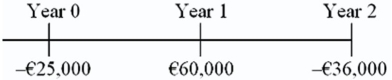 The current exchange rate is $1.55 = €1.00.The inflation rate in the U.S.is 6 percent and in the euro zone 2 percent.The appropriate cost of capital to a U.S.-based firm for a domestic project of this risk is 8 percent.
What is the euro-denominated IRR of this project?
The current exchange rate is $1.55 = €1.00.The inflation rate in the U.S.is 6 percent and in the euro zone 2 percent.The appropriate cost of capital to a U.S.-based firm for a domestic project of this risk is 8 percent.
What is the euro-denominated IRR of this project? (Essay)
4.8/5 (87)
(87) Consider a project of the Cornell Haul Moving Company,the timing and size of the incremental after-tax cash flows (for an all-equity firm)are shown below in millions:  The firm's tax rate is 34 percent; the firm's bonds trade with a yield to maturity of 8 percent; the current and target debt-equity ratio is 2; if the firm were financed entirely with equity,the required return would be 10 percent. Using the APV method,what is the value of the debt side effects?
 (Multiple Choice)
4.8/5 (78)
(78) As of today,the spot exchange rate is €1.00 = $1.50 and the rates of inflation expected to prevail for the next year in the U.S.is 2 percent and 3 percent in the euro zone.What is the one-year forward rate that should prevail?
(Multiple Choice)
4.8/5 (84)
(84) Your firm is in the 34 percent tax bracket.The yield to maturity on your existing bonds is 8 percent.The state of Georgia offers to loan your firm $1,000,000 with a two year amortizing loan at a 5 percent rate of interest and annual payments due at the end of the year. The interest will be deductible at the time that you pay.What is the APV of this below-market loan to your firm? I did not round any of my intermediate steps.You might be a little bit off.Pick the answer closest to yours.
(Multiple Choice)
4.8/5 (76)
(76) The required return on equity for an all-equity firm is 10.0 percent.They currently have a beta of one and the risk-free rate is 5 percent and the market risk premium is 5 percent.They are considering a change in capital structure to a debt-to-equity ratio of ½ the tax rate is 40 percent,the pre-tax cost of debt is 8 percent.Find the beta if this firm changes capital structure.
(Multiple Choice)
4.8/5 (67)
(67) The adjusted present value (APV)model that is suitable for an MNC is the basic net present value (NPV)model expanded to
(Multiple Choice)
4.9/5 (62)
(62) Consider the following international investment opportunity:  The current exchange rate is $1.60 = €1.00.The inflation rate in the U.S.is 3 percent and in the euro zone 2 percent.The appropriate cost of capital to a U.S.-based firm for a domestic project of this risk is 8 percent.
What is the dollar-denominated IRR of this project?
The current exchange rate is $1.60 = €1.00.The inflation rate in the U.S.is 3 percent and in the euro zone 2 percent.The appropriate cost of capital to a U.S.-based firm for a domestic project of this risk is 8 percent.
What is the dollar-denominated IRR of this project? (Essay)
4.9/5 (88)
(88) i = rdebt = 6% OCF0 = −$100,000 Ku = rassets = 12% OCF1-4 = $39,800 = 25,000 × ($5 − $3)× (1 − 0.34)+ $20,000 × 0.34
Kl = requity = 27.84% OCF5 = $43,100 = $39,800 + $5,000 × (1 − 0.34)K = rWACC = 8.74% π = Tax rate = 34% Debt-to-equity ratio = 4 Risk-free rate = 2%
The 5-year project requires equipment that costs $100,000.If undertaken,the shareholders will contribute $20,000 cash and borrow $80,000 at 6 percent with an interest-only loan with a maturity of 5 years and annual interest payments.The equipment will be depreciated straight-line to zero over the 5-year life of the project.There will be a pre-tax salvage value of $5,000.There are no other start-up costs at year 0.During years 1 through 5,the firm will sell 25,000 units of product at $5; variable costs are $3; there are no fixed costs.
What is the NPV of the project using the WACC methodology?
(Multiple Choice)
4.8/5 (78)
(78) What proportion of the firm is financed by debt for a firm that expects a 15 percent return on equity,a 12 percent return on assets,and a 10 percent return on debt? The tax rate is 25 percent.
(Multiple Choice)
4.8/5 (76)
(76) Tiger Towers,Inc.is considering an expansion of their existing business,student apartments.The new project will be built on some vacant land that the firm has just contracted to buy.The land cost $1,000,000 and the payment is due today.Construction of a 20-unit office building will cost $3 million; this expense will be depreciated straight-line over 30 years to zero salvage value; the pretax value of the land and building in year 30 will be $18,000,000.The $3,000,000 construction cost is to be paid today.The project will not change the risk level of the firm.The firm will lease 20 office suites at $20,000 per suite per year; payment is due at the start of the year; occupancy will begin in one year.Variable cost is $3,500 per suite.Fixed costs,excluding depreciation,are $75,000 per year.The project will require a $10,000 investment in net working capital. = 10.0% = 11.20% = 15.0% tax rate = 34% = 3 = 24.9% = 2% Assume that the firm will partially finance the project with a $3,000,000 interest-only 30-year loan at 10.0 percent APR with annual payments.
What is the levered after-tax incremental cash flow for year 1?
(Multiple Choice)
4.7/5 (79)
(79) Your firm is based in southern Ireland (and thereby operates in euro,not pounds)and is considering an investment in the United States.
The project involves selling widgets: you project a sales volume of 50,000 widgets per year,sales price of $20 per widget with a contribution margin of $15 per widget.
The project will last for 5 years,require an investment of $1,000,000 at time zero (which will be depreciated straight-line to $10,000 over the 5 years).Salvage value for the equipment is projected to be $10,000.The project will operate in rented quarters: $300,000 rent is due at the start of each year.
The corporate tax rate is 12½ percent in Ireland and 40 percent in the U.S.
For simplicity,assume that taxes are paid like sales taxes: immediately.
The spot exchange rate is $1.50 = €1.00.The cost of capital to the Irish firm for a domestic project of this risk is 8 percent.The U.S.risk-free rate is 3 percent; the Irish risk-free rate is 2 percent.
Repeat the above project analysis assuming that the Irish firm could replicate the project in Ireland.(i.e.cash flow out the project in Ireland and find break-even price (in €),quantity,NPV,IRR (in euro not dollars).
(Essay)
4.9/5 (61)
(61) An American Hedge Fund is considering a one-year investment in an Italian government bond with a one-year maturity and a euro-denominated rate of return of i€ = 5%.The bond costs €1,000 today and will return €1,050 at the end of one year without risk.The current exchange rate is €1.00 = $1.50.U.S.dollar-denominated government bonds currently have a yield to maturity of 4 percent.Suppose that the European Central Bank is considering either tightening or loosening its monetary policy.It is widely believed that in one year there are only two possibilities:
S1 ($/€)= €1.80 per €
S1 ($/€)= €1.40 per €
Following revaluation,the exchange rate is expected to remain steady for at least another year.
Using the notion of hedging,make a recommendation vis-à-vis how to undertake the project today without "buying" the option.
(Essay)
4.9/5 (78)
(78) i = rdebt = 10% OCF0 = −$100,000 Ku = rassets = 15% OCF1-4 = $39,800 = 25,000 × ($5 − $3)× (1 − 0.34)+ $20,000 × 0.34
Kl = requity = 24.9% OCF5 = $43,100 = $39,800 + $5,000 × (1 − 0.34)K = rWACC = 11.20% Tax rate = 34% Debt-to-equity ratio = 3 Risk-free rate = 2%
The 5-year project requires equipment that costs $100,000.If undertaken,the shareholders will contribute $25,000 cash and borrow $75,000 with an interest-only loan with a maturity of 5 years and annual interest payments.The equipment will be depreciated straight-line to zero over the 5-year life of the project.There will be a pre-tax salvage value of $5,000.There are no other start-up costs at year 0.During years 1 through 5,the firm will sell 25,000 units of product at $5; variable costs are $3; there are no fixed costs.
When using the APV methodology,what is the NPV of the depreciation tax shield?
(Multiple Choice)
4.9/5 (73)
(73) Consider a project of the Cornell Haul Moving Company,the timing and size of the incremental after-tax cash flows (for an all-equity firm)are shown below in millions:  The firm's tax rate is 34 percent; the firm's bonds trade with a yield to maturity of 8 percent; the current and target debt-equity ratio is 2; if the firm were financed entirely with equity,the required return would be 10 percent. Using the weighted average cost of capital methodology,what is the NPV? I didn't round my intermediate steps.If you do,you're not going to get the right answer.
 (Multiple Choice)
4.8/5 (80)
(80) A French firm is considering a one-year investment in the United Kingdom with a pound-denominated rate of return of i£ = 15%.The firm's local cost of capital is i€ = 10%.The project costs £1,000 and will return £1,150 at the end of one year.The current exchange rate is €2.00 = £1.00.
Suppose that the bank of England is considering either tightening or loosening its monetary policy.It is widely believed that in one year there are only two possibilities:
S1 (€/£)= €2.20 per £
S1 (€/£)= €1.80 per £
Following revaluation,the exchange rate is expected to remain steady for at least another year.
Find the NPV in euro for the French firm if they wait one year to undertake the project after the exchange rate rises to S1(€/£)= €2.20 per £.
(Essay)
4.8/5 (69)
(69) An American Hedge Fund is considering a one-year investment in an Italian government bond with a one-year maturity and a euro-denominated rate of return of i€ = 5%.The bond costs €1,000 today and will return €1,050 at the end of one year without risk.The current exchange rate is €1.00 = $1.50.U.S.dollar-denominated government bonds currently have a yield to maturity of 4 percent.Suppose that the European Central Bank is considering either tightening or loosening its monetary policy.It is widely believed that in one year there are only two possibilities:
S1 ($/€)= €1.80 per €
S1 ($/€)= €1.40 per €
Following revaluation,the exchange rate is expected to remain steady for at least another year.
Find the ex post IRR in euro for the American firm if they buy the bond today and then the exchange rate falls to S1($/€)= $1.40 per €.
(Essay)
4.9/5 (70)
(70) Sensitivity analysis in the calculation of the adjusted present value (APV)allows the financial manager to
(Multiple Choice)
4.9/5 (79)
(79) 
Filters
- Essay(0)
- Multiple Choice(0)
- Short Answer(0)
- True False(0)
- Matching(0)