



 Chat with AI
Exam 1: International Monetary System

Exam 1: International Monetary System100 Questions
Exam 2: Globalization and the Multinational Firm100 Questions
Exam 3: Balance of Payments97 Questions
Exam 4: Corporate Governance Around the World100 Questions
Exam 5: The Market for Foreign Exchange100 Questions
Exam 6: International Parity Relationships and Forecasting Foreign Exchange Rates85 Questions
Exam 7: Futures and Options on Foreign Exchange94 Questions
Exam 8: Management of Transaction Exposure100 Questions
Exam 9: Management of Economic Exposure100 Questions
Exam 10: Management of Translation Exposure81 Questions
Exam 11: International Banking and Money Market100 Questions
Exam 12: International Bond Market100 Questions
Exam 13: International Equity Markets100 Questions
Exam 14: Interest Rate and Currency Swaps100 Questions
Exam 15: International Portfolio Investment100 Questions
Exam 16: Foreign Direct Investment and Cross-Border Acquisitions100 Questions
Exam 17: International Capital Structure and the Cost of Capital100 Questions
Exam 18: International Capital Budgeting99 Questions
Exam 19: Multinational Cash Management82 Questions
Exam 20: International Trade Finance100 Questions
Exam 21: International Tax Environment and Transfer Pricing98 Questions
Select questions type


Since the end of the fixed exchange rate system of the Smithsonian agreement

Free
(Multiple Choice)
4.9/5  (79)
(79) Correct Answer: Verified
B
Prior to the Argentine Peso Crisis
Free
(Multiple Choice)
4.8/5 (72)
(72) Correct Answer:Verified
VerifiedD
The international monetary system went through several distinct stages of evolution.These stages are summarized,in alphabetic order,as follows: (i)Bimetallism
(ii)Bretton Woods system
(iii)Classical gold standard
(iv)Flexible exchange rate regime
(v)Interwar period
The chronological order that they actually occurred is:
(Multiple Choice)
4.9/5 (85)
(85) The gold standard still has ardent supporters who believe that it provides
(Multiple Choice)
4.8/5 (75)
(75) With regard to the current exchange rate arrangement between the U.S.and the U.K.,it is best characterized as
(Multiple Choice)
4.7/5 (73)
(73) The European Monetary System (EMS)has the chief objective(s)
(Multiple Choice)
4.8/5 (78)
(78) Ecuador does not have its own national currency,circulating the U.S.dollar instead.About how many countries do not have their own national currency?
(Multiple Choice)
4.7/5 (76)
(76) Prior to the 1870s,both gold and silver were used as international means of payment and the exchange rates among currencies were determined by either their gold or silver contents.Suppose that the dollar was pegged to gold at $30 per ounce,the French franc is pegged to gold at 90 francs per ounce and to silver at 9 francs per ounce of silver,and the German mark pegged to silver at 1 mark per ounce of silver.What would the exchange rate between the U.S.dollar and German mark be under this system?
(Multiple Choice)
4.8/5 (80)
(80) A "good" (or ideal)international monetary system should provide
(Multiple Choice)
4.9/5 (84)
(84) Generally speaking,a country would be more prone to asymmetric shocks
(Multiple Choice)
4.9/5 (64)
(64) Consider the supply-demand framework for the British pound relative to the U.S.dollar shown in the following chart.The exchange rate is currently $1.80 = £1.00.Which of the following is correct? 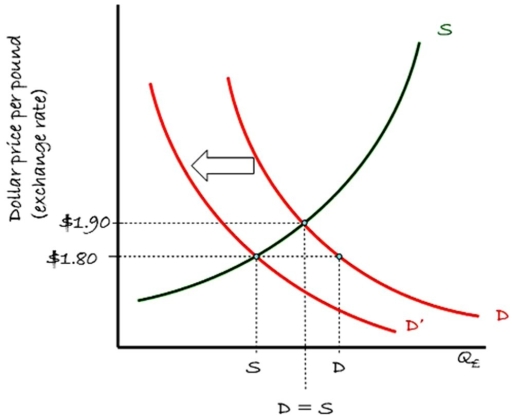
(Multiple Choice)
4.9/5 (63)
(63) Under the Bretton Woods system each country established a par value for its currency in relation to the dollar.And the U.S.dollar was pegged to gold at
(Multiple Choice)
4.7/5 (85)
(85) Suppose that the pound is pegged to gold at £20 per ounce and the dollar is pegged to gold at $35 per ounce.This implies an exchange rate of $1.75 per pound.If the current market exchange rate is $1.60 per pound,how would you take advantage of this situation? Hint: assume that you have $350 available for investment.
(Multiple Choice)
4.7/5 (86)
(86) 
Filters
- Essay(0)
- Multiple Choice(0)
- Short Answer(0)
- True False(0)
- Matching(0)