



 Chat with AI
Exam 17: Analysis of Financial Statements

Exam 1: Accounting in Business241 Questions
Exam 2: Analyzing and Recording Transactions188 Questions
Exam 3: Adjusting Accounts and Preparing Financial Statements213 Questions
Exam 4: Completing the Accounting Cycle168 Questions
Exam 5: Accounting for Merchandising Operations189 Questions
Exam 7: Accounting Information Systems164 Questions
Exam 8: Cash and Internal Controls193 Questions
Exam 9: Accounting for Receivables170 Questions
Exam 10: Plant Assets, natural Resources, and Intangibles216 Questions
Exam 11: Current Liabilities and Payroll Accounting194 Questions
Exam 12: Accounting for Partnerships133 Questions
Exam 13: Accounting for Corporations210 Questions
Exam 14: Long-Term Liabilities199 Questions
Exam 15: Investments and International Operations175 Questions
Exam 16: Reporting the Statement of Cash Flows178 Questions
Exam 17: Analysis of Financial Statements178 Questions
Exam 18: Managerial Accounting Concepts and Principles203 Questions
Exam 19: Job Order Costing160 Questions
Exam 20: Process Costing156 Questions
Exam 21: Cost-Volume-Profit Analysis180 Questions
Exam 22: Master Budgets and Planning153 Questions
Exam 23: Flexible Budgets and Standard Costs168 Questions
Exam 24: Performance Measurement and Responsibility Accounting163 Questions
Exam 25: Capital Budgeting and Managerial Decisions131 Questions
Exam 26: Time Value of Money B60 Questions
Exam 27: Activity-Based Costing C37 Questions
Select questions type


Use the following selected information from Farris,LLC to determine the Year 2 and Year 1 common size percents for cost of goods sold using Year 1 net sales as the base. 
(Multiple Choice)
4.8/5  (71)
(71) _________________ applies analytical tools to general-purpose financial statements and related data for making business decisions.
(Short Answer)
4.7/5 (68)
(68) Vertical analysis is a tool to evaluate individual financial statement items or groups of items in terms of a specific base amount.
(True/False)
4.7/5 (79)
(79) Refer to the following selected financial information from Fennie's,LLC.Compute the company's current ratio for Year 2. 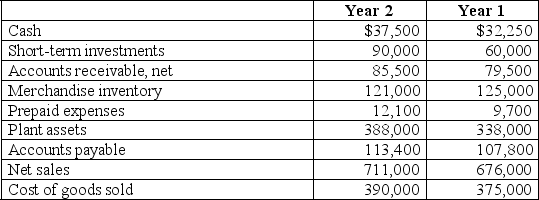
(Multiple Choice)
4.9/5 (72)
(72) The greater the times interest earned ratio,the greater the risk a company is exposed to.
(True/False)
4.7/5 (89)
(89) A high level of expected risk suggests a low price-earnings ratio.
(True/False)
4.7/5 (84)
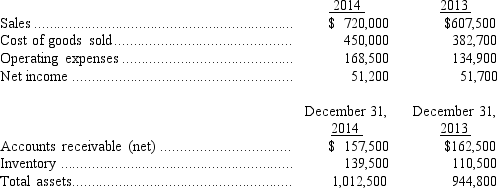
(84) Comparative calendar-year financial data for a company are shown below.Calculate the following ratios for the company for 2014:
(a)accounts receivable turnover
(b)day's sales uncollected
(c)inventory turnover
(d)days' sales in inventory
(Essay)
4.8/5 (71)
(71) Vertical analysis is used to reveal patterns in data covering successive periods.
(True/False)
4.8/5 (86)
(86) When a company's activities include income-related events not part of normal,continuing operations,the complete income statement could potentially have the following sections:
(Multiple Choice)
4.9/5 (74)
(74) Refer to the following selected financial information from Fennie's,LLC.Compute the company's days' sales uncollected for Year 2. 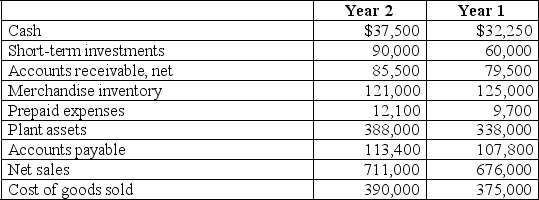
(Multiple Choice)
4.8/5 (91)
(91) The evaluation of company performance and financial condition includes evaluation of (1)past and current performance,(2)current financial position,and (3)future performance and risk.
(True/False)
4.8/5 (79)
(79) Use the following selected information from Farris,LLC to determine the Year 2 and Year 1 trend percents for cost of goods sold using Year 1 as the base. 
(Multiple Choice)
4.8/5 (87)
(87) Financial statement analysis lessens the need for expert judgment.
(True/False)
4.9/5 (77)
(77) Comparative statements for Kool Corporation are shown below:
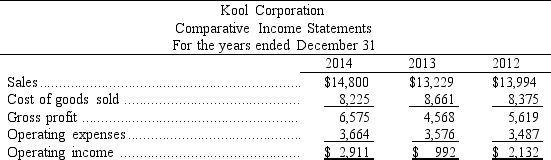 Calculate trend percentages for all income statement amounts shown and comment on the results.Use 2012 as the base year.Comment on the results.
 (Essay)
4.8/5 (70)
(70) Analysis of a single financial number is often of limited value.
(True/False)
4.8/5 (78)
(78) Dividing accounts receivable,net by net sales and multiplying the result by 365 is the:
(Multiple Choice)
4.9/5 (82)
(82) 
Filters
- Essay(0)
- Multiple Choice(0)
- Short Answer(0)
- True False(0)
- Matching(0)