



 Chat with AI
Exam 17: Analysis of Financial Statements

Exam 1: Accounting in Business241 Questions
Exam 2: Analyzing and Recording Transactions188 Questions
Exam 3: Adjusting Accounts and Preparing Financial Statements213 Questions
Exam 4: Completing the Accounting Cycle168 Questions
Exam 5: Accounting for Merchandising Operations189 Questions
Exam 7: Accounting Information Systems164 Questions
Exam 8: Cash and Internal Controls193 Questions
Exam 9: Accounting for Receivables170 Questions
Exam 10: Plant Assets, natural Resources, and Intangibles216 Questions
Exam 11: Current Liabilities and Payroll Accounting194 Questions
Exam 12: Accounting for Partnerships133 Questions
Exam 13: Accounting for Corporations210 Questions
Exam 14: Long-Term Liabilities199 Questions
Exam 15: Investments and International Operations175 Questions
Exam 16: Reporting the Statement of Cash Flows178 Questions
Exam 17: Analysis of Financial Statements178 Questions
Exam 18: Managerial Accounting Concepts and Principles203 Questions
Exam 19: Job Order Costing160 Questions
Exam 20: Process Costing156 Questions
Exam 21: Cost-Volume-Profit Analysis180 Questions
Exam 22: Master Budgets and Planning153 Questions
Exam 23: Flexible Budgets and Standard Costs168 Questions
Exam 24: Performance Measurement and Responsibility Accounting163 Questions
Exam 25: Capital Budgeting and Managerial Decisions131 Questions
Exam 26: Time Value of Money B60 Questions
Exam 27: Activity-Based Costing C37 Questions
Select questions type


Three of the most common tools of financial analysis include horizontal analysis,vertical analysis,and ratio analysis.
(True/False)
5.0/5  (82)
(82) Refer to the following selected financial information from Fennie's,LLC.Compute the company's acid-test ratio for Year 2. 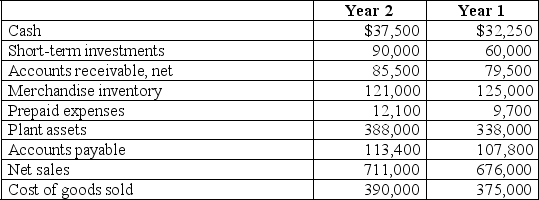
(Multiple Choice)
4.8/5 (86)
(86) Three of the most common tools of financial analysis are (1)____________,(2)__________________,and (3)______________________.
(Essay)
4.8/5 (85)
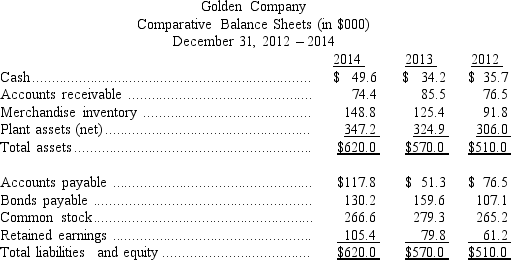
(85) The comparative balance sheet for Golden Co.is shown below.Express the balance sheet in common-size percents.
(Essay)
4.8/5 (74)
(74) The percent change is computed by subtracting the analysis period amount from the base period amount,dividing the result by the base period amount and multiplying that result by 100.
(True/False)
4.9/5 (79)
(79) General-purpose financial statements include the (1)______________,(2)_____________,(3)_______________,(4)______________ and (5)________________.
(Essay)
4.8/5 (67)
(67) Refer to the following selected financial information from Hansen's,LLC.Compute the company's profit margin for Year 2. 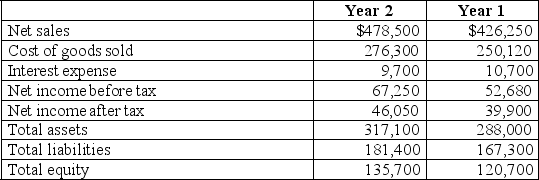
(Multiple Choice)
4.9/5 (72)
(72) Financial analysis only refers to the communication of relevant financial information to decision makers.
(True/False)
4.9/5 (84)
(84) Financial reporting includes not only general purpose financial statements,but also information from SEC filings,press releases,shareholders' meetings,forecasts,management letters,auditor's reports,and Webcasts.
(True/False)
4.8/5 (70)
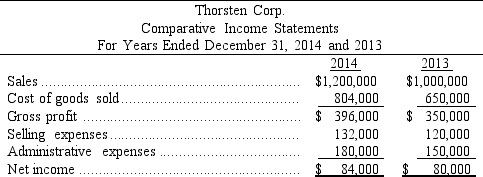
(70) Express the following income statement information in common-size percents (round to nearest whole percent).Comment on the results.
(Essay)
5.0/5 (70)
(70) Vertical analysis is the comparison of a company's financial condition and performance across time.
(True/False)
4.8/5 (76)
(76) Capital structure refers to a company's long-run financial viability and its ability to cover long-term obligations.
(True/False)
4.8/5 (91)
(91) In order to be classified as an extraordinary gain or loss,the item must be both (1)_______________ and (2)____________.
(Essay)
4.7/5 (87)
(87) The base amount for a common-size balance sheet is usually total assets.
(True/False)
4.9/5 (55)
(55) Refer to the following selected financial information from Fennie's,LLC.Compute the company's inventory turnover for Year 2. 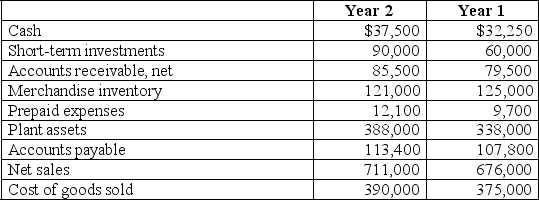
(Multiple Choice)
4.9/5 (76)
(76) Standards for comparison are necessary when making judgments about a company's performance.
(True/False)
4.9/5 (79)
(79) The following selected financial information for a company was reported for the current year end.Calculate the following company ratios:
(a)Accounts receivable turnover.
(b)Inventory turnover.
(c)Days' sales uncollected
Accounts receivable,beginning-year……………. $170,000
Accounts receivable,year-end…………………… 190,000
Merchandise inventory,beginning-year…………. 80,000
Merchandise inventory,year-end………………… 60,000
Cost of goods sold………………………………... 580,000
Credit sales………………………………………... 1,000,000
(Essay)
4.8/5 (86)
(86) 
Filters
- Essay(0)
- Multiple Choice(0)
- Short Answer(0)
- True False(0)
- Matching(0)