



 Chat with AI
Exam 17: Analysis of Financial Statements

Exam 1: Accounting in Business241 Questions
Exam 2: Analyzing and Recording Transactions188 Questions
Exam 3: Adjusting Accounts and Preparing Financial Statements213 Questions
Exam 4: Completing the Accounting Cycle168 Questions
Exam 5: Accounting for Merchandising Operations189 Questions
Exam 7: Accounting Information Systems164 Questions
Exam 8: Cash and Internal Controls193 Questions
Exam 9: Accounting for Receivables170 Questions
Exam 10: Plant Assets, natural Resources, and Intangibles216 Questions
Exam 11: Current Liabilities and Payroll Accounting194 Questions
Exam 12: Accounting for Partnerships133 Questions
Exam 13: Accounting for Corporations210 Questions
Exam 14: Long-Term Liabilities199 Questions
Exam 15: Investments and International Operations175 Questions
Exam 16: Reporting the Statement of Cash Flows178 Questions
Exam 17: Analysis of Financial Statements178 Questions
Exam 18: Managerial Accounting Concepts and Principles203 Questions
Exam 19: Job Order Costing160 Questions
Exam 20: Process Costing156 Questions
Exam 21: Cost-Volume-Profit Analysis180 Questions
Exam 22: Master Budgets and Planning153 Questions
Exam 23: Flexible Budgets and Standard Costs168 Questions
Exam 24: Performance Measurement and Responsibility Accounting163 Questions
Exam 25: Capital Budgeting and Managerial Decisions131 Questions
Exam 26: Time Value of Money B60 Questions
Exam 27: Activity-Based Costing C37 Questions
Select questions type


The dollar change for a financial statement item is calculated by:
(Multiple Choice)
4.9/5  (84)
(84) Refer to the following selected financial information from Fennie's,LLC.Compute the company's working capital for Year 2. 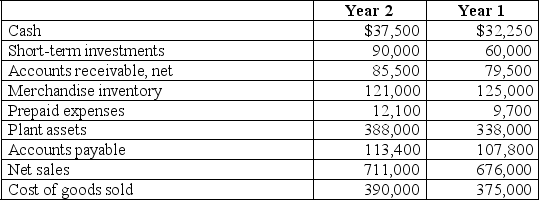
(Multiple Choice)
4.9/5 (94)
(94) The use of debt is sometimes described as financial leverage because debt can have the effect of increasing the return on equity.
(True/False)
4.8/5 (76)
(76) Refer to the following selected financial information from Hansen's,LLC.Compute the company's times interest earned for Year 2. 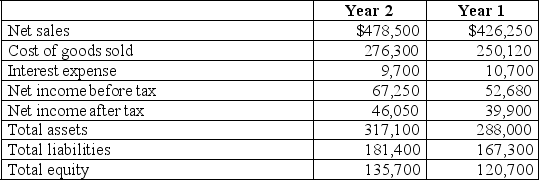
(Multiple Choice)
4.7/5 (94)
(94) Trend analysis is a form of horizontal analysis that can reveal patterns in data across successive periods.
(True/False)
4.9/5 (94)
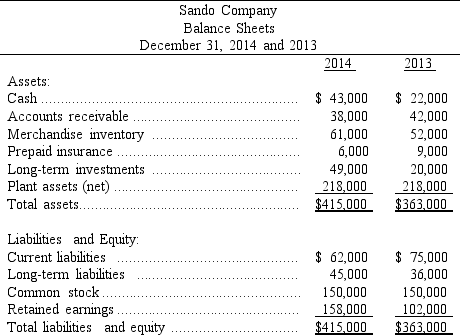
(94) Use the balance sheets of Sando shown below to calculate the following ratios for 2014 (round to the hundredths):
(a)Current ratio.
(b)Acid-test ratio.
(c)Debt ratio.
(d)Equity ratio.
(Essay)
5.0/5 (71)
(71) Identify and describe three common tools of financial statement analysis.
(Essay)
4.9/5 (72)
(72) Net sales divided by average accounts receivable,net is the:
(Multiple Choice)
4.9/5 (75)
(75) Earnings per share are calculated only on income from continuing operations.
(True/False)
4.9/5 (76)
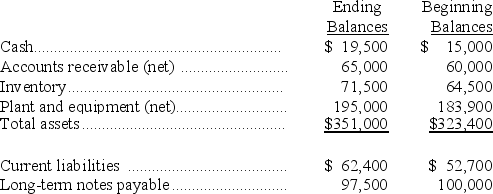
(76) Use the financial data shown below to calculate the following ratios for the current year:
(a)Current ratio.
(b)Acid-test ratio.
(c)Accounts receivable turnover.
(d)Days' sales uncollected.
(e)Inventory turnover.
(f)Days' sales in inventory.
 Sales (all on credit)………………………………… $650,000
Cost of goods sold…………………………………. 425,000
Income before taxes……………………………….. 78,000
Net income………………………………………… 54,600
Sales (all on credit)………………………………… $650,000
Cost of goods sold…………………………………. 425,000
Income before taxes……………………………….. 78,000
Net income………………………………………… 54,600
(Essay)
4.7/5 (80)
(80) The income level most likely to continue into the future and is commonly used in PE ratios and other market-based measures of performance is the ________________________.
(Short Answer)
4.9/5 (81)
(81) General-purpose financial statements include the (1)income statement,(2)balance sheet,(3)statement of stockholders' equity (or statement of retained earnings),(4)statement of cash flows,and (5)notes to these statements.
(True/False)
4.9/5 (69)
(69) Comparative financial statements in which each individual financial statement amount is expressed as a percentage of a base amount are called:
(Multiple Choice)
4.8/5 (94)
(94) The standards for comparisons in financial statement analysis include (1)___________,(2)____________,(3)_____________,and (4)_______________.
(Essay)
4.8/5 (83)
(83) 
Filters
- Essay(0)
- Multiple Choice(0)
- Short Answer(0)
- True False(0)
- Matching(0)