



 Chat with AI
Exam 17: Radioactivity and Nuclear Chemistry

Exam 1: The Chemical World59 Questions
Exam 2: Measurement and Problem Solving131 Questions
Exam 3: Matter and Energy118 Questions
Exam 4: Atoms and Elements112 Questions
Exam 5: Molecules and Compounds110 Questions
Exam 6: Chemical Composition118 Questions
Exam 7: Chemical Reactions113 Questions
Exam 8: Quantities in Chemical Reactions115 Questions
Exam 9: Electrons in Atoms and the Periodic Table111 Questions
Exam 10: Chemical Bonding109 Questions
Exam 11: Gases123 Questions
Exam 12: Liquids, solids, and Intermolecular Forces115 Questions
Exam 13: Solutions122 Questions
Exam 14: Acids and Bases117 Questions
Exam 15: Chemical Equilibrium118 Questions
Exam 16: Oxidation and Reduction113 Questions
Exam 17: Radioactivity and Nuclear Chemistry115 Questions
Exam 18: Organic Chemistry109 Questions
Exam 19: Biochemistry110 Questions
Select questions type


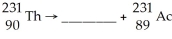

What happens to the mass number of a nucleus that emits a positron?
(Multiple Choice)
4.8/5  (84)
(84) Which of the following isotopes contains the most number of neutrons?
(Multiple Choice)
4.9/5 (91)
(91) The reaction  H +
 H →
 He +
 neutron is an example of nuclear fission.
H + H → He + neutron is an example of nuclear fission. (True/False)
4.8/5 (75)
(75) In a Geiger-Muller counter,radioactive particles pass through NaI which emits UV-Vis light.
(True/False)
4.7/5 (79)
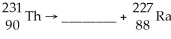
(79) 
A C-14 dating experiment revealed that an artifact had 50.0% of the activity of a modern organism.Given the half-life of C-14 is 5730 years,approximately how old is the artifact?
(Multiple Choice)
5.0/5 (69)
(69) A positron particle comes from the decay of a proton into a neutron and a positron.
(True/False)
4.9/5 (76)
(76)  Th undergoes beta decay?
Which of the following statements about beta particles is FALSE?
(Multiple Choice)
5.0/5 (77)
(77) 
Filters
- Essay(0)
- Multiple Choice(0)
- Short Answer(0)
- True False(0)
- Matching(0)