



 Chat with AI
Exam 9: Management of Economic Exposure

Exam 1: Globalization and the Multinational Firm98 Questions
Exam 2: International Monetary System100 Questions
Exam 3: Balance of Payments100 Questions
Exam 4: Corporate Governance Around the World100 Questions
Exam 5: The Market for Foreign Exchange100 Questions
Exam 6: International Parity Relationships and Forecasting Foreign Exchange Rates100 Questions
Exam 7: Futures and Options on Foreign Exchange100 Questions
Exam 8: Management of Transaction Exposure100 Questions
Exam 9: Management of Economic Exposure100 Questions
Exam 10: Management of Translation Exposure81 Questions
Exam 11: International Banking and Money Market101 Questions
Exam 12: International Bond Market100 Questions
Exam 13: International Equity Markets99 Questions
Exam 14: Interest Rate and Currency Swaps100 Questions
Exam 15: International Portfolio Investment101 Questions
Exam 16: Foreign Direct Investment and Cross-Border Acquisitions100 Questions
Exam 17: International Capital Structure and the Cost of Capital99 Questions
Exam 18: International Capital Budgeting101 Questions
Exam 19: Multinational Cash Management100 Questions
Exam 20: International Trade Finance100 Questions
Exam 21: International Tax Environment and Transfer Pricing100 Questions
Select questions type


With regard to operational hedging versus financial hedging,

Free
(Multiple Choice)
4.8/5  (83)
(83) Correct Answer: Verified
A
Suppose a U.S.firm has an asset in Italy whose local currency price is random.For simplicity,suppose there are only three states of the world and each state is equally likely to occur.The future local currency price of this asset (P*)as well as the future exchange rate (S)will be determined,depending on the realized state of the world.  Assume that you choose to "hedge" this asset by selling forward the expected value of the euro denominated cash flow at F1($/£)= $1.50/€.Calculate your cash flows in each of the possible states.
Free
(Multiple Choice)
4.9/5 (79)
(79) Correct Answer:Verified
VerifiedA
The price elasticity of demand for commodity products tends to be
Free
(Multiple Choice)
4.9/5 (71)
(71) Correct Answer:Verified
VerifiedA
Consider a U.S.MNC who owns a foreign asset.If the foreign currency value of the asset is inversely related to changes in the dollar-foreign currency exchange rate,
(Multiple Choice)
4.8/5 (90)
(90) Consider a U.S.MNC with operations in Great Britain.Which of the following are potential risks following a strengthening of the dollar?
(Multiple Choice)
4.8/5 (66)
(66) From the perspective of the U.S.firm that owns an asset in Britain,the exposure that can be measured by the coefficient b in regressing the dollar value P of the British asset on the dollar/pound exchange rate S using the regression equation  is
is (Multiple Choice)
5.0/5 (92)
(92) 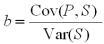 in the regression
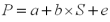 informs
Suppose the U.S.dollar substantially depreciates against the Japanese yen.The change in exchange rate
(Multiple Choice)
4.7/5 (86)
(86) A firm that is committed to keeping manufacturing facilities in only the home country (and not developing multiple production sites in a variety of countries)can
(Multiple Choice)
4.8/5 (88)
(88) Consider a U.S.-based MNC with a wholly-owned Italian subsidiary.Following a depreciation of the dollar against the euro,which of the following conclusions are correct?
(Multiple Choice)
4.9/5 (88)
(88) The link between a firm's future operating cash flows and exchange rate fluctuations is
(Multiple Choice)
4.9/5 (79)
(79) The extent to which the firm's operating cash flows would be affected by random changes in exchange rates is called
(Multiple Choice)
4.8/5 (92)
(92) Generally speaking,a firm is subject to high degrees of operating exposure
(Multiple Choice)
4.8/5 (78)
(78)  is given by:
Developing multiple production sites in a variety of countries,
(Multiple Choice)
4.9/5 (73)
(73) 
Filters
- Essay(0)
- Multiple Choice(0)
- Short Answer(0)
- True False(0)
- Matching(0)