



 Chat with AI
Exam 17: International Capital Structure and the Cost of Capital

Exam 1: Globalization and the Multinational Firm98 Questions
Exam 2: International Monetary System100 Questions
Exam 3: Balance of Payments100 Questions
Exam 4: Corporate Governance Around the World100 Questions
Exam 5: The Market for Foreign Exchange100 Questions
Exam 6: International Parity Relationships and Forecasting Foreign Exchange Rates100 Questions
Exam 7: Futures and Options on Foreign Exchange100 Questions
Exam 8: Management of Transaction Exposure100 Questions
Exam 9: Management of Economic Exposure100 Questions
Exam 10: Management of Translation Exposure81 Questions
Exam 11: International Banking and Money Market101 Questions
Exam 12: International Bond Market100 Questions
Exam 13: International Equity Markets99 Questions
Exam 14: Interest Rate and Currency Swaps100 Questions
Exam 15: International Portfolio Investment101 Questions
Exam 16: Foreign Direct Investment and Cross-Border Acquisitions100 Questions
Exam 17: International Capital Structure and the Cost of Capital99 Questions
Exam 18: International Capital Budgeting101 Questions
Exam 19: Multinational Cash Management100 Questions
Exam 20: International Trade Finance100 Questions
Exam 21: International Tax Environment and Transfer Pricing100 Questions
Select questions type


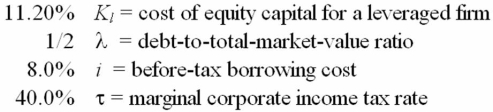
Solve for the weighted average cost of capital: 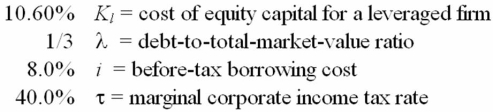

Free
(Multiple Choice)
4.9/5  (78)
(78) Correct Answer: Verified
A
Compute the debt-to-equity ratio for a firm that has a debt-to-value ratio of 60%.
Free
(Multiple Choice)
4.8/5 (91)
(91) Correct Answer:Verified
VerifiedC
Assume that the risk-free rate of return is 4%,and the expected return on the market portfolio is 10%.If the systematic risk inherent in the stock of ABC Corporation is 1.80,using the Capital Asset Pricing Model (CAPM)calculate the expected return of ABC.
Free
(Multiple Choice)
4.7/5 (92)
(92) Correct Answer:Verified
VerifiedB
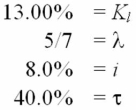
In the notation of the book,K = (1 - )Kl + (1 - )i Which of the following are correct?
(Multiple Choice)
4.9/5 (72)
(72) 
Find the debt-to-value ratio for a firm with a debt-to-equity ratio of 1½.
(Multiple Choice)
4.7/5 (66)
(66) Find the debt-to-value ratio for a firm with a debt-to-equity ratio of 1.
(Multiple Choice)
4.9/5 (70)
(70) Suppose that the firm's cost of capital can be reduced from Kl under the local capital structure to Kg under an internationalized capital structure.The take-away lesson from the graph is that 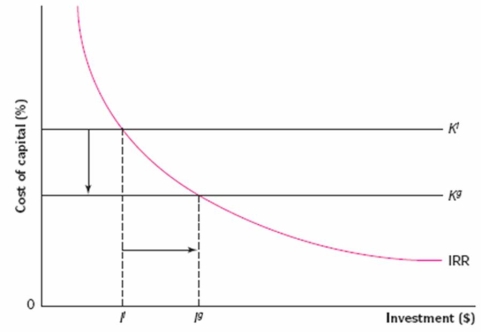
(Multiple Choice)
4.9/5 (76)
(76) 
One likely effect of a company or government instituting foreign equity ownership restrictions is
(Multiple Choice)
4.8/5 (81)
(81) In the Capital Asset Pricing Model (CAPM),the term Beta, ,is
(Multiple Choice)
4.7/5 (85)
(85) Studies suggest that international capital markets are not segmented anymore
(Multiple Choice)
4.9/5 (79)
(79) 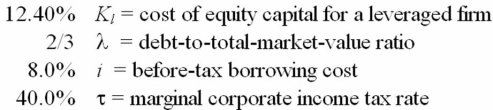
Find the weighted average cost of capital for a firm that has a debt-to-equity ratio of 2,a tax rate of 40%,a levered cost of equity of 12% and a pre-tax cost of debt of 9%.
(Multiple Choice)
4.7/5 (88)
(88) The following is an outline of certain potential benefits as well as costs associated with the cross-border listings of stocks: (i)- the company can expand its potential investor base
(ii)- issues involving the disclosure and listing requirements
(iii)- creates a secondary market for the company's shares
(iv)- volatility spillover from the overseas markets
(v)- liquidity
(vi)- control of the company by foreigners
(vii)- enhances the visibility of the company's name and its products in foreign marketplaces
Which of the following represent all the potential benefits of the cross-border listings of stocks?
(Multiple Choice)
4.8/5 (74)
(74) The parent company should decide the financing method for its own subsidiaries
(Multiple Choice)
4.9/5 (72)
(72) Companies domiciled in countries with weak investor protection can reduce agency costs between shareholders and management
(Multiple Choice)
4.7/5 (78)
(78) Find the debt-to-equity ratio for a firm with a debt-to-total-value ratio of 4/5.
(Multiple Choice)
4.7/5 (75)
(75) 
Filters
- Essay(0)
- Multiple Choice(0)
- Short Answer(0)
- True False(0)
- Matching(0)