



 Chat with AI
Exam 10: Depreciation, Amortization, and Impairment

Exam 1: The Framework for Financial Reporting69 Questions
Exam 2: Accounting Judgements77 Questions
Exam 3: Statements of Income and Comprehensive Income168 Questions
Exam 4: Statements of Financial Position and Changes in Equity; Disclosure Notes127 Questions
Exam 5: The Statement of Cash Flows116 Questions
Exam 6: Revenue Recognition98 Questions
Exam 7: Financial Assets: Cash and Receivables227 Questions
Exam 8: Cost-Based Inventories and Cost of Sales93 Questions
Exam 9: Long-Lived Assets134 Questions
Exam 10: Depreciation, Amortization, and Impairment154 Questions
Exam 11: Financial Instruments: Investments in Bonds and Equity Securities162 Questions
Select questions type


Following are five separate and completely independent cases:
CASE A: A $700 item was excluded incorrectly from the ending inventory; the related purchase was not recorded.
CASE B: A $200 item was included incorrectly in the ending inventory; the related purchase was recorded.
CASE C: A $900 item was included incorrectly in the ending inventory; the related purchase was not recorded.
CASE D: A $500 item was excluded incorrectly from ending inventory; the related purchase was recorded.
CASE E: The beginning inventory was Overstated $400.
Enter dollar amounts where appropriate in the following tabulation to indicate the effect on the financial statements of each of the items given above (disregard income tax). 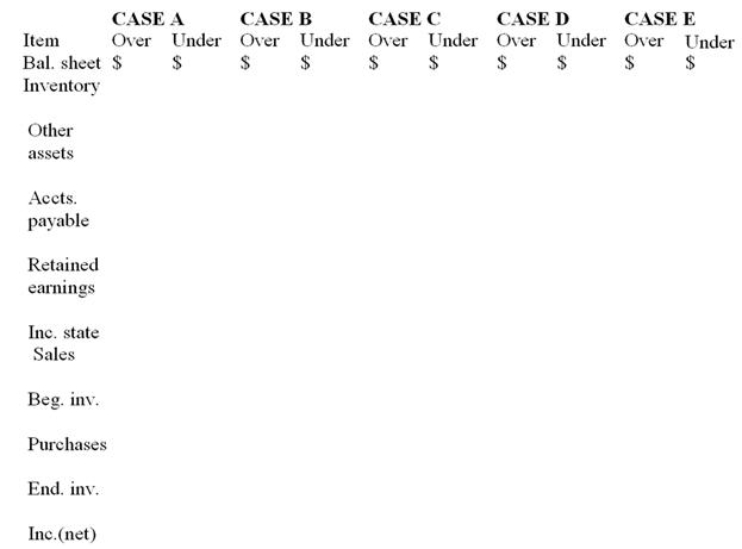
(Essay)
4.9/5  (78)
(78) If a $1,000 purchase on credit last year was not recorded until this year and these goods purchased were not included in any year's ending inventory,the purchase error is counterbalancing.
(True/False)
5.0/5 (97)
(97) Give the correct response to each of the following events:
(a)An overstatement of accrued wages payable by $2,000 at the end of 20x1 would cause retained earnings at the end of 20x2 to be _____ Overstated; _____ Understated by; _____ correct (assuming no correcting entry).
(b)A $6,000 purchase of merchandise on credit in 20x1 was not recorded in 20x1; but it was recorded in 20x2 when the cash was paid.It was discovered during 20x3.The merchandise was not included in the 20x1 ending inventory.Therefore,20x1 income was: _____ Overstated; _____ Understated by; _____ correct.
(c)The 20x2 ending inventory was Overstated $4,000 and no correcting entry has been made.Therefore the 20x3 net income is: _____ Overstated; _____ Understated by; _____ correct.
(Essay)
4.8/5 (78)
(78) On January 1,20x1,DB purchased equipment that cost $48,000.It was depreciated on the straight-line basis for the years 20x1,20x2 and 20x3 (estimated useful life 5 years and no residual value).During early 20x4,DB changed the estimated total useful life to 7 years and the residual value to $3,200 at the end of year 7.
(a)Give any entry required during 20x4 by DB to reflect the change.If none is required,explain why.
(b)Give the adjusting journal entry required on December 31,20x4.
(Essay)
4.9/5 (81)
(81) The records of CDF reflected the following data for 20x1:
Cash paid during 20x1 for expenses,$10,000.  The amount of expense that CDF should report on the 20x1 income statement is $_____________________.
 (Essay)
4.9/5 (81)
(81) A change from the sum-of-the-years'-digits depreciation method to the straight-line depreciation method should be accounted for as a(n):
(Multiple Choice)
4.9/5 (78)
(78) In 20x2,a firm changed from the straight-line (SL)method of depreciation to double declining balance (DDB)to conform to long-standing industry practice.The firm's 20x1 and 20x2 comparative financial statements will reflect which method or methods. 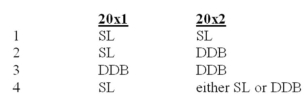
(Multiple Choice)
4.9/5 (68)
(68) Some changes in accounting principle must be reported by using the retrospective approach.
(True/False)
4.9/5 (84)
(84) With respect to a retrospectively applied change in accounting policy,the effects on prior years' income is treated as an adjustment to opening retained earnings.
(True/False)
4.8/5 (72)
(72) The concept of consistency is sacrificed in the accounting for which of the following items?
(Multiple Choice)
4.8/5 (90)
(90) XYZ decided to change its depreciation policy by (1)discontinuing to record depreciation on land,and (2)changing the estimated useful life on all autos used in the business from five years to four years.Choose the correct statement concerning these two changes:
(Multiple Choice)
4.8/5 (80)
(80) The following errors were discovered during January 20x3 (prior to any reversing entries):  The accounting period ends December 31.What effect would these errors have on 20x3 pre-tax income?
 (Multiple Choice)
4.7/5 (100)
(100) On January 1,2015,JTC changed to the weighted-average cost method from the first-in,first-out (FIFO)cost method for inventory cost flow purposes.JTC can justify this as a change in policy.The change will result in a $120,000 decrease in the beginning inventory at January 1,2015.Ignoring income taxes,the cumulative effect of changing to the weighted-average method from the FIFO method must be reported by JTC in the 2015:
(Multiple Choice)
4.8/5 (81)
(81) 
Filters
- Essay(0)
- Multiple Choice(0)
- Short Answer(0)
- True False(0)
- Matching(0)