



 Chat with AI
Exam 10: Depreciation, Amortization, and Impairment

Exam 1: The Framework for Financial Reporting69 Questions
Exam 2: Accounting Judgements77 Questions
Exam 3: Statements of Income and Comprehensive Income168 Questions
Exam 4: Statements of Financial Position and Changes in Equity; Disclosure Notes127 Questions
Exam 5: The Statement of Cash Flows116 Questions
Exam 6: Revenue Recognition98 Questions
Exam 7: Financial Assets: Cash and Receivables227 Questions
Exam 8: Cost-Based Inventories and Cost of Sales93 Questions
Exam 9: Long-Lived Assets134 Questions
Exam 10: Depreciation, Amortization, and Impairment154 Questions
Exam 11: Financial Instruments: Investments in Bonds and Equity Securities162 Questions
Select questions type


Which of the following is not a change in accounting policy?
(Multiple Choice)
4.9/5  (84)
(84) A retrospectively applied change in accounting policy relating to fixed assets where a company changes from the straight-line amortization method to the double-declining balance method would result in a decrease to opening retained earnings.
(True/False)
4.8/5 (68)
(68) A change from a non-GAAP procedure to a GAAP procedure usually is referred to as a change in accounting principle.
(True/False)
4.8/5 (87)
(87) Changes in estimates and prospectively-applied accounting policy changes occur more often in practice than do retrospectively-applied accounting policy changes.
(True/False)
4.8/5 (67)
(67) A change in policy mandated by a change of standard under IFRS is an example of a mandatory policy change.
(True/False)
5.0/5 (76)
(76) The following errors were discovered during January 20x3 (prior to any reversing entries).The accounting period ends December 31.  What effect did these errors have on the 20x2 pre-tax income?
 (Multiple Choice)
4.7/5 (82)
(82) Accounting changes reported by using the current approach,require that the "catch-up adjustment" include the effect on earnings in the year of the change.
(True/False)
4.8/5 (62)
(62) Which of the following is not an example of a change in accounting estimate?
(Multiple Choice)
4.8/5 (90)
(90) Depreciation expense for the most recent fiscal year on equipment purchased a few years ago is $10,000.The balance sheet at the end of the same year disclosed the following:  The asset is not expected to have a salvage value and the firm depreciates the asset on the straight-line basis.In March of the next year (the year of change),the firm decided to reduce the original total useful life 20% and that a salvage value of $30,000 is a reasonable estimate.What is depreciation in the year of the change?
 (Multiple Choice)
4.9/5 (74)
(74) The failure to accrue revenues for services rendered but not billable until future periods would be considered a self-correcting error.
(True/False)
4.7/5 (80)
(80) An asset that cost $49,500 was being depreciated on a sum-of-the-years'-digits basis over five years with an estimated residual value of $4,500.After the end of the third year,it was decided to change to straight-line depreciation (ignore income taxes).
(a)Give any required entry as of the beginning of year 4.
(b)Give the adjusting entry to record depreciation at the end of the fourth year,taking into account the new decision.
(Essay)
4.8/5 (78)
(78) ABC Inc.'s Year 1 ending inventory was overstated by $20,000.Its Year 2 ending inventory was understated by $30,000.Assuming that the books for Year 2 are still open,which of the following adjustments would be required? Assume a tax rate of 25%.
(Multiple Choice)
4.9/5 (74)
(74) Complete the following tabulation by inserting in each square the appropriate code as follows: "O" for Overstated; "U" for Understated by; and "N" for no effect Complete all squares.Each transaction (but not years)is a separate situation independent of the others. 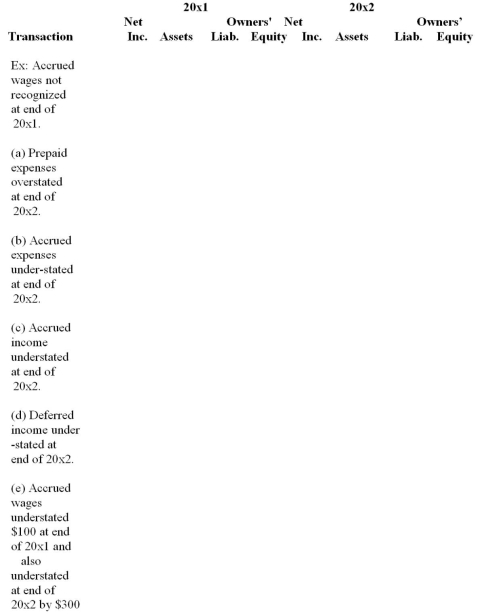
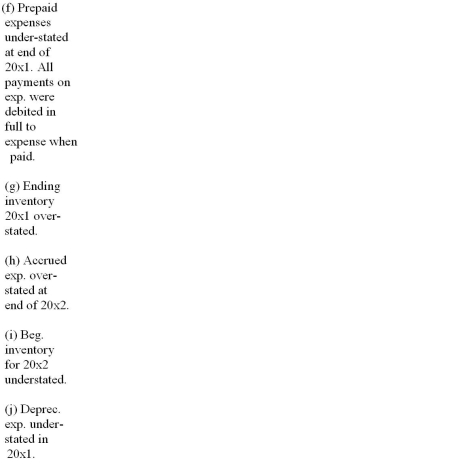
(Essay)
5.0/5 (82)
(82) A change in accounting principle occurs when a company adopts a principle different from an inappropriate procedure that was used previously.
(True/False)
4.9/5 (80)
(80) In reporting the effect of an accounting change on comparative financial statements,recommended accounting procedure requires that the following be used for correcting an accounting error:
(Multiple Choice)
4.8/5 (80)
(80) The correction of an accounting error affecting prior years' income is reported and recorded by using the retrospective approach.
(True/False)
4.9/5 (77)
(77) Which of the following changes would be disclosed as a change in accounting principle but reported by applying the new method retrospectively as restatements of prior periods?
(Multiple Choice)
4.7/5 (84)
(84) Which of the following changes would be accounted for prospectively?
(Multiple Choice)
4.7/5 (93)
(93) Early adoption of involuntary changes in accounting policy is prohibited under IFRS.
(True/False)
4.9/5 (76)
(76) 
Filters
- Essay(0)
- Multiple Choice(0)
- Short Answer(0)
- True False(0)
- Matching(0)