



 Chat with AI
Exam 21: International Corporate Finance

Exam 1: Introduction to Corporate Finance71 Questions
Exam 2: Financial Statements, Taxes, and Cash Flow81 Questions
Exam 3: Working With Financial Statements96 Questions
Exam 4: Long-Term Financial Planning and Growth80 Questions
Exam 5: Introduction to Valuation: The Time Value of Money68 Questions
Exam 6: Discounted Cash Flow Valuation132 Questions
Exam 7: Interest Rates and Bond Valuation129 Questions
Exam 8: Stock Valuation119 Questions
Exam 9: Net Present Value and Other Investment Criteria115 Questions
Exam 10: Making Capital Investment Decisions108 Questions
Exam 11: Project Analysis and Evaluation106 Questions
Exam 12: Some Lessons From Capital Market History98 Questions
Exam 13: Return, Risk, and the Security Market Line109 Questions
Exam 14: Cost of Capital100 Questions
Exam 15: Raising Capital93 Questions
Exam 16: Financial Leverage and Capital Structure Policy98 Questions
Exam 17: Dividends and Payout Policy103 Questions
Exam 18: Short-Term Finance and Planning109 Questions
Exam 19: Cash and Liquidity Management101 Questions
Exam 20: Credit and Inventory Management97 Questions
Exam 21: International Corporate Finance99 Questions
Exam 22: Behavioral Finance: Implications for Financial Management45 Questions
Exam 23: Enterprise Risk Management68 Questions
Exam 24: Options and Corporate Finance106 Questions
Exam 25: Option Valuation79 Questions
Exam 26: Mergers and Acquisitions89 Questions
Exam 27: Leasing72 Questions
Select questions type


Describe the foreign currency and home currency approaches to capital budgeting for a foreign project.Which is better?
Which approach would you recommend a U.S.firm use?
Justify your answer.
(Essay)
4.8/5  (86)
(86) The LIBOR is primarily used as the basis for the rate charged on:
(Multiple Choice)
4.8/5 (78)
(78) You want to invest in a riskless project in Sweden.The project has an initial cost of SKr3.8million and is expected to produce cash inflows of SKr1.75 million a year for three years.The project will be worthless after three years.The expected inflation rate in Sweden is 3.2 percent while it is 4.3 percent in the U.S.A risk-free security is paying 5.5 percent in the U.S.The current spot rate is $1 = SKr7.7274.What is the net present value of this project in Swedish kroner? Assume the international Fisher effect applies.
(Multiple Choice)
4.8/5 (82)
(82) You have 100 British pounds.A friend of yours is willing to exchange 180 Canadian dollars for your 100 British pounds.What will be your profit or loss if you accept your friend's offer,given the following exchange rates? 
(Multiple Choice)
4.9/5 (76)
(76) Assume that ¥95.42 equal $1.Also assume that SKr7.7274 equal $1.How many Japanese yen can you acquire in exchange for 3,000 Swedish krone?
(Multiple Choice)
4.9/5 (72)
(72) You observe that the inflation rate in the United States is 3.5 percent per year and that T-bills currently yield 3.8 percent annually.What do you estimate the inflation rate to be in Australia,if short-term Australian government securities yield 4.5 percent per year?
(Multiple Choice)
4.9/5 (63)
(63) Absolute purchasing power parity is most apt to exist for which one of the following items?
(Multiple Choice)
4.9/5 (94)
(94) International bonds issued in multiple countries but denominated solely in the issuer's currency are called:
(Multiple Choice)
4.7/5 (75)
(75) What is the relationship between the value of the dollar and the value of the euro in relation to the rate of inflation in the United States?
(Essay)
4.7/5 (86)
(86) Suppose the spot and six-month forward rates on the Norwegian krone are Kr6.36 and Kr6.56,respectively.The annual risk-free rate in the United States is 4.5 percent,and the annual risk-free rate in Norway is 7 percent.What would the six-month forward rate have to be on the Norwegian krone to prevent arbitrage?
(Multiple Choice)
4.9/5 (81)
(81) Today,you can get either 121 Canadian dollars or 1,288 Mexican pesos for 100 U.S.dollars.Last year,100 U.S.dollars was worth 115 Canadian dollars or 1,291 Mexican pesos.Which one of the following statements is correct given this information?
(Multiple Choice)
4.9/5 (79)
(79) Based on the information below,what is the cross-rate for Australian dollars in terms of Swiss francs? 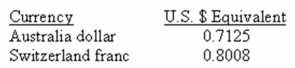
(Multiple Choice)
4.7/5 (79)
(79) Suppose the current spot rate for the Norwegian kroner is $1 = NKr6.6869.The expected inflation rate in Norway is 6 percent and in the U.S.it is 3.1 percent.A risk-free asset in the U.S.is yielding 4 percent.What risk-free rate of return should you expect on a Norwegian security?
(Multiple Choice)
4.9/5 (95)
(95) Using currencies A,B,and C construct an example in which triangle arbitrage exists and then show how to exploit it.
(Essay)
4.9/5 (79)
(79) You want to import $147,000 worth of rugs from India.How many rupees will you need to pay for this purchase if one rupee is worth $0.0203?
(Multiple Choice)
4.8/5 (86)
(86) The foreign currency approach to capital budgeting analysis:
I.is computationally easier to use than the home currency approach.
II.produces the same results as the home currency approach.
III.requires an exchange rate for each time period for which there is a cash flow.
IV.computes the NPV of a project in both the foreign and the domestic currency.
(Multiple Choice)
4.9/5 (83)
(83) Which of the following conditions are required for absolute purchasing power parity to exist?
I.goods must be identical
II.goods must have equal economic value
III.transaction costs must be zero
IV.there can be no barriers to trade
(Multiple Choice)
4.8/5 (76)
(76) Which one of the following is a suggested method of reducing a U.S.importer's short-run exposure to exchange rate risk?
(Multiple Choice)
4.8/5 (79)
(79) Assume the spot rate on the Canadian dollar is C$1.1847.The risk-free nominal rate in the U.S.is 5 percent while it is only 4 percent in Canada.What one-year forward rate will create interest rate parity?
(Multiple Choice)
4.9/5 (74)
(74) 
Filters
- Essay(0)
- Multiple Choice(0)
- Short Answer(0)
- True False(0)
- Matching(0)