



 Chat with AI
Exam 7: Work and Kinetic Energy

Exam 1: Introduction to Physics100 Questions
Exam 2: One-Dimensional Kinematics112 Questions
Exam 3: Vectors in Physics82 Questions
Exam 4: Two-Dimensional Kinematics95 Questions
Exam 5: Newtons Laws of Motion101 Questions
Exam 6: Applications of Newtons Laws105 Questions
Exam 7: Work and Kinetic Energy92 Questions
Exam 8: Potential Energy and Conservation of Energy99 Questions
Exam 9: Linear Momentum and Collisions102 Questions
Exam 10: Rotational Kinematics and Energy102 Questions
Exam 11: Rotational Dynamics and Static Equilibrium97 Questions
Exam 12: Gravity94 Questions
Exam 13: Oscillations About Equilibrium102 Questions
Exam 14: Waves and Sound104 Questions
Exam 15: Fluids107 Questions
Exam 16: Temperature and Heat103 Questions
Exam 17: Phases and Phase Changes100 Questions
Exam 18: The Laws of Thermodynamics97 Questions
Exam 19: Electric Charges, Forces, and Fields88 Questions
Exam 20: Electric Potential and Electric Potential Energy99 Questions
Exam 21: Electric Current and Direct-Current Circuits99 Questions
Exam 22: Magnetism101 Questions
Exam 23: Magnetic Flux and Faradays Law of Induction99 Questions
Exam 24: Alternating-Current Circuits93 Questions
Exam 25: Electromagnetic Waves90 Questions
Exam 26: Geometrical Optics92 Questions
Exam 27: Optical Instruments102 Questions
Exam 28: Physical Optics: Interference and Diffraction93 Questions
Exam 29: Relativity100 Questions
Exam 30: Quantum Physics100 Questions
Exam 31: Atomic Physics75 Questions
Exam 32: Nuclear Physics and Nuclear Radiation89 Questions
Select questions type


An object of 1.0 kg mass is pulled up an inclined plane by a constant force of 10 N that causes a displacement of 0.50 m. The angle of inclination with the horizontal is 30°. Neglect friction and use g = 10 m/s2. What is the work done by the 10 N force on the object along the inclined plane?
(Multiple Choice)
4.8/5  (87)
(87) FIGURE 7-4 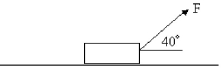 A constant force of 100 N is applied to a mass of 40.0 kg as shown in Figure 7-4. The force causes a displacement of 20.0 m to this mass along the + x-axis. Neglect friction.
-What is the work done by the component of the force in Figure 7-4 along the +x-axis?
A constant force of 100 N is applied to a mass of 40.0 kg as shown in Figure 7-4. The force causes a displacement of 20.0 m to this mass along the + x-axis. Neglect friction.
-What is the work done by the component of the force in Figure 7-4 along the +x-axis? (Multiple Choice)
4.7/5 (84)
(84) A man lifts a 20.0-kg bucket of concrete from the ground up to the top of a 20.0-m tall building. The bucket is initially at rest, but is traveling at 4.0 m/s when it reaches the top of the building. How much work was done by the man in lifting the bucket?
(Multiple Choice)
4.7/5 (72)
(72) If the net work done on an object is positive, then the object's kinetic energy
(Multiple Choice)
4.8/5 (78)
(78) Consider a plot of the displacement (x) vs. applied force (F) for an ideal elastic spring. The slope of the curve would be
(Multiple Choice)
4.8/5 (76)
(76) A person applies a constant force on an object of mass 20 kg that causes the object to move horizontally at a constant speed of 0.20 m/s through a distance of 0.80 m. What is the work done on the object?
(Multiple Choice)
5.0/5 (87)
(87) A person applies a constant force of 20 N to a rock of mass 1000 kg, for a total of 20 seconds. What is the work done by this person if the rock does not move at all by this applied force?
(Multiple Choice)
4.8/5 (74)
(74) Lisa runs up 4 flights of stairs in 22. seconds. She weighs 510. Newtons. If each flight rises 310. cm:
(a) What is her change in potential?
(b) What average power (watts) was required during the 22. s?
(c) What minimum horsepower motor would be required to do this?
(Short Answer)
4.7/5 (80)
(80) FIGURE 7-2 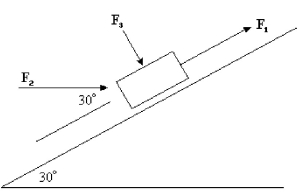 Three applied forces, F1 = 20.0 N, F2 = 40.0 N, and F3 = 10.0 N act on an object with a mass of 2.00 kg which can move along an inclined plane as shown in the figure. The questions refer to the instant when the object has moved 0.600 m along the surface of the inclined plane in the upward direction. Neglect friction and use g = 10.0 m/s2.
-Refer to Figure 7-2. What is the amount of work done by force F2 as the object moves up the inclined plane?
Three applied forces, F1 = 20.0 N, F2 = 40.0 N, and F3 = 10.0 N act on an object with a mass of 2.00 kg which can move along an inclined plane as shown in the figure. The questions refer to the instant when the object has moved 0.600 m along the surface of the inclined plane in the upward direction. Neglect friction and use g = 10.0 m/s2.
-Refer to Figure 7-2. What is the amount of work done by force F2 as the object moves up the inclined plane? (Multiple Choice)
4.8/5 (82)
(82) A truck has four times the mass of a car and is moving with twice the speed of the car. If Kt and Kc refer to the kinetic energies of truck and car respectively, it is correct to say that
(Multiple Choice)
4.7/5 (82)
(82) An object of mass 10.0 kg is released from the top of an inclined plane which makes an angle of inclination of 30.0° with the horizontal. The object slides along the inclined plane. The questions refer to the instant when the object has traveled through a distance of 2.00 m measured along the slope. The coefficient of kinetic friction between the mass and the surface is 0.200. Use g = 10.0 m/s2.
(a) How much work is done by the net force on the mass?
(b) How much work is done by the force of friction?
(Short Answer)
4.9/5 (71)
(71) 
Filters
- Essay(0)
- Multiple Choice(0)
- Short Answer(0)
- True False(0)
- Matching(0)