



 Chat with AI
Exam 7: Work and Kinetic Energy

Exam 1: Introduction to Physics100 Questions
Exam 2: One-Dimensional Kinematics112 Questions
Exam 3: Vectors in Physics82 Questions
Exam 4: Two-Dimensional Kinematics95 Questions
Exam 5: Newtons Laws of Motion101 Questions
Exam 6: Applications of Newtons Laws105 Questions
Exam 7: Work and Kinetic Energy92 Questions
Exam 8: Potential Energy and Conservation of Energy99 Questions
Exam 9: Linear Momentum and Collisions102 Questions
Exam 10: Rotational Kinematics and Energy102 Questions
Exam 11: Rotational Dynamics and Static Equilibrium97 Questions
Exam 12: Gravity94 Questions
Exam 13: Oscillations About Equilibrium102 Questions
Exam 14: Waves and Sound104 Questions
Exam 15: Fluids107 Questions
Exam 16: Temperature and Heat103 Questions
Exam 17: Phases and Phase Changes100 Questions
Exam 18: The Laws of Thermodynamics97 Questions
Exam 19: Electric Charges, Forces, and Fields88 Questions
Exam 20: Electric Potential and Electric Potential Energy99 Questions
Exam 21: Electric Current and Direct-Current Circuits99 Questions
Exam 22: Magnetism101 Questions
Exam 23: Magnetic Flux and Faradays Law of Induction99 Questions
Exam 24: Alternating-Current Circuits93 Questions
Exam 25: Electromagnetic Waves90 Questions
Exam 26: Geometrical Optics92 Questions
Exam 27: Optical Instruments102 Questions
Exam 28: Physical Optics: Interference and Diffraction93 Questions
Exam 29: Relativity100 Questions
Exam 30: Quantum Physics100 Questions
Exam 31: Atomic Physics75 Questions
Exam 32: Nuclear Physics and Nuclear Radiation89 Questions
Select questions type


An airplane flies 160 km at a constant altitude in a direction 30.0° north of east. A wind is blowing that results in a net horizontal force on the plane due to the air of 2.40 kN in a direction 10.0° south of west. How much work is done by the air on the plane?
(Multiple Choice)
4.8/5  (84)
(84) How many joules of energy are used by a 2.0 hp motor that runs for 1.0 hr?
(Short Answer)
5.0/5 (80)
(80) As compared to Jack, Jill does twice the work in half the time. Jill's power output is
(Multiple Choice)
4.8/5 (75)
(75) If you walk 5.0 m horizontally forward at a constant velocity carrying a 10 N object, the amount of work you do is
(Multiple Choice)
4.8/5 (84)
(84) What is the power needed to change the speed of a 1600-kg sport utility vehicle from 15.0 m/s to 40.0 m/s in 4.00 seconds?
(Multiple Choice)
4.8/5 (77)
(77) If the net work done on an object is zero, then the object's kinetic energy
(Multiple Choice)
4.8/5 (80)
(80) FIGURE 7-2 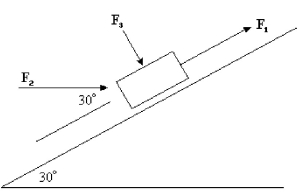 Three applied forces, F1 = 20.0 N, F2 = 40.0 N, and F3 = 10.0 N act on an object with a mass of 2.00 kg which can move along an inclined plane as shown in the figure. The questions refer to the instant when the object has moved 0.600 m along the surface of the inclined plane in the upward direction. Neglect friction and use g = 10.0 m/s2.
-Refer to Figure 7-2. What is the amount of work done by force F1 as the object moves up the inclined plane?
Three applied forces, F1 = 20.0 N, F2 = 40.0 N, and F3 = 10.0 N act on an object with a mass of 2.00 kg which can move along an inclined plane as shown in the figure. The questions refer to the instant when the object has moved 0.600 m along the surface of the inclined plane in the upward direction. Neglect friction and use g = 10.0 m/s2.
-Refer to Figure 7-2. What is the amount of work done by force F1 as the object moves up the inclined plane? (Multiple Choice)
4.9/5 (86)
(86) On a force vs. position graph, the area under curve is a representation of
(Multiple Choice)
4.9/5 (74)
(74) A person carries a mass of 10 kg and walks along the +x-axis for a distance of 100 m with a constant velocity of 2 m/s. What is the work done by this person?
(Multiple Choice)
4.8/5 (84)
(84) If the net work done on an object is negative, then the object's kinetic energy
(Multiple Choice)
4.7/5 (93)
(93) If you push twice as hard against a stationary brick wall, the amount of work you do
(Multiple Choice)
4.9/5 (66)
(66) FIGURE 7-4 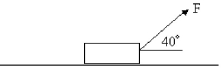 A constant force of 100 N is applied to a mass of 40.0 kg as shown in Figure 7-4. The force causes a displacement of 20.0 m to this mass along the + x-axis. Neglect friction.
-What is the work done by the component of the force in Figure 7-4 along the + y-axis?
A constant force of 100 N is applied to a mass of 40.0 kg as shown in Figure 7-4. The force causes a displacement of 20.0 m to this mass along the + x-axis. Neglect friction.
-What is the work done by the component of the force in Figure 7-4 along the + y-axis? (Multiple Choice)
4.9/5 (86)
(86) The ratio of power outputs of Jack and Jill is 2: 1 to complete a certain amount of work. If Jill takes 4 minutes to complete this work, how long will Jack take to finish the same work?
(Multiple Choice)
4.8/5 (73)
(73) A car accelerates from rest to a speed of 19.0 m/s in 6.00 seconds. If the car weighs 16,000 N, what average power must the motor produce to cause this acceleration? Use g = 10 m/s2.
(Multiple Choice)
4.9/5 (67)
(67) A student slides her 80.0-kg desk across the level floor of her dormitory room a distance 4.00 m at constant speed. If the coefficient of kinetic friction between the desk and the floor is 0.400, how much work did she do?
(Multiple Choice)
4.7/5 (63)
(63) A 4.0 kg mass is moving with speed 2.0 m/s. A 1.0 kg mass is moving with speed 4.0 m/s. Both objects encounter the same constant braking force, and are brought to rest. Which object travels the greater distance before stopping?
(Multiple Choice)
4.8/5 (87)
(87) A 5.00-kg box slides 4.00 m across the floor before coming to rest. What is the coefficient of kinetic friction between the floor and the box if the box had an initial speed of 3.00 m/s?
(Multiple Choice)
4.8/5 (70)
(70) FIGURE 7-1 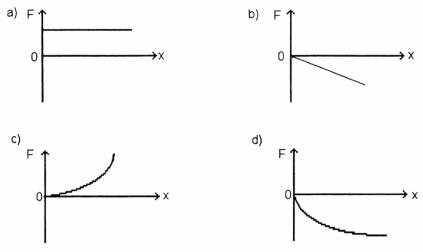 -Which of the graphs in Figure 7-1 illustrates Hooke's Law?
 (Multiple Choice)
4.9/5 (72)
(72) FIGURE 7-5 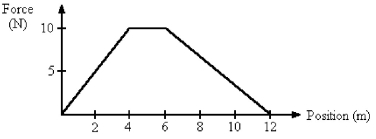 -An object is under the influence of a force as represented by the force vs. position graph in Figure 7-5. What is the work done as the object moves from 0 m to 4 m?
 (Multiple Choice)
4.8/5 (91)
(91) 
Filters
- Essay(0)
- Multiple Choice(0)
- Short Answer(0)
- True False(0)
- Matching(0)