



 Chat with AI
Exam 7: Work and Kinetic Energy

Exam 1: Introduction to Physics100 Questions
Exam 2: One-Dimensional Kinematics112 Questions
Exam 3: Vectors in Physics82 Questions
Exam 4: Two-Dimensional Kinematics95 Questions
Exam 5: Newtons Laws of Motion101 Questions
Exam 6: Applications of Newtons Laws105 Questions
Exam 7: Work and Kinetic Energy92 Questions
Exam 8: Potential Energy and Conservation of Energy99 Questions
Exam 9: Linear Momentum and Collisions102 Questions
Exam 10: Rotational Kinematics and Energy102 Questions
Exam 11: Rotational Dynamics and Static Equilibrium97 Questions
Exam 12: Gravity94 Questions
Exam 13: Oscillations About Equilibrium102 Questions
Exam 14: Waves and Sound104 Questions
Exam 15: Fluids107 Questions
Exam 16: Temperature and Heat103 Questions
Exam 17: Phases and Phase Changes100 Questions
Exam 18: The Laws of Thermodynamics97 Questions
Exam 19: Electric Charges, Forces, and Fields88 Questions
Exam 20: Electric Potential and Electric Potential Energy99 Questions
Exam 21: Electric Current and Direct-Current Circuits99 Questions
Exam 22: Magnetism101 Questions
Exam 23: Magnetic Flux and Faradays Law of Induction99 Questions
Exam 24: Alternating-Current Circuits93 Questions
Exam 25: Electromagnetic Waves90 Questions
Exam 26: Geometrical Optics92 Questions
Exam 27: Optical Instruments102 Questions
Exam 28: Physical Optics: Interference and Diffraction93 Questions
Exam 29: Relativity100 Questions
Exam 30: Quantum Physics100 Questions
Exam 31: Atomic Physics75 Questions
Exam 32: Nuclear Physics and Nuclear Radiation89 Questions
Select questions type


The ratio of the kinetic energy of object A to the kinetic energy of the object B is 2: 1. The mass of object A is 2.0 kg and the mass of object B is 4.0 kg. If object A has a speed of 4.0 m/s, what is the speed of object B?
(Multiple Choice)
4.9/5  (74)
(74) The ratio of kinetic energy of object A to the kinetic energy of object B is 2: 1. Object A is moving with a speed of 6.0 m/s and object B is moving with a speed of 2.0 m/s. If the mass of object A is 4.0 kg then what is the mass of object B?
(Multiple Choice)
4.8/5 (68)
(68) A weight of 200 N is hung from a spring with a spring constant of 2500 N/m and lowered slowly. How much will the spring stretch?
(Multiple Choice)
5.0/5 (82)
(82) The kinetic energy of an object increases linearly as the velocity of the object increases.
(True/False)
4.7/5 (84)
(84) FIGURE 7-5 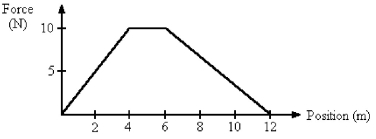 -An object is under the influence of a force as represented by the force vs. position graph in Figure 7-5. What is the work done as the object moves from 6 m to 12 m?
 (Multiple Choice)
4.9/5 (79)
(79) The ratio of the mass of object A to the mass of object B is 2: 1 and the ratio of their speeds is 1:
2 in the same order. What is the ratio of their kinetic energies?
(Multiple Choice)
4.8/5 (78)
(78) You slam on the brakes of your car in a panic, and skid a certain distance on a straight, level road. If you had been traveling twice as fast, what distance would the car have skidded, under the same conditions?
(Multiple Choice)
4.8/5 (79)
(79) An object hits a wall and bounces back with half of its original speed. What is the ratio of the final kinetic energy to the initial kinetic energy?
(Multiple Choice)
4.9/5 (80)
(80) A block of mass m is pushed against a spring of spring constant k. The spring is compressed by a distance d, the block is then released. It is launched by the spring along a horizontal frictionless surface with a final speed v. A second block, this one having mass 4m is pushed against the same spring by distance 6d and released. What is the final speed of the block in this case?
(Multiple Choice)
4.7/5 (68)
(68) An object of mass 10.0 kg is released from the top of an inclined plane which makes an angle of inclination of 30.0° with the horizontal. The object slides along the inclined plane. The questions refer to the instant when the object has traveled through a distance of 2.00 m measured along the slope. The coefficient of kinetic friction between the mass and the surface is 0.200. Use g = 10 m/s2. How much work is done by gravity?
(Multiple Choice)
4.9/5 (85)
(85) FIGURE 7-6 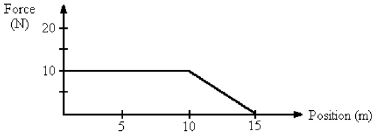 -An object is under the influence of a force as represented by the force vs. position graph as shown in Figure 7-6. What is the work done as it moves from 0 to 10 m?
 (Multiple Choice)
4.8/5 (73)
(73) How much energy is needed to change the speed of a 1600 kg sport utility vehicle from 15.0 m/s to 40.0 m/s?
(Multiple Choice)
5.0/5 (90)
(90) A 220-kg object is lifted at a constant speed through a height of 42 m by a crane. If the crane takes a total time of 1.8 seconds to lift this object, what is the average power required? Use g = 10 m/s2.
(Multiple Choice)
4.9/5 (73)
(73) A simple pendulum, consisting of a mass m and a string of length L, swings upward, making an angle θ with the vertical. The work done by the tension force is
(Multiple Choice)
4.8/5 (74)
(74) A force produces power P by doing work W in a time T. What power will be produced by a force that does six times as much work in half as much time?
(Multiple Choice)
4.8/5 (81)
(81) FIGURE 7-1 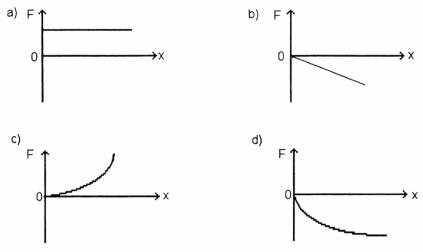 -Describe the type of spring "constant" needed to produce a constant restoring force like curve (a) in Figure 7-1.
 (Multiple Choice)
4.7/5 (77)
(77) How large a force is required to accelerate a 1600 kg car from rest to a speed of 25 m/s in a distance of 200 m?
(Multiple Choice)
4.9/5 (77)
(77) A car originally at rest has its speed increased to a value v in a period of 5 seconds. The work performed in this part of the motion is W1. Over the next 5 seconds the speed of the car is increased to 2v. In the second part of the motion the work performed is W2. It is correct to say that:
(Multiple Choice)
4.9/5 (83)
(83) A horizontal force of 40 N pushes an object of mass 5.0 kg up an inclined plane through a distance of 1.6 m measured along the plane. The plane is inclined at an angle of 30° to the horizontal. Neglect friction and use g = 10 m/s2.
(a) What is the work done by the horizontal force on the object?
(b) What is the work done by the net force on the object?
(c) What is the work done by the normal force on the object?
(Short Answer)
4.8/5 (76)
(76) 
Filters
- Essay(0)
- Multiple Choice(0)
- Short Answer(0)
- True False(0)
- Matching(0)