



 Chat with AI
Exam 13: Fiscal Policy

Exam 1: What Is Economics?479 Questions
Exam 2: The Economic Problem440 Questions
Exam 3: Demand and Supply515 Questions
Exam 4: Measuring GDP and Economic Growth395 Questions
Exam 5: Monitoring Jobs and Inflation407 Questions
Exam 6: Economic Growth353 Questions
Exam 7: Finance, Saving, and Investment225 Questions
Exam 8: Money, the Price Level, and Inflation578 Questions
Exam 9: The Exchange Rate and the Balance of Payments492 Questions
Exam 10: Aggregate Supply and Aggregate Demand428 Questions
Exam 11: Expenditure Multipliers469 Questions
Exam 12: The Business Cycle, Inflation, and Deflation410 Questions
Exam 13: Fiscal Policy263 Questions
Exam 14: Monetary Policy227 Questions
Exam 15: International Trade Policy200 Questions
Select questions type


How can discretionary fiscal policy be used to close a recessionary gap?
(Essay)
4.8/5  (79)
(79) Between 2000 and 2005, Finland increased its tax on interest income. As a result, the supply curve for loanable funds shifted ________ and the tax wedge ________.
(Multiple Choice)
4.8/5 (76)
(76) Taking account of the supply-side effects, a tax cut on labor income ________ employment and ________ potential GDP.
(Multiple Choice)
4.8/5 (73)
(73) The Employment Act of 1946 made it the responsibility of the federal government to
(Multiple Choice)
4.8/5 (65)
(65) "More than 9,000 laid-off Nevada workers will qualify for a second 13-week round of extended unemployment benefits, under federal legislation signed by President Bush. [The] workers exhausted their first 13 weeks of extended benefits and will now be eligible for the new benefits, which pay an average of $293 a week."
Www)mercurynews.com 11/24/2008
Unemployment benefits are considered part of ________ fiscal policy. The extension of benefits would ________ fiscal policy.
(Multiple Choice)
4.8/5 (73)
(73) Deliberate changes in government expenditures and taxes to influence GDP are discretionary fiscal policy.
(True/False)
4.8/5 (80)
(80) In January 2013 certain tax rates increased, which were predicted to increase the federal government's tax revenue. An increase in tax revenue ________ the government's budget deficit and over time thereby ________ the amount of government debt.
(Multiple Choice)
4.8/5 (80)
(80) 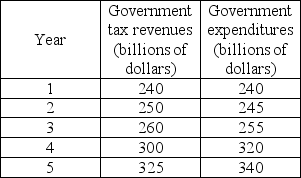 -What is the amount of the surplus or deficit incurred in year 2 by the government shown in the above table?
 (Multiple Choice)
4.7/5 (73)
(73) What is automatic fiscal policy? How does it affect the budget deficit and/or budget surplus during a recession and during an expansion?
(Essay)
4.9/5 (82)
(82) Which of the following policies shifts the AD curve the farthest leftward?
(Multiple Choice)
4.8/5 (69)
(69) The use of the U.S. federal budget to help stabilize the economy grew in reaction to the ________ and is known as ________.
(Multiple Choice)
4.9/5 (80)
(80) A fiscal action that is triggered by the state of the economy is called
(Multiple Choice)
4.9/5 (67)
(67) The structural surplus measures whether a budget surplus is cyclical or structural.
(True/False)
4.8/5 (80)
(80) An increase in taxes on labor income shifts the labor supply curve ________ and the ________.
(Multiple Choice)
4.7/5 (85)
(85) Suppose that real GDP equals potential GDP, but the government believes that the economy is in a below full-employment equilibrium. As a result, the government increases its expenditure on goods and services. In response to the government's fiscal policy
(Multiple Choice)
4.8/5 (72)
(72) On January 1, 2013 the income tax rate for single taxpayers making more than $400,000 per year increased from 35 percent to 39.6 percent. This tax rise has ________ potential GDP.
(Multiple Choice)
4.9/5 (92)
(92)
-The government begins year 1 with $25 billion of debt. Based on the information in the above table, what is the amount of debt following year 1?
-The government begins year 1 with $25 billion of debt. Based on the information in the above table, what is the amount of debt following year 1? (Multiple Choice)
4.7/5 (95)
(95) Federal government outlays as a percentage of GDP are approximately
(Multiple Choice)
5.0/5 (94)
(94) 
Filters
- Essay(0)
- Multiple Choice(0)
- Short Answer(0)
- True False(0)
- Matching(0)