



 Chat with AI
Exam 12: The Business Cycle, Inflation, and Deflation

Exam 1: What Is Economics?479 Questions
Exam 2: The Economic Problem440 Questions
Exam 3: Demand and Supply515 Questions
Exam 4: Measuring GDP and Economic Growth395 Questions
Exam 5: Monitoring Jobs and Inflation407 Questions
Exam 6: Economic Growth353 Questions
Exam 7: Finance, Saving, and Investment225 Questions
Exam 8: Money, the Price Level, and Inflation578 Questions
Exam 9: The Exchange Rate and the Balance of Payments492 Questions
Exam 10: Aggregate Supply and Aggregate Demand428 Questions
Exam 11: Expenditure Multipliers469 Questions
Exam 12: The Business Cycle, Inflation, and Deflation410 Questions
Exam 13: Fiscal Policy263 Questions
Exam 14: Monetary Policy227 Questions
Exam 15: International Trade Policy200 Questions
Select questions type


In 2008, when a recession started, the growth of government expenditures on goods and services doubled compared to its growth in 2007. According to the aggregate demand theories of the business cycle
(Multiple Choice)
4.8/5  (91)
(91) Which of the following is TRUE regarding the monetarist theory of the business cycle?
I.Monetarists assume that the quantity of money increases at a constant rate.
II.Fluctuations in interest rates cause business cycles.
III.Changes in the growth rate of the quantity of money affect aggregate demand.
(Multiple Choice)
4.8/5 (72)
(72) Cost-push inflation is an inflation that results from an initial ________.
(Multiple Choice)
4.8/5 (85)
(85) What factors can start a cost-push inflation? What must the Fed's response be for the inflation to continue?
(Essay)
4.7/5 (67)
(67) If oil prices increase, then in the short run, real GDP will ________ and the price level will ________.
(Multiple Choice)
4.8/5 (88)
(88)  -In the above figure, if the economy moves from point A to point E
 (Multiple Choice)
5.0/5 (88)
(88) 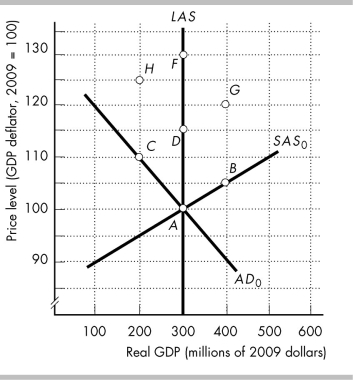 -The figure above shows the initial aggregate demand curve, AD?, the initial short-run aggregate supply curve, SAS?, and the long-run aggregate supply curve, LAS. The points in the figure show possible combinations of real GDP and the price level at which the economy of Atlantia is in macroeconomic equilibrium. The economy is initially at point A. Atlantia's Central Bank then increases the quantity of money year after year. Draw the necessary curves in the figure to show the effects of this on Atlantia's real GDP and price level.
a)What happens to Atlantia's potential GDP?
b)In the short run, what happens to aggregate supply and aggregate demand?
c)What are the new short-run equilibrium real GDP and price level?
d)In the long run, what happens to aggregate supply and aggregate demand?
e)In the long run, what process is unfolding?
-The figure above shows the initial aggregate demand curve, AD?, the initial short-run aggregate supply curve, SAS?, and the long-run aggregate supply curve, LAS. The points in the figure show possible combinations of real GDP and the price level at which the economy of Atlantia is in macroeconomic equilibrium. The economy is initially at point A. Atlantia's Central Bank then increases the quantity of money year after year. Draw the necessary curves in the figure to show the effects of this on Atlantia's real GDP and price level.
a)What happens to Atlantia's potential GDP?
b)In the short run, what happens to aggregate supply and aggregate demand?
c)What are the new short-run equilibrium real GDP and price level?
d)In the long run, what happens to aggregate supply and aggregate demand?
e)In the long run, what process is unfolding? (Essay)
4.8/5 (86)
(86)  -In the above figure, the economy is at point A. The inflation rate falls by two percentage points and people correctly expected the fall. As a result, the economy moves to point
 (Multiple Choice)
4.8/5 (84)
(84) What does the short-run Phillips curve indicate about the relationship between inflation and unemployment?
(Essay)
4.9/5 (80)
(80) A one-time rise in the price level can turn into a demand-pull inflation when ________.
(Multiple Choice)
5.0/5 (72)
(72) By itself, a supply shock such as a hike in the price of oil, can
(Multiple Choice)
4.9/5 (66)
(66) The short-run Phillips curve and the long-run Phillips curve intersect at the ________ and ________.
(Multiple Choice)
4.8/5 (80)
(80) Demand-pull inflation results from continually increasing the quantity of money, which leads to a continually
(Multiple Choice)
4.9/5 (90)
(90) According to which theory of the business cycle do changes in the quantity of money never play a role in helping to explain fluctuations in real variables?
(Multiple Choice)
4.9/5 (83)
(83) The new classical cycle theory views anticipated fluctuations in aggregate demand as the main source of business cycle economic fluctuations.
(True/False)
4.8/5 (74)
(74)  -The figure above shows an economy's Phillips curves. Currently, the inflation rate is 6 percent a year. The natural unemployment rate is ________ percent and the expected inflation rate is ________ percent a year.
 (Multiple Choice)
4.8/5 (82)
(82) Which of the following are business cycle theories that regard fluctuations in aggregate demand as the factor that is creating business cycles?
I.Keynesian cycle theory
II.real business cycle theory
III.monetarist cycle theory
(Multiple Choice)
4.7/5 (74)
(74) 
Filters
- Essay(0)
- Multiple Choice(0)
- Short Answer(0)
- True False(0)
- Matching(0)