



 Chat with AI
Exam 12: The Business Cycle, Inflation, and Deflation

Exam 1: What Is Economics?479 Questions
Exam 2: The Economic Problem440 Questions
Exam 3: Demand and Supply515 Questions
Exam 4: Measuring GDP and Economic Growth395 Questions
Exam 5: Monitoring Jobs and Inflation407 Questions
Exam 6: Economic Growth353 Questions
Exam 7: Finance, Saving, and Investment225 Questions
Exam 8: Money, the Price Level, and Inflation578 Questions
Exam 9: The Exchange Rate and the Balance of Payments492 Questions
Exam 10: Aggregate Supply and Aggregate Demand428 Questions
Exam 11: Expenditure Multipliers469 Questions
Exam 12: The Business Cycle, Inflation, and Deflation410 Questions
Exam 13: Fiscal Policy263 Questions
Exam 14: Monetary Policy227 Questions
Exam 15: International Trade Policy200 Questions
Select questions type


Which of the following could NOT start a demand-pull inflation?
(Multiple Choice)
4.9/5  (75)
(75) 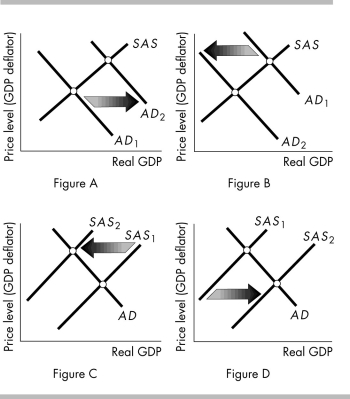 -In the above, which figure shows the start of a cost-push inflation?
 (Multiple Choice)
4.7/5 (78)
(78) If the economy is initially at potential GDP and people correctly anticipate an increase in inflation so that their money wage rate adjusts immediately, then
(Multiple Choice)
4.9/5 (89)
(89)  -In the above figure, the economy is at point A. An increase in oil prices that sets off a cost-push inflation will initially move the economy from point A to point
 (Multiple Choice)
4.7/5 (81)
(81) According to the new classical theory, ________ policy changes have no effect on real GDP and according to the new Keynesian theory, ________ policy changes have an effect on real GDP.
(Multiple Choice)
5.0/5 (87)
(87) In the short run, an unexpected increase in the inflation rate leads to
(Multiple Choice)
4.9/5 (82)
(82) The position of the long-run Phillips curve is determined by
(Multiple Choice)
4.9/5 (85)
(85) If the Fed responds to an initial increase in aggregate demand by increasing the quantity of money
(Multiple Choice)
4.9/5 (78)
(78) Suppose oil prices rise. The Fed can ________ the quantity of money to ________ the unemployment rate back to its natural rate.
(Multiple Choice)
4.9/5 (82)
(82) According to the real business cycle theory, technological change
(Multiple Choice)
4.9/5 (71)
(71) For monetarists, the main cause of economic fluctuations is represented by changes in
(Multiple Choice)
4.8/5 (77)
(77) Which of the following is the factor that leads to business cycles in the new classical business cycle theory?
(Multiple Choice)
4.8/5 (85)
(85) Movements upward along the short-run Phillips curve result from
(Multiple Choice)
4.9/5 (75)
(75) One model of the business cycle claims that volatile business confidence is the primary factor in starting a business cycle. This model is the
(Multiple Choice)
5.0/5 (84)
(84) Stagflation is the combination of a ________ and ________.
(Multiple Choice)
4.8/5 (71)
(71) If people correctly expect an increase in aggregate demand, their money wage rate ________ immediately, the SAS curve shifts ________.
(Multiple Choice)
4.8/5 (90)
(90) 
Filters
- Essay(0)
- Multiple Choice(0)
- Short Answer(0)
- True False(0)
- Matching(0)